
Affiliate Disclosure: This post contains affiliate links. If you book a hotel, tour, flight, or travel service through links on this page, Morocco’s Gate may earn a small commission at no extra cost to you. We only recommend services we genuinely trust. Every stat and opinion in this guide is based on real data and first-hand experience. Thank you for supporting our independent Morocco travel content.
Morocco Tourism Boom 2026: Record Visitors, New Hotels, and Why Everyone Is Going
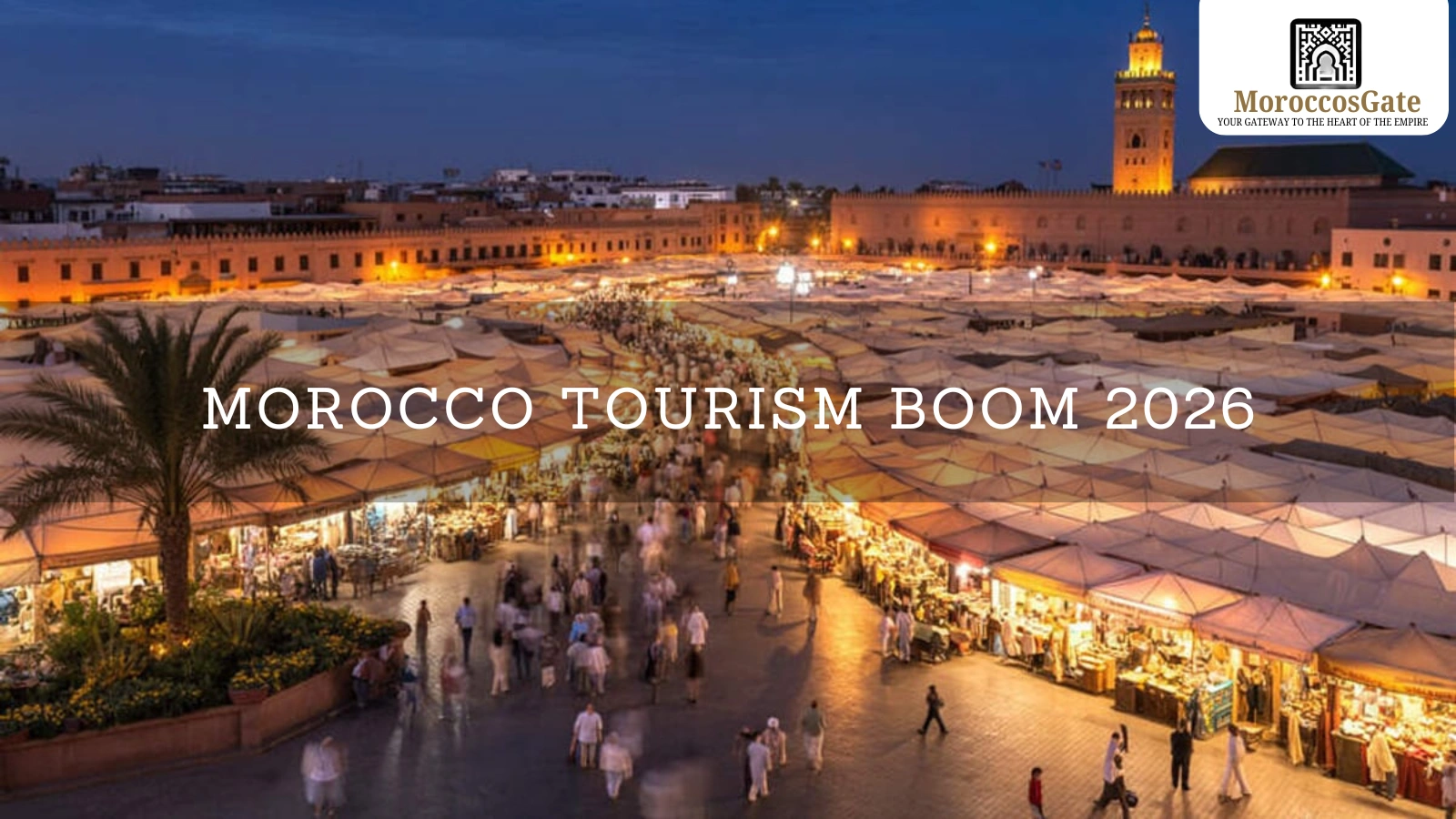
Morocco’s tourism boom in 2026 is the biggest in the country’s history. In the first quarter of 2026 alone, Morocco welcomed 4.3 million international tourists — a 7% year-on-year increase — with March 2026 recording an 18% surge. Tourism revenues reached MAD 31 billion ($3.1 billion) in Q1 2026, up 24% on the same period in 2025. The country attracted nearly 19.8 million visitors in 2025 (up 14% on 2024) and is targeting 20 million for the full year of 2026, en route to 26 million by 2030. Morocco is now officially Africa’s most visited country and has been declared a leading African model for tourism innovation by the United Nations.
The numbers are extraordinary. But numbers alone do not capture what is actually happening in Morocco right now. To understand the 2026 tourism boom, you need to understand the story behind it: a decade of deliberate, well-funded strategy; the catalytic effect of the Atlas Lions’ 2022 World Cup semi-final run; the AFCON 2025 success; the looming 2030 FIFA World Cup; 80 new air routes opened in a single year; 43,000 new hotel beds added ahead of target; and a UN Tourism office opened in Rabat — the organisation’s first-ever thematic office in Africa — to recognise what Morocco has achieved.
This is not a fluke. This is a country that decided to become a major global tourism destination, made the investments required, and is now reaping the results at a pace that is surprising even optimistic forecasters.
For travellers from Ireland, the UK, and Europe, the Morocco tourism boom has a very direct implication: this is one of the world’s most accessible and compelling travel destinations right now, with more flights, better hotels, and an extraordinary range of experiences — and it is still more affordable than virtually any comparable European destination. If you are considering a visit, 2026 is an exceptionally good year to go.
This guide covers exactly what is driving Morocco’s tourism boom, what is being built and improved, which experiences the boom is making more accessible, and — critically — what this all means for you as a traveller planning a Morocco trip in 2026 or 2027.
The Numbers: Morocco Tourism in 2026 by the Figures
| Metric | Figure | Change |
|---|---|---|
| Q1 2026 international arrivals | 4.3 million | +7% year-on-year |
| March 2026 arrivals | ~1.6 million | +18% vs March 2025 |
| Q1 2026 tourism revenue | MAD 31 billion (~$3.1bn) | +24% year-on-year |
| Full year 2025 arrivals | 19.8 million | +14% vs 2024 |
| Full year 2025 revenue | MAD 124 billion (~$13bn) | +19% year-on-year |
| New air routes (2025) | 80 new routes / 12M+ seats | +12% seat capacity |
| Air seats secured (2026) | 14.5 million seats | ~+20% vs 2025 |
| New hotel beds (since roadmap) | 43,000+ beds added | Exceeded initial targets |
| Hotel renovation projects approved | 91 projects underway | New in 2026 |
| 2026 tourism target | 20 million visitors | Roadmap target |
| 2030 tourism target | 26 million visitors | World Cup milestone |
| Tourism’s GDP contribution | 7.3% of GDP | Key growth driver |
Sources: Morocco Ministry of Tourism, Morocco World News, Travel and Tour World, ATTA (April 2026 data).
What Is Driving Morocco’s Tourism Boom in 2026?
1. The 2023–2026 Tourism Roadmap: A $600 Million National Strategy
The foundation of Morocco’s 2026 tourism success is not luck — it is planning. The 2023–2026 Tourism Roadmap, backed by an investment of $600 million, was designed to upgrade hotels, double air capacity, and boost global marketing efforts. The roadmap set a target of attracting 17.5 million tourists, creating 200,000 new jobs, and generating 120 billion dirhams in foreign exchange earnings.
The country has exceeded virtually every benchmark of this plan ahead of schedule. The 17.5 million tourist target was already surpassed in 2024. The 19.8 million achieved in 2025 blew past projections. The revised target of 20 million for 2026 now looks conservative. Morocco’s Tourism Minister Fatim-Zahra Ammor has described the sector as having entered a “real and lasting” growth phase — a confidence born of data, not optimism.
The roadmap’s emphasis on diversifying tourism beyond the traditional Marrakech-Agadir axis has also paid dividends. Fes, Tangier, Rabat, Chefchaouen, and the Souss Valley are all seeing increased visitor numbers. Three “thematic value chains” have been developed: nature and outdoor travel (focused on national parks like Toubkal and Ifrane), desert and oasis tourism (centred on the Sahara and southern valleys), and domestic nature-based tourism (ensuring Moroccan citizens can access their own country’s natural wealth).
2. Explosive Air Connectivity Growth
No single factor explains Morocco’s tourism boom more directly than the extraordinary expansion of air connectivity. In 2025, Morocco opened 80 new air routes connecting key source markets, adding more than 12 million seats — a 12% year-on-year increase. For 2026, airlines have already secured 14.5 million seats, representing an expected increase of nearly 20%.
The impact of this cannot be overstated. Every new air route from a European, North American, or Middle Eastern city is a direct pipeline of new visitors. Morocco’s proximity to Europe — just 3–4 hours by direct flight from Dublin, London, Paris, or Madrid — has always been its greatest competitive advantage. The aviation expansion is converting that geographic advantage into millions of additional arrivals.
Morocco’s connectivity strategy is no longer Euro-centric either. Casablanca’s direct Beijing route has been operating for over a year, underpinning a strategy to tap Asian markets and reduce structural dependence on traditional European sources. Saudi Arabia, the UAE, Canada, and Brazil are all appearing in Morocco’s growing source market diversity data.
From Ireland specifically, direct routes to Marrakech, Casablanca, Fes, Tangier, and Agadir are operating with increasing frequency and competitive pricing. Getting to Morocco from Dublin in 2026 is easier, more affordable, and more frequent than at any point in history.
3. AFCON 2025: Morocco’s Global Sporting Rehearsal
The Africa Cup of Nations 2025 — held in Morocco from December 2025 through January 2026 — was more than a football tournament. It was Morocco’s dress rehearsal for the 2030 FIFA World Cup, and it demonstrated to a global audience that the country can organise and host a major international sporting event with the kind of professionalism that Africa-based tournaments have not always been associated with.
Morocco spent approximately €1.8 billion on stadiums for AFCON 2025, built six new venues and refurbished three others. The final took place at the Prince Moulay Abdellah Stadium in Rabat. Cities like Rabat, Tangier, and Fes became hubs of African football, drawing visitors from across the continent and further afield. People stayed longer and moved between host cities. The director of the ONMT (Moroccan National Tourist Office) called AFCON 2025 a rehearsal for handling large visitor numbers and working with international partners — and the sector data confirms it accelerated momentum heading into 2026.
4. The 2030 FIFA World Cup Effect
The confirmation of Morocco as co-host of the 2030 FIFA World Cup (alongside Spain and Portugal) at the FIFA Extraordinary Congress in December 2024 has had an immediate and measurable impact on tourism investment and traveller interest. The World Cup announcement is a signal — not just to football fans, but to hotel investors, airline route planners, luxury resort developers, and curious travellers worldwide — that Morocco is a credible, world-class destination.
The investment flowing into Morocco as a result is enormous: $4 billion to increase hotel capacity by 20%, 25,000 new hotel rooms being added, 15 new Hilton hotels confirmed, 25 new Radisson properties before 2030, a Waldorf Astoria in Tangier, a Nikki Beach resort opening in Marrakech in 2028, airport capacity being doubled from 38 million to 80 million passengers annually, and the Al Boraq high-speed rail extending to Marrakech.
All of this investment is creating a virtuous cycle: better infrastructure attracts more visitors, more visitors justify more investment, more investment improves the experience, and so on. The 2030 World Cup is the engine driving this cycle — and 2026 travellers are among the first to benefit from the improvements without yet having to pay the full World Cup premium. For more on this, see our guide on why visiting Morocco before 2030 is the smartest travel decision you can make.
5. UN Tourism’s African Innovation Recognition
On 23 April 2026, the United Nations Tourism organisation officially inaugurated its first thematic office for innovation in Africa, located in Morocco’s capital, Rabat. This development was immediately followed by the second edition of the International Conference on Technological Innovation and Tourism Investment in Marrakech, organised by Morocco’s Agency for Tourism Engineering (SMIT) in partnership with the Ministry of Tourism and UN Tourism.
During the summit, UN Tourism Secretary-General Shaikha Nasser Al Nowais formally declared Morocco a leading African model in innovative tourism development, citing political stability, modern infrastructure, and a long-term strategic vision as the foundational pillars of this status.
This is not a ceremonial recognition. The UN Tourism office in Rabat gives Morocco permanent institutional backing for its innovation agenda — connecting Moroccan tourism operators with global networks, data, and best-practice frameworks. It is a signal to the international tourism industry that Morocco is not merely a rising destination but a continent-wide leader in how tourism development should be done.
6. Diversifying Beyond the Traditional Tourist Trail
One of the most encouraging aspects of Morocco’s tourism boom is that growth is spreading beyond the traditional Marrakech-Agadir axis. A massive renovation programme is underway, with 91 major accommodation projects already approved. The stated goal is to encourage investment across all regions — moving the spotlight away from established hubs toward lesser-known destinations.
Regions benefiting from this diversification strategy include the Souss-Massa (Agadir and surrounding area), the Oriental region (Oujda, Nador), the Drâa-Tafilalet (Zagora, Merzouga, the Dades Valley), the Beni Mellal-Khénifra region, and the Atlantic coast south of Casablanca. For travellers, this means that Morocco in 2026 offers genuine experiences beyond the most photographed streets of the medina — and those experiences are increasingly supported by proper accommodation, guided tour infrastructure, and transport connections.
The Go Tourism (Go Siyaha) programme has already approved 1,400 projects with 300 more expected in 2026, directly supporting small and medium-sized tourism enterprises across the country.
What the Morocco Tourism Boom Means for Travellers in 2026
Better Flights, More Often, at More Competitive Prices
The most immediately practical effect of Morocco’s aviation boom for travellers is more choice and lower prices. Ryanair, EasyJet, Aer Lingus, Royal Air Maroc, Transavia, Iberia, and numerous other carriers are all expanding Morocco services in 2026. From Dublin, direct flights operate to Marrakech, Casablanca, Fes, Tangier, and Agadir. From London, the options are even broader.
Competition between carriers on the most popular routes — Dublin/London to Marrakech, in particular — has kept fares competitive even as overall demand has grown. Booking 8–12 weeks in advance for spring and autumn 2026 generally yields the best fares. Last-minute summer availability exists but commands a premium, particularly post-Jazzablanca (July) and around major festivals.
An Improving Accommodation Landscape
The investment in Morocco’s accommodation sector is visible on the ground in 2026. New properties are opening regularly. Existing riads and guesthouses — particularly those participating in the government’s renovation programme — are upgrading their facilities. The 43,000 new hotel beds added since the roadmap began have improved both quality and availability, particularly in the 4- and 5-star segments.
For travellers, the practical effect is more choice at more price points than ever before. The beloved traditional riads of Marrakech and Fes remain the finest accommodation experience Morocco offers — beautifully decorated courtyard houses with genuine character that no international chain can replicate — and these are now surrounded by a stronger ecosystem of quality alternatives, from boutique beach resorts in Agadir to new urban hotels in Tangier and Casablanca.
For our curated recommendations across Morocco’s finest accommodation, see our guide to Morocco’s luxury riads in 2026.
A Richer Experience Landscape
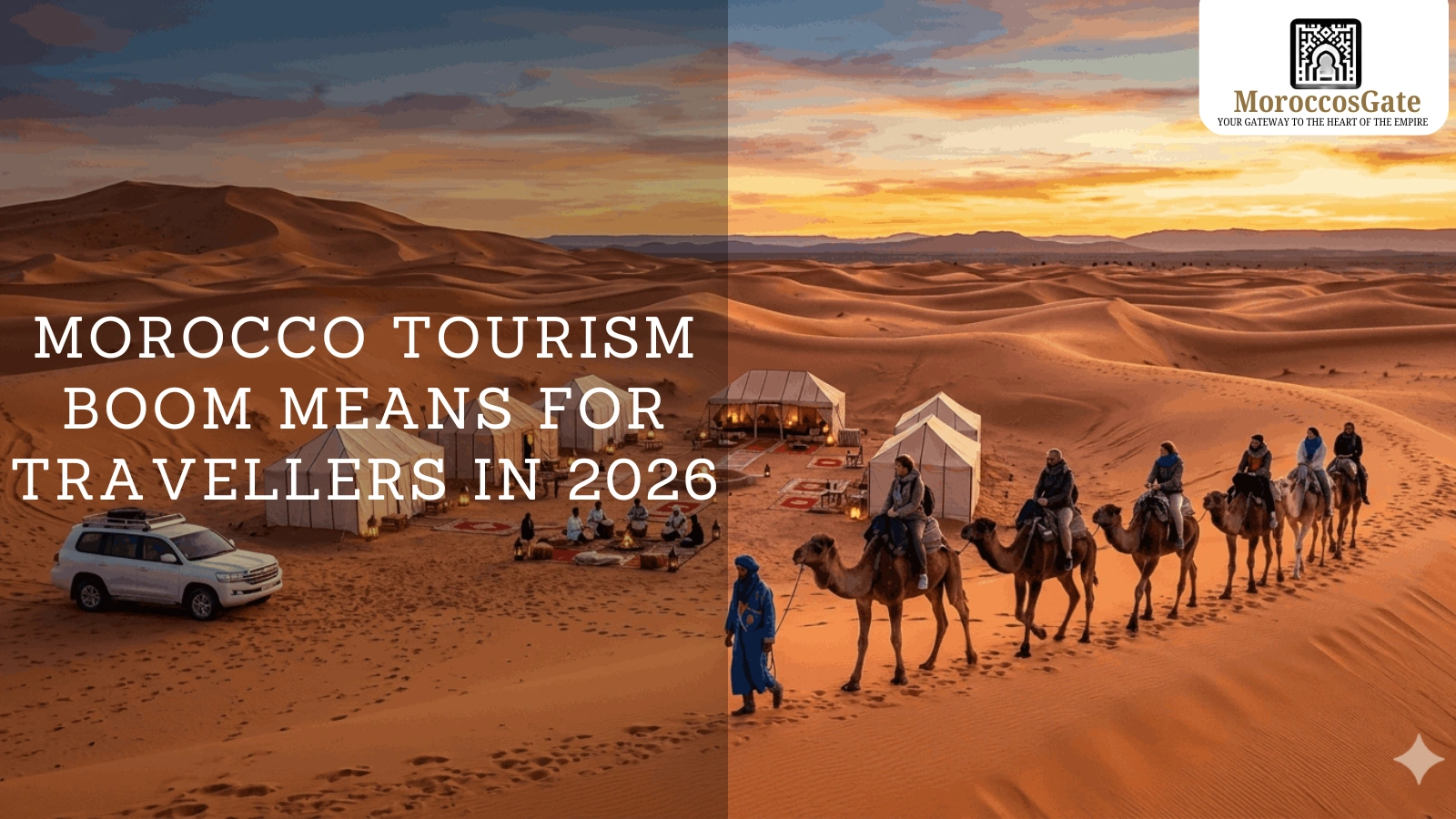
Morocco’s tourism diversification strategy is not just about numbers — it is about experiences. The focus on nature and outdoor travel (Toubkal, Ifrane, the national parks), desert and oasis tourism (Merzouga, Zagora, the palm oases of the Drâa Valley), and cultural heritage tourism (Fes, Meknes, Volubilis) means that more regions of the country are being made genuinely accessible to international visitors with the infrastructure to support a good experience.
The boom in sustainable luxury tourism is also creating new experiences at the premium end of the market. Golf resorts (Morocco has some of the finest in Africa), glamping and eco-camp operations in the desert, wellness retreats combining hammam culture with contemporary wellbeing programming, and culinary tourism focused on Morocco’s extraordinary food traditions — all of these are growing rapidly in 2026 as operators respond to the spending power and interests of the increasingly diverse international visitor.
Rising Prices — But Still Outstanding Value
It would be dishonest to report on Morocco’s tourism boom without acknowledging that it is pushing prices upward. Accommodation in Marrakech and Casablanca has already increased 15–20% since 2024, and the trajectory continues. Restaurant prices in tourist areas of major cities are creeping toward European levels at the premium end. Guided tour prices are rising as demand for qualified guides outstrips supply in peak season.
And yet. Morocco in 2026 remains extraordinary value by European standards. A quality mid-range riad with breakfast — a room with handcrafted plasterwork, a rooftop terrace, and a medina location — can be had for £60–£90 per night. A three-course dinner at a genuinely excellent Moroccan restaurant costs £15–£25 per person. A full-day guided experience — medina walking tour, souk exploration, lunch — costs £30–£50 per person. Return flights from Dublin or London to Marrakech or Fes cost £80–£200. By any comparison with Italy, France, Spain, or even Portugal, Morocco is exceptionally good value for the quality and depth of experience it offers.
The message is clear: prices are rising, but the window of outstanding value is still open. Our guide on visiting Morocco before the 2030 World Cup makes the case for going sooner rather than later in full.
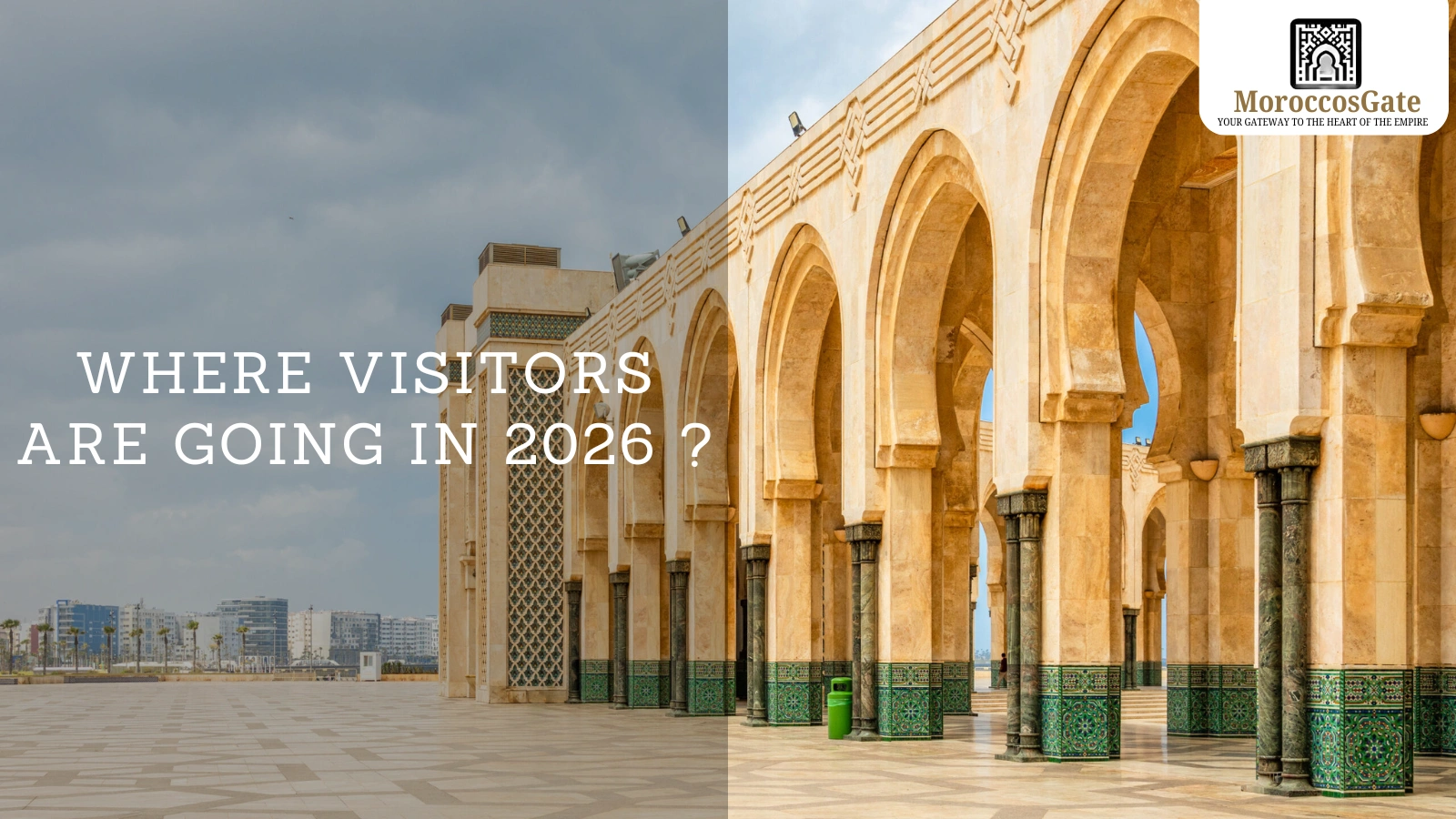
Morocco’s Tourism Boom by Region: Where Visitors Are Going in 2026
Marrakech: Still the Undisputed Tourism Capital
Marrakech remains Morocco’s most visited city and the entry point for the majority of European leisure tourists. The city’s extraordinary combination of a living medieval medina, world-class riads and restaurants, Atlas Mountains day trips, and a vibrant arts and nightlife scene makes it essentially unrivalled in Morocco’s tourism landscape.
The Jemaa el-Fna square — still one of the world’s great public spaces, a UNESCO Intangible Cultural Heritage — is busier than ever in 2026. The Majorelle Garden (restored and maintained by the Yves Saint Laurent foundation) has introduced timed entry tickets to manage the surge in visitors. The luxury riad market in Marrakech continues to grow in both volume and quality, with new boutique properties opening regularly in the medina’s quieter northern quarters.
Marrakech’s proximity to the Atlas Mountains — Imlil and the Toubkal National Park are 90 minutes away, Aït Benhaddou 2.5 hours, the Dades Valley 4 hours — makes it a genuinely versatile base for both city tourism and adventure travel. See our guide to the Toubkal hike and Atlas Mountains experiences for the adventurous side of Marrakech-based travel.
Casablanca: Morocco’s Rising Star for International Tourism
Casablanca has historically been overlooked by leisure tourists who used it as a transit hub. In 2026, this is changing dramatically. The city’s $1.28 billion airport expansion (adding 20 million passenger capacity through a new terminal and runway upgrades), its growing events calendar (Jazzablanca, 2–11 July 2026, is one of Africa’s most impressive music festivals), and its own increasingly confident cultural tourism offer are attracting visitors to stay longer and explore more.
The Hassan II Mosque — one of the world’s most extraordinary buildings and one of the very few mosques in Morocco open to non-Muslim visitors — is seeing record visitor numbers in 2026. The city’s 1930s Art Deco architecture (one of the finest collections in the world) is being promoted more actively through guided architectural walks. The Ain Diab Corniche beachfront is being upgraded. And the Grand Stade Hassan II construction site in Benslimane is already attracting curious visitors driving past on the coastal road.
For our full guide to Morocco’s six 2030 World Cup host cities — including Casablanca — see our Morocco World Cup 2030 Travel Guide.
Fes: The Ancient City Having a Modern Tourism Moment
Fes el-Bali — the largest car-free urban area in the world, a UNESCO World Heritage Site, and home to the Kairouyine University (founded 859 AD) — is increasingly recognised as the single most extraordinary urban environment available within a short-haul flight of Europe. In 2026, visitor numbers to Fes are growing faster than Marrakech as travellers seek more authenticity and less commercialisation in their Morocco experience.
The Grand Stade de Fès (built for AFCON 2025) has added modern sports infrastructure to a city already richly endowed with cultural and historical assets. The Fes Festival of World Sacred Music (4–7 June 2026) — one of the world’s most respected cultural events — continues to draw an increasingly international audience. And Fes’s network of traditional artisan workshops — copper-beating, leatherwork, zellige tile production, hand-woven textiles — is both a living heritage site and a rapidly growing draw for design-conscious tourists from Europe and North America.
See our guides to the Fes Sacred Music Festival 2026 and Morocco’s full music festival calendar for planning resources.
Essaouira, Agadir and the Atlantic Coast: Coastal Morocco Rising
Morocco’s Atlantic coastline is experiencing some of the fastest tourism growth in the country. Essaouira — the beautiful walled city on the Atlantic — is increasingly popular year-round, drawing visitors for the Gnaoua World Music Festival (June), the Moga electronic music festival (late September/October), surf culture, and its distinctive blue-and-white medina atmosphere. El Jadida’s Mazagan Beach and Golf Resort has been recognised as Morocco’s Leading Family Resort at the World Travel Awards — evidence that coastal luxury tourism is now globally competitive.
Agadir continues to consolidate its position as Morocco’s most accessible beach resort destination, with direct flights from multiple Irish and UK airports year-round and the Festival Timitar (mid-July, free entry) offering a world-class music experience alongside the beach. For a full guide to Morocco’s coastal festival season, see our Morocco Summer Beach Festivals 2026 guide.
Chefchaouen, Tangier, and the North: Discovery Tourism
Northern Morocco is experiencing a discovery tourism boom driven largely by social media — Chefchaouen’s blue-painted alleyways remain one of the most photographed destinations in Africa — but sustained by a genuinely rich travel experience that extends well beyond the photogenic. Tangier, with its extraordinary Strait of Gibraltar position, its literary heritage (Burroughs, Bowles, Kerouac), its forthcoming Waldorf Astoria, and its Grand Stade Ibn Batouta (65,000 capacity, upgraded for 2030), is repositioning as a sophisticated short-break destination accessible from Spain by 35-minute ferry or from Dublin and London by direct flight.
The Tourism Boom’s Impact on Moroccan Society and Economy
Jobs and Economic Growth
Morocco’s 2023–2026 Tourism Roadmap set a target of creating 200,000 new jobs in the tourism sector. In 2026, the sector contributes 7.3% of GDP — a figure that understates the true economic impact when indirect and induced effects (transport, agriculture, retail, craft) are included. The tourism boom is directly supporting livelihoods in every region of the country, from Berber mountain guides in the Atlas to ksar guesthouse owners in the Drâa Valley.
The “Kafaa” programme — launched in 2026 to certify the professional experience of 5,000 tourism workers — represents an important investment in the dignity and career progression of people who have spent decades delivering world-class service without formal credentials. By formalising their expertise, Morocco is strengthening the professional ecosystem that underpins its tourism offer while ensuring that growth benefits existing workers as well as new entrants to the sector.
Sustainable Tourism: The Next Challenge
Morocco’s tourism boom is not without its tensions. The concentration of visitors in major medinas — Marrakech and Fes in particular — creates pressure on historic urban fabric, water resources, and the day-to-day lives of residents. One of the most heartening aspects of the 2026 strategy is the active effort to distribute tourism more evenly across the country’s regions, reducing the pressure on over-visited areas while opening up genuine economic opportunities in secondary cities and rural communities.
Sustainable tourism practices are becoming increasingly important to Morocco’s growing share of the European luxury travel market. The Grand Stade Hassan II’s design includes ambitious sustainability targets — designed to be 45–60% more energy-efficient than a typical stadium. The development of eco-camp and glamping infrastructure in the desert reflects a conscious effort to grow tourism revenue without destroying the natural environment that attracts visitors in the first place.
The 5G and Digital Infrastructure Investment
Less glamorous than a new Hilton or a stadium roof, but critically important for the travel experience: Morocco’s mobile network infrastructure is being upgraded to 5G, with expected coverage reaching 70% by 2030. For travellers, this means better connectivity in cities, improved navigation and translation apps in medinas, and a smoother overall digital experience — including better connectivity in the Al Boraq high-speed train, which has historically had patchy mobile coverage between cities.
What the Tourism Boom Means for Your Morocco Travel Plans
Book Earlier Than You Think You Need To
The single most important practical advice for anyone planning a Morocco trip in 2026 or 2027: book earlier than you would have done two years ago. The best-value riads in Marrakech for April, May, and October are filling up months in advance. The finest desert camps in Merzouga are booked out for peak spring and autumn nights with increasing lead times. Guided experiences — licensed medina guides in Fes, Toubkal trek operators in Imlil, cooking class providers in Marrakech — are in higher demand than at any point in Morocco’s tourism history.
This is not cause for panic — Morocco’s tourism infrastructure has expanded significantly and can handle the volume. But it does mean that the traveller who plans three to six months ahead secures both better availability and better prices than the one who leaves it to the last minute.
Explore Beyond the Famous Names
One of the genuine benefits of Morocco’s diversification strategy for independent travellers is the improving infrastructure in less-visited destinations. The Drâa Valley between Ouarzazate and Zagora — a magnificent landscape of palm oases, ancient ksour (fortified villages), and pre-Saharan plains — now has a growing selection of boutique guesthouses and licensed guide operations. The Aït Benhaddou UNESCO kasbah has improved visitor management. The Ifrane national park in the Middle Atlas is increasingly supported by ecotourism infrastructure.
Our guide to Morocco’s hidden gems covers the destinations beyond the famous names that reward curious travellers with extraordinary experiences and genuinely fewer crowds.
Time Your Visit Around Morocco’s Festival Calendar
Morocco’s tourism boom is closely linked to its extraordinary festival and events calendar — and aligning your visit with the right event dramatically enriches the experience. Key dates for 2026:
- Rose Festival, El Kelaâ M’Gouna: 6–9 May 2026 — see our complete guide
- Fes Festival of World Sacred Music: 4–7 June 2026 — see our cultural events guide
- Mawazine, Rabat: 19–27 June 2026 — see our music festivals guide
- Gnaoua Festival, Essaouira: 25–27 June 2026
- Jazzablanca, Casablanca: 2–11 July 2026 — see our summer beach festivals guide
- Timitar, Agadir: Mid-July 2026 (free)
- Moga Festival, Essaouira: 30 September–4 October 2026
Consider Spring or Autumn — and Book Now
Spring (March–May) and autumn (September–November) remain Morocco’s finest travel seasons — warm, largely dry, and ideal for everything from city exploration to Sahara desert trips and Atlas Mountains trekking. In 2026, with visitor numbers running at record levels, spring availability in the best properties is tighter than ever before. If you are considering a spring Morocco trip, the time to book is now, not when the season approaches.
For everything you need to know about Morocco’s seasons, weather, and when to visit for each type of experience, see our comprehensive Best Time to Visit Morocco 2026 guide.
Morocco Tourism Boom 2026: The Morocco’s Gate View
We have been travelling to Morocco, writing about Morocco, and helping people plan Morocco trips since 2015. We have seen the country through difficult years — the 2016 tourism slump, the pandemic — and through the extraordinary recovery that began in 2022 and has accelerated every year since.
2026 feels genuinely different. Not just because the numbers are bigger — though they are dramatically bigger. It is the quality of what is happening that is striking. The new hotels are genuinely good. The new air routes are being used. The AFCON success demonstrated operational capacity that sceptics doubted. The UN recognition is meaningful because it comes with institutional support, not just a certificate. And the 2030 World Cup looming on the horizon is giving everything — public and private investment alike — a sense of purposeful urgency that is translating into visible improvements on the ground, in every city, every year.
Morocco’s tourism boom in 2026 is real, it is data-supported, and it is making the country a better travel destination in measurable ways. The question for any traveller is simply: when are you going?
Our honest advice — from a decade of watching this country up close — is that the answer should be soon. The boom is real. The improvements it is bringing are real. And the window of genuinely excellent value, before 2030 pricing fully reshapes the market, is real too. Talk to our team and start planning your Morocco trip.
Frequently Asked Questions — Morocco Tourism Boom 2026
Q1. How many tourists visited Morocco in 2026?
A1. Morocco welcomed 4.3 million international tourists in Q1 2026 alone — a 7% year-on-year increase — with March 2026 recording an 18% surge. The full-year 2026 target is 20 million visitors. In 2025, Morocco attracted a record 19.8 million tourists, a 14% increase on 2024.
Q2. Why is Morocco’s tourism booming in 2026?
A2. Morocco’s tourism boom in 2026 is driven by five key factors: the $600 million 2023–2026 Tourism Roadmap, the addition of 80 new air routes in 2025 and 14.5 million new air seats in 2026, the legacy of AFCON 2025 (Morocco’s successful dress rehearsal for 2030), the FIFA World Cup 2030 investment effect, and the UN Tourism recognition of Morocco as Africa’s leading model for tourism innovation.
Q3. How much tourism revenue did Morocco generate in 2026?
A3. Morocco’s tourism revenues reached MAD 31 billion (~$3.1 billion) in Q1 2026 alone — a 24% increase on Q1 2025. Full-year 2025 revenues were MAD 124 billion (~$13 billion), up 19% on 2024.
Q4. Is Morocco good to visit in 2026?
A4. Yes — 2026 is an exceptional year to visit Morocco. The country offers more direct flights, better hotels, improved transport infrastructure, and an extraordinary range of experiences — all at prices that remain significantly lower than comparable European destinations. The full-year festival calendar (Rose Festival, Mawazine, Gnaoua, Jazzablanca, Timitar, Moga) offers world-class events alongside the country’s cultural and natural highlights.
Q5. What new hotels are opening in Morocco in 2026?
A5. Morocco has added 43,000 new hotel beds since its 2023 roadmap began, with 91 major renovation projects underway. Hilton is set to more than double its Morocco footprint with 15 new hotels. Radisson has announced 25 new properties before 2030. A Waldorf Astoria is opening in Tangier and a Nikki Beach resort is planned for Marrakech (opening 2028).
Q6. What is the UN Tourism Morocco connection in 2026?
A6. On 23 April 2026, UN Tourism officially opened its first thematic office for innovation in Africa in Rabat, Morocco. At the subsequent International Conference on Technological Innovation and Tourism Investment in Marrakech, UN Tourism Secretary-General Shaikha Nasser Al Nowais declared Morocco a leading African model in innovative tourism development.
Q7. How does Morocco’s tourism boom affect prices?
A7. Accommodation prices in Marrakech and Casablanca have risen 15–20% since 2024 and are increasing at approximately 10–15% per year. Morocco remains outstanding value by European standards, but the price advantage is narrowing annually. 2026 offers the last genuinely affordable window before World Cup pricing transforms the market from 2028 onwards.
Q8. What is Morocco’s tourism target for 2030?
A8. Morocco is targeting 26 million annual tourists by 2030, with tourism revenues reaching MAD 200 billion (~$20 billion). The 2030 FIFA World Cup (co-hosted with Spain and Portugal) is the centrepiece of Morocco’s long-term tourism strategy.
Plan Your Morocco Trip with Morocco’s Gate
Morocco in 2026 is the most connected, best-serviced, most internationally validated travel destination in Africa — and still one of the finest value-for-money destinations on earth. Whether you want to walk the labyrinth of Fes el-Bali, stand on the summit of Mount Toubkal at dawn, dance at Mawazine in Rabat, or spend three nights in a Sahara desert camp under a sky of unimaginable stars, Morocco in 2026 has the infrastructure to make it happen and the character to make it unforgettable.
Morocco’s Gate has been making this experience real for Irish and European travellers since 2015. We know what has improved, what to watch for, where to stay, and how to get the most from every day you spend in this extraordinary country.
- → Talk to our team and start planning your 2026 Morocco trip
- → Browse our curated Morocco travel deals
- → Read our Best Time to Visit Morocco 2026 guide
- → Explore Morocco’s complete 2026 music festival calendar
- → Why visiting Morocco before the 2030 World Cup is the smartest trip you can take
About the Author: Morocco’s Gate Editorial Team
Morocco’s Gate is based between Dublin, Ireland, and Morocco. We have been tracking Morocco’s tourism data, visiting its cities, and helping travellers plan real trips since 2015. We watched the country through the pandemic, followed its extraordinary recovery, and have been on the ground through every year of the current boom. The statistics in this guide come from official Moroccan government sources, major international travel publications, and our own direct experience. When we say Morocco in 2026 is the best it has ever been — we mean it, and we can show our working.
Affiliate Disclosure: This article contains affiliate links. Morocco’s Gate may earn a commission when you book tours, accommodation, or travel services through links on this page — at no additional cost to you. All recommendations are based on genuine editorial judgement and first-hand experience. This commission helps us continue producing free, independent Morocco travel content.