
Affiliate Disclosure: This article contains affiliate links. If you book a tour, hotel, or travel service through links on this page, MoroccosGate may earn a small commission at no extra cost to you. We only recommend services we genuinely trust and believe will enhance your trip. Thank you for supporting our work.
Morocco Rose Festival 2026: The Ultimate Guide to El Kelaâ M’Gouna’s Fête des Roses
Close your eyes for a moment and imagine waking before dawn in a quiet valley nestled between the folds of the High Atlas Mountains. The air is cool and unexpectedly sweet — not with the synthetic fragrance of a department store, but with the deep, honeyed perfume of millions of Damask roses still glistening with dew. Somewhere beyond the apricot orchards, a drumbeat starts. Voices join it. The valley is waking up, and today is the Festival of Roses.
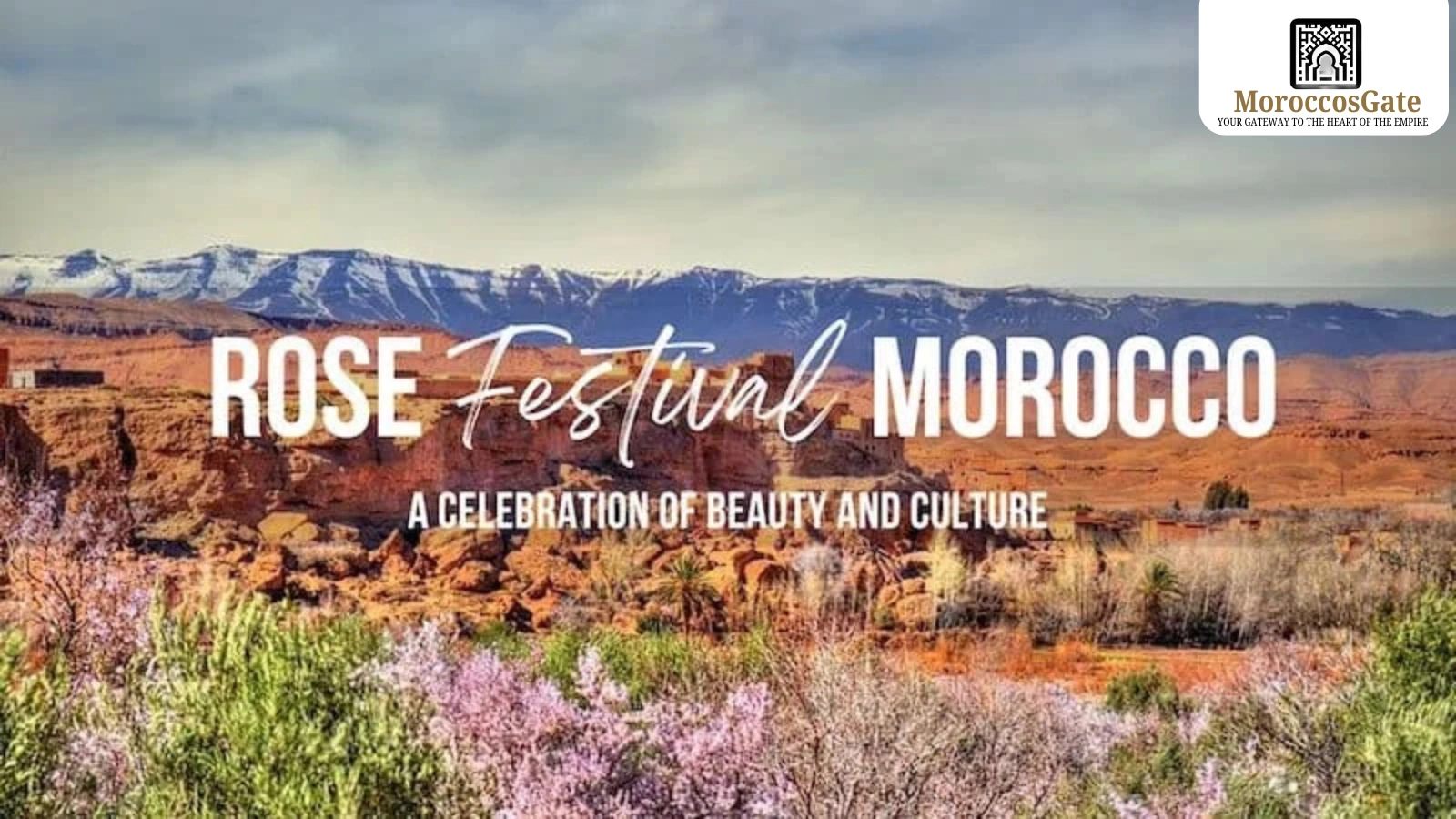
This is El Kelaâ M’Gouna in early May, and for travellers fortunate enough to find themselves here, the experience is nothing short of transformative. The Morocco Rose Festival 2026 — formally known as the Fête des Roses or Moussem des Roses — is one of the country’s most beloved and visually extraordinary cultural celebrations, drawing visitors from across Europe, North Africa, and beyond to this remote corner of southern Morocco.
In this guide, MoroccosGate brings you everything you need to plan your visit: confirmed 2026 festival dates, how to get there, what to expect on each day, what to buy, where to stay, and the rich cultural story behind the roses themselves.
What Is the Morocco Rose Festival?
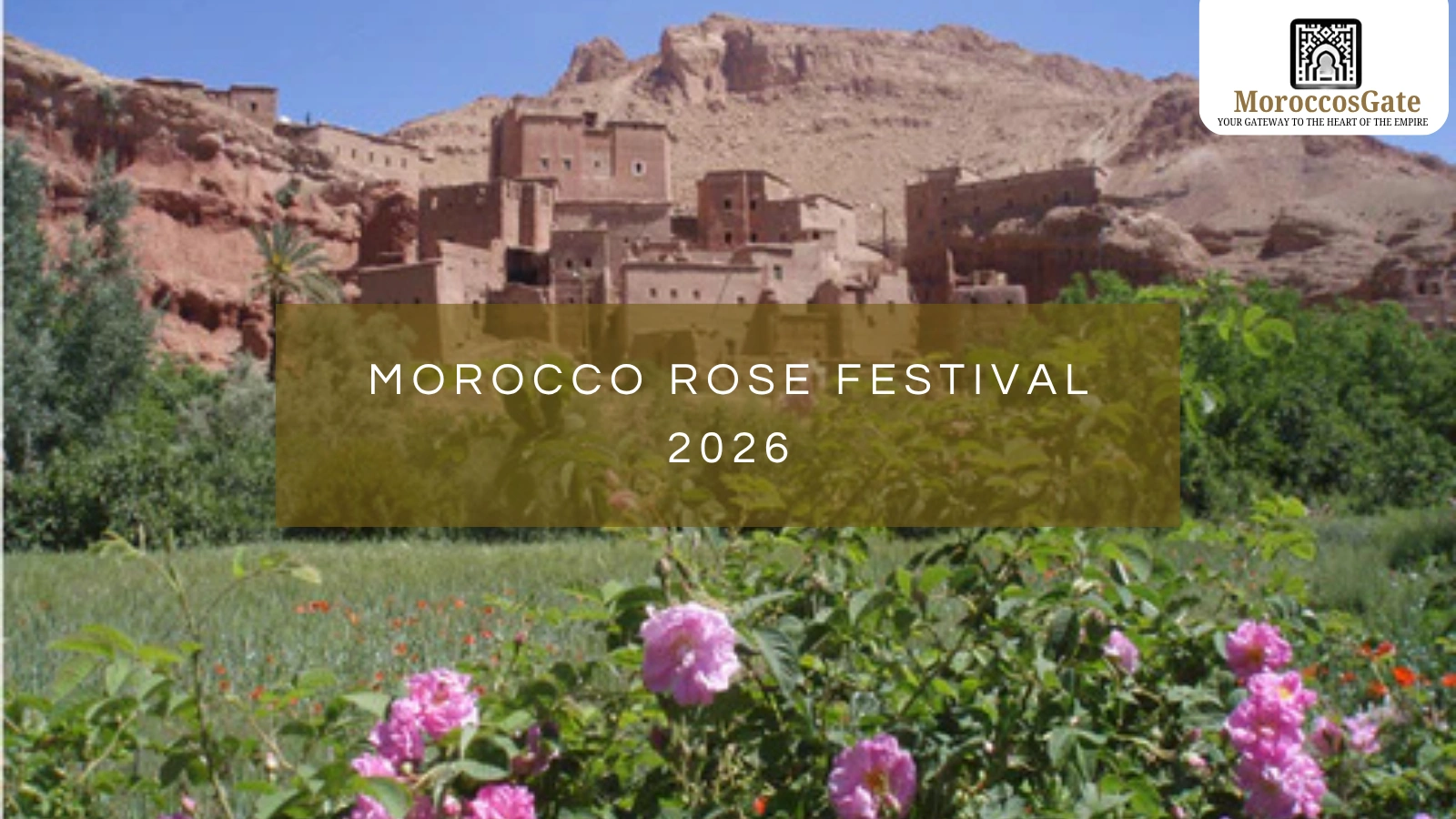
The Festival of Roses is an annual celebration of the Damask rose harvest held in the town of El Kelaâ M’Gouna (also written as Kelaat M’Gouna or Kalaat M’Gouna), the self-proclaimed “Rose Capital of Morocco.” The town sits in the Tinghir Province, deep in the Dades Valley — a fertile river corridor flanked by dramatic red rock formations and the snow-dusted peaks of the High Atlas.
The festival has been held continuously since 1962, making it one of Morocco’s longest-running moussems (traditional seasonal festivals). It was originally organised to mark the peak of the annual rose harvest and to give local cooperatives a platform to sell their products. Over six decades, it has grown into a three-to-four-day celebration that blends agricultural tradition, Amazigh (Berber) cultural performance, commerce, and community pride into something genuinely unlike anything else on the Moroccan cultural calendar.
At its heart, the Fête des Roses is a tribute to a flower — and to the communities that have cultivated it for generations. The Damask rose, known locally as ward bladi (literally “country rose”), has become the economic backbone of this valley, and the festival is both a thanksgiving and a showcase to the wider world.
Morocco Rose Festival 2026: Dates, Location, and Key Facts
Planning your trip starts with the essential logistics. Here is everything confirmed for the 2026 festival.
Festival Dates
The Morocco Rose Festival 2026 is scheduled for 6–9 May 2026. The festival traditionally spans the first or second weekend of May, timed to coincide with the peak of the rose harvest. Because the exact bloom depends on that year’s weather conditions — winter rainfall and spring sunshine both play a role — dates can shift slightly from year to year, but May 6–9 represents the confirmed window for 2026 based on local organisers and regional sources.
Our strong advice: book your accommodation and transport by early March at the latest. The town fills rapidly, and nearby guesthouses in the Dades Valley are taken weeks in advance.
Location
- Town: El Kelaâ M’Gouna (Kelaat M’Gouna)
- Province: Tinghir Province, Drâa-Tafilalet Region
- Region: Southern Morocco
- Distance from Marrakech: Approximately 330 km (a 5–6 hour drive via the Tizi n’Tichka pass)
- Distance from Ouarzazate: Approximately 94 km (a 1.5-hour drive)
- Altitude: Approximately 1,450 metres above sea level
Quick Reference: Key Facts
| Detail | Information |
|---|---|
| Festival name | Fête des Roses / Moussem des Roses |
| 2026 dates | 6–9 May 2026 |
| Location | El Kelaâ M’Gouna, Tinghir Province |
| Admission | Free public event |
| Duration | 4 days |
| Festival since | 1962 |
| Rose variety | Damask rose (Rosa damascena) |
| Nearest airport | Ouarzazate (OZZ) or Marrakech (RAK) |
The Story of the Damask Rose in Morocco
To truly appreciate the festival, you need to understand the flower at its centre. The Damask rose (Rosa damascena) is believed to have originated in ancient Persia and arrived in the Dades Valley during the early 20th century — brought by French colonial administrators who introduced the first rose bushes as hedgerows to protect orchard crops from livestock and wind erosion.
What began as a practical agricultural decision transformed the valley entirely. The rose bushes thrived in the unique microclimate of the Dades — the combination of altitude, rich riverbed soil, cold nights, and warm sunny days produced flowers of exceptional fragrance and essential oil content. By the late 1930s, the first rose water distillery had been established in El Kelaâ M’Gouna, and the rose industry was born.
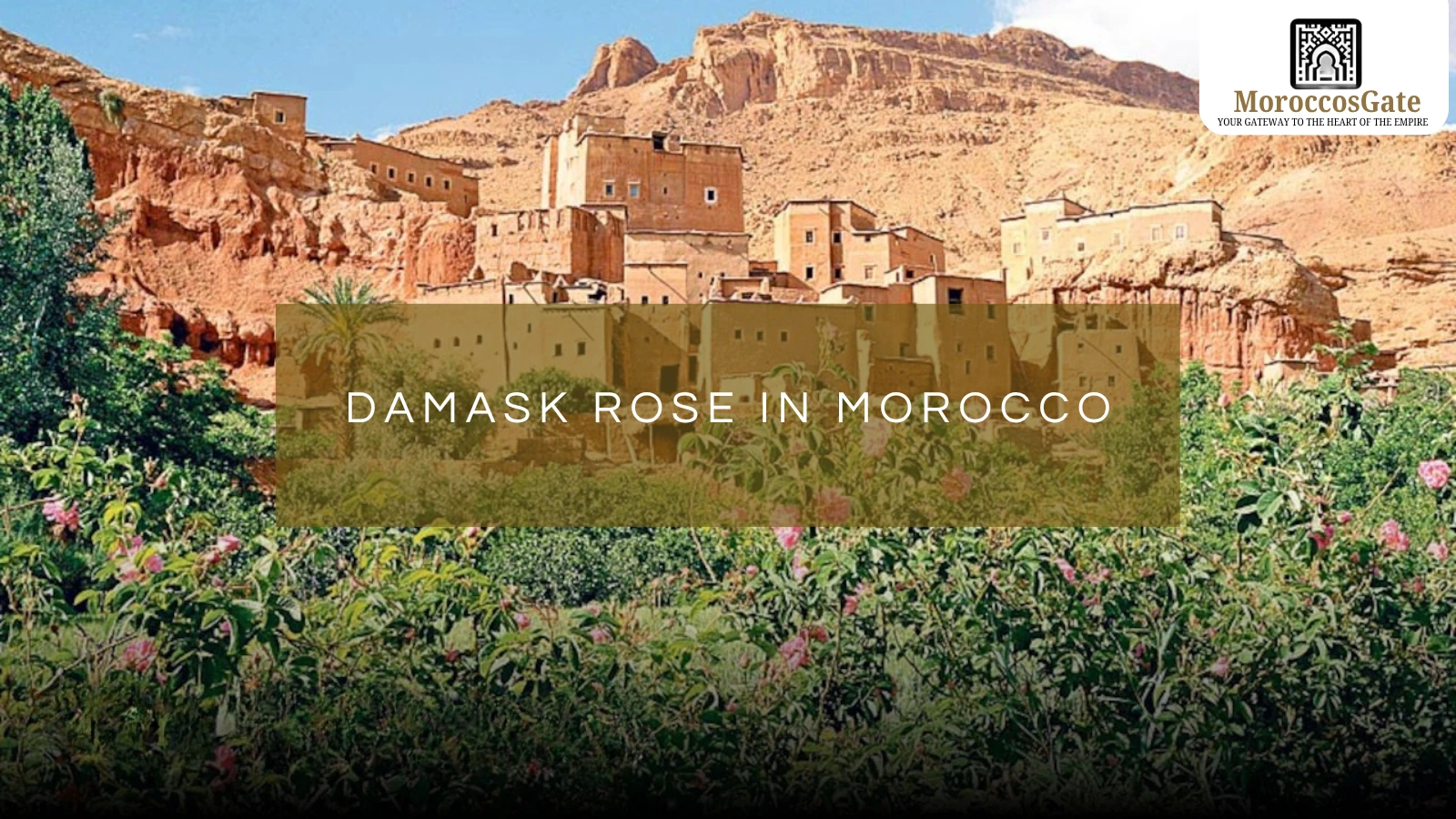
Today, the valley is home to over 4,000 kilometres of rose hedgerows — an extraordinary patchwork of pink that blankets fields, lines footpaths, and borders the riverbanks of the M’Goun Valley. The entire region is sometimes called Vallée des Roses (Valley of the Roses), and it produces between 2,000 and 4,000 tonnes of flowers annually, depending on seasonal conditions.
The Economics of the Rose
Rose cultivation here is not a romantic hobby — it is a serious industry, and a labour-intensive one. The Damask rose flowers for only a brief window each spring, typically three to four weeks, and every petal must be harvested by hand before sunrise to preserve the volatile aromatic compounds that give the flower its distinctive scent. Exposure to the heat of the midday sun degrades the essential oils rapidly, so harvesting teams — predominantly women — begin work in the pre-dawn darkness and finish before 10 o’clock in the morning.
The economics of rose oil production are humbling. It takes approximately three to five tonnes of fresh rose petals to produce just one kilogram of pure rose essential oil (huile de rose). Rose water (eau de rose), produced as a by-product of steam distillation, requires similarly vast quantities of raw flowers. The resulting products command significant prices in global perfumery, cosmetics, and food markets — Morocco produces roughly 5% of the world’s supply of rose oil, and its product is prized for being entirely natural and pesticide-free.
For the families of El Kelaâ M’Gouna and the surrounding villages, the rose harvest represents a vital portion of their annual income. The festival, then, is not merely a tourist attraction — it is a genuine celebration of a harvest that sustains livelihoods.
What Happens at the Festival? A Day-by-Day Guide
The Fête des Roses is a multi-day event with a full programme of activities. Here is what to expect across the four days of the 2026 festival.
The Grand Parade and Coronation of Miss Rose
The undisputed centrepiece of the festival is the grand parade, which typically takes place on the penultimate or final day of festivities (historically the Sunday). This is the event that draws the largest crowds, and it is worth positioning yourself along the main parade route at least an hour before the scheduled start time — prime spots fill quickly.
The parade winds through the main streets of El Kelaâ M’Gouna in a riot of colour, fragrance, and sound. Floats elaborately decorated with thousands of fresh Damask roses move slowly through the crowds, accompanied by dancers in traditional Amazigh dress and musicians playing traditional instruments. The air is thick with the scent of rose petals, which are scattered generously by onlookers and participants alike.
The emotional and symbolic centrepiece of the parade is the crowning of Miss Rose — a local young woman selected to represent the festival and the region for the coming year. The selection process reflects not merely physical beauty but knowledge of rose cultivation, community standing, and cultural identity. The newly crowned Miss Rose rides at the head of the parade, draped in traditional Berber dress adorned with fresh roses, waving to the crowds from an elevated float.
For photographers, the parade is an extraordinary opportunity. The colour palette — deep pinks of the roses against the ochre walls of the town’s buildings, the vivid embroidered costumes of the dancers, the golden light of a May morning — is genuinely exceptional. Bring a long lens for detail shots and a wide angle for the full spectacle.
Traditional Amazigh Music and Dance
Throughout the festival, the streets, open squares, and dedicated performance areas of El Kelaâ M’Gouna come alive with traditional Amazigh (Berber) music and dance. The most prominent style you will encounter is ahwash — a collective performance in which large groups of men and women arrange themselves in circular formations, moving in rhythmic synchrony to the beat of frame drums (bendir), hand-clapping, and call-and-response vocal chanting.
These are not performances staged for tourists. Ahwash is a genuine communal tradition, practised across the Amazigh communities of southern Morocco for centuries. Watching a full ahwash performance — particularly by firelight in the evening — is one of the most memorable cultural experiences Morocco can offer. Do not be surprised if audience members are gradually invited to join the outer circles of the dance.
You may also encounter performances featuring the rbaб (a traditional single-string fiddle), loutar (a type of lute), and various percussive instruments. Spoken poetry competitions in the Tamazight language are also sometimes staged, reflecting the rich oral literary tradition of the Amazigh people.
The Rose Souk and Trade Fair
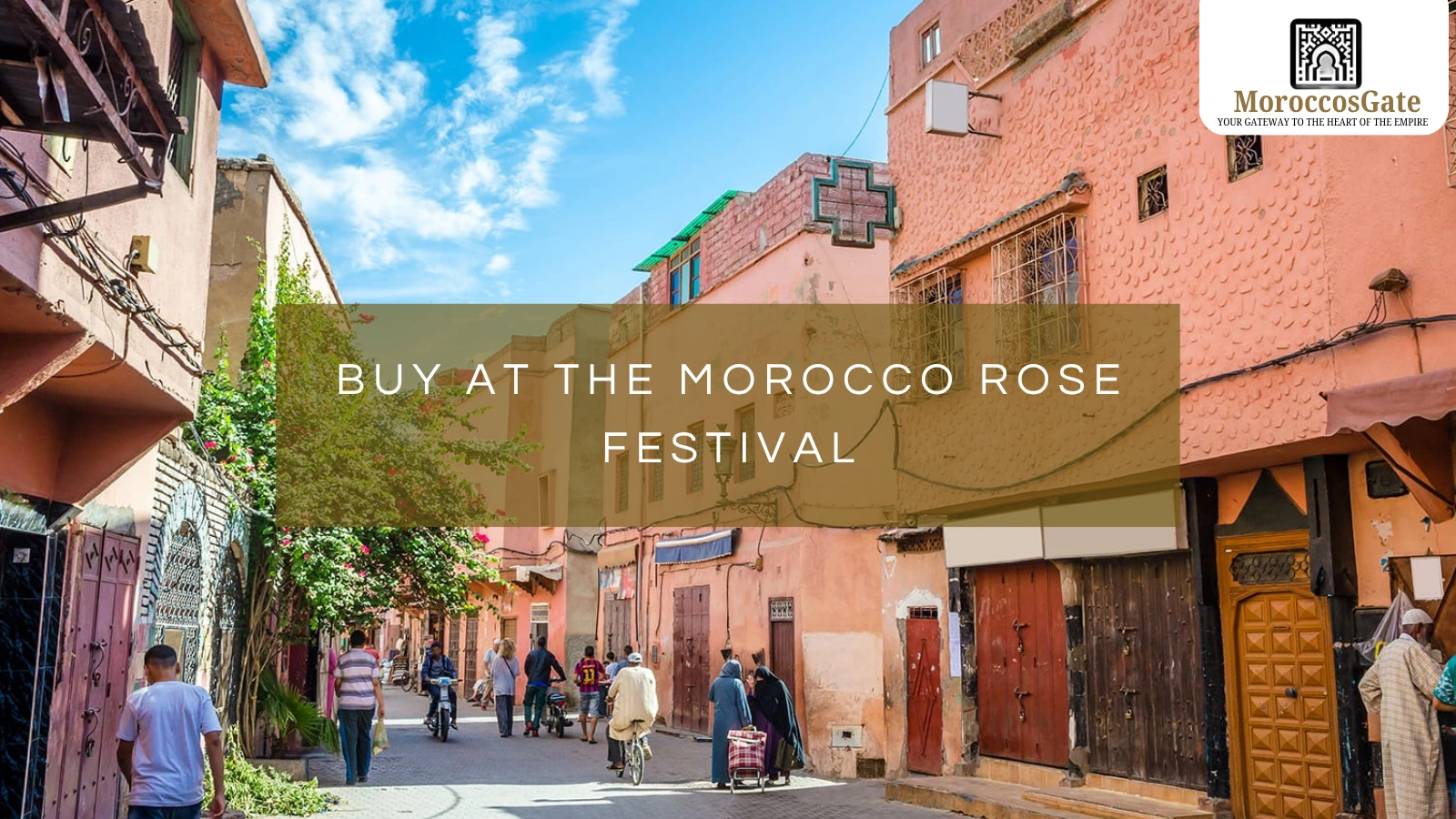
Running throughout the festival, the open-air souk and trade fair is one of the most practical and rewarding parts of the event for visitors. Local cooperatives, family distilleries, and independent artisans set up stalls selling the full range of rose-based products produced in the valley, alongside traditional crafts, jewellery, textiles, and food.
This is genuinely the best place in Morocco — and arguably the world — to purchase authentic rose products. You are buying directly from producers, and prices, while negotiated in the traditional fashion, reflect real value rather than tourist mark-up. More on what to buy, and how to identify genuine quality products, in the section below.
The souk also offers a window into the wider craft traditions of southern Morocco. Look out for hand-woven Berber rugs and blankets in earthy geometric patterns, silver jewellery set with semi-precious stones, hand-tooled leather goods, argan oil products from further west, saffron from Taliouine, and an abundance of dried herbs and spices.
Distillery Visits and Rose Field Walks
Beyond the formal festival programme, El Kelaâ M’Gouna offers remarkable experiences for those willing to venture slightly off the beaten track. The town and its surrounding villages are home to several working rose distilleries, and during the festival period, many are open to visitors who wish to observe the distillation process.
Watching freshly harvested petals loaded into copper stills, steam rising, and the first drops of rose water condensing from the pipes above is a genuinely moving experience — ancient alchemy made visible. Ask your guesthouse or a local guide to arrange a visit to a family-run distillery rather than a large commercial operation if possible; the experience is far more intimate.
If you are visiting in the days around the festival when harvesting is still underway, you may be able to join a guided walk through the rose fields at dawn. Witnessing the harvest — women moving quietly through the pink-laden hedgerows, filling baskets with buds before the sun climbs too high — is one of the most serene and beautiful experiences the festival season offers.
What to Buy at the Morocco Rose Festival
The festival souk offers an overwhelming abundance of rose-based products. Here is a guide to the key items, what to look for, and how to ensure you are purchasing genuine quality.
Rose Water (Eau de Rose)
Rose water is the most widely available and affordable rose product in the souk. It is used extensively in Moroccan cooking (particularly in pastries and sweet dishes), as a facial toner and skin refresher, and as a fragrant room or linen spray. When purchasing rose water, look for a clear, colourless liquid — authentic rose water has no pink or red tint. Pink-tinted versions are often adulterated with dyes or synthetic fragrance. Smell before you buy: genuine rose water has a soft, fresh floral scent with a subtle green note; synthetic versions smell sharp or overwhelmingly sweet.
Rose Essential Oil (Huile Essentielle de Rose)
Pure rose essential oil is the most precious and expensive product available at the festival. Given that several tonnes of petals are required to produce a single kilogram of oil, genuine rose absolute commands significant prices — be deeply sceptical of any vendor selling large quantities at very low prices, as these are almost certainly synthetic or heavily diluted. A small 5ml bottle of genuine rose essential oil from a reputable cooperative should cost upwards of 150–300 Moroccan Dirhams. Ask for a certificate of origin or an indication that the oil comes from a named cooperative.
Rose-Based Cosmetics
The souk is excellent for rose-infused skincare: creams, serums, soaps, and face masks produced by local cooperatives using locally distilled rose water and oil. These products are typically natural, free from harsh synthetic additives, and considerably more affordable than equivalent European products. Women’s cooperatives in the Dades Valley have developed sophisticated small-scale cosmetics operations, and purchasing from them directly supports rural female entrepreneurship.
Dried Rosebuds and Petals
Dried Damask rosebuds make beautiful and intensely fragrant souvenirs — they can be used in herbal teas, pot-pourri, culinary applications, or simply as decoration. Look for buds that are plump, well-formed, and deeply fragrant, with a rich pink or red colour. Pale, dusty, or odourless dried roses have typically been stored too long or in poor conditions.
Rose-Scented Candles and Soaps
Artisan candles and cold-pressed soaps scented with genuine rose water or oil make excellent, compact souvenirs. They are widely available at the festival souk at very reasonable prices.
Practical tip: Bring cash to the souk. Many small producers and cooperative stalls do not accept card payments. ATMs exist in El Kelaâ M’Gouna but may have queues during the festival; withdraw sufficient Moroccan Dirhams in Ouarzazate or Marrakech before you arrive.
How to Get to El Kelaâ M’Gouna
El Kelaâ M’Gouna is not an easy destination to reach — but that relative remoteness is precisely part of its charm. The journey through the High Atlas and the dramatic Drâa-Tafilalet landscapes is itself a significant part of the experience. Here are the main route options.
By Air
The two nearest airports are:
- Marrakech Menara Airport (RAK) — the most internationally connected option, with direct flights from many European cities including London, Dublin, Paris, Amsterdam, and Madrid. From Marrakech, El Kelaâ M’Gouna is approximately 330 km (5–6 hours by road).
- Ouarzazate Airport (OZZ) — a smaller regional airport with limited but growing connections (primarily from Casablanca and some seasonal European charter routes). From Ouarzazate, El Kelaâ M’Gouna is approximately 94 km (about 1.5 hours).
By Road from Marrakech
The classic route from Marrakech follows the N9 highway over the spectacular Tizi n’Tichka pass (2,260 metres altitude), descending towards Ouarzazate before continuing east on the N10 through the Drâa Valley and on towards the Dades Valley. This route takes you past Aït Benhaddou — a UNESCO World Heritage ksar that makes an excellent half-day stop — and through Skoura, with its ancient palm grove and kasbahs.
This is one of Morocco’s most breathtaking road journeys. If you are driving independently, allow a full day and stop frequently. Alternatively, MoroccosGate can arrange private guided transfers from Marrakech that include stops at key sights along the route.
Combining with a Sahara Desert Tour
El Kelaâ M’Gouna sits naturally on the classic southern Morocco circuit that connects Marrakech, Aït Benhaddou, Ouarzazate, the Dades Gorges, Todra Gorge, and the Sahara Desert at Merzouga. If you are planning a Morocco road trip in May, building the Rose Festival into a broader 7–10 day southern circuit is highly recommended — it gives the festival context within the extraordinary landscape that produces it.
Where to Stay
Accommodation in and around El Kelaâ M’Gouna ranges from simple local guesthouses to beautifully converted kasbahs and riads in the surrounding Dades Valley. The key advice: book early. Festival week sees demand far outstrip local supply, and the best properties are taken months in advance.
Staying in El Kelaâ M’Gouna
Accommodation within the town itself is limited — primarily small family-run guesthouses and local hotels of 2–3-star standard. Staying in town gives you the most immersive experience and easiest access to early morning festival events, but expect simpler facilities. If you are considering this option, book by February at the latest.
Staying in the Dades Valley
The Dades Valley, stretching roughly 30–40 minutes west of El Kelaâ M’Gouna, offers a much wider range of accommodation including beautifully restored kasbah guesthouses and boutique 4-star properties. This is our recommended base for most travellers — you enjoy considerably better comfort while remaining close enough to drive into the festival each morning.
Staying in Ouarzazate or Skoura
Ouarzazate (1.5 hours from El Kelaâ M’Gouna) and Skoura (about 50 km west) offer the widest choice of accommodation including 4- and 5-star hotels and luxury riads. This suits travellers who prioritise comfort and are happy to make the drive to and from the festival each day. Ouarzazate in particular has excellent infrastructure and a good selection of restaurants.
MoroccosGate recommends booking through trusted accommodation partners — click here to explore curated guesthouse and riad options near El Kelaâ M’Gouna.
Practical Travel Tips for the Rose Festival
What to Wear
May in the Dades Valley can be deceptively variable. Daytime temperatures during festival week typically range from 20–28°C and can feel warm in direct sunshine. However, at 1,450 metres altitude, mornings and evenings cool rapidly — temperatures can drop to 8–12°C after sunset. Pack layers: a light jacket or fleece for evenings is essential. As you are in a traditional rural community, modest dress (covering shoulders and knees) is respectful and appreciated.
Language
The primary local language is Tamazight (the Amazigh Berber language), with Moroccan Arabic (Darija) also widely spoken. French is useful in hotels and with tour operators. English is spoken in tourist-facing businesses but less commonly in the souk. Learning a few words of Darija or Tamazight — even just a greeting — will be warmly received.
Photography
The festival is a photographer’s paradise, but please respect the community. Always ask permission before photographing individuals at close range, particularly women. A smile and a gesture towards your camera is usually sufficient to gauge willingness. If someone declines, accept this gracefully. A local guide can act as a cultural intermediary and enormously enrich the quality of your photography experience.
Visiting the Rose Fields
The best time to visit the rose fields is between 5:30 and 9:00 AM, when harvesting is underway and the light is at its most beautiful. After 10 AM, harvesting largely ceases and the midday heat diminishes both the fragrance and the photographic quality of the light. Arrange an early morning visit through your guesthouse or local guide.
Stay Hydrated and Sun-Protected
The May sun in southern Morocco is intense, particularly at altitude. Bring high-SPF sunscreen, a hat, and a reusable water bottle. Drinking water is widely available for purchase in the town.
Safety
El Kelaâ M’Gouna is a very safe destination and the festival is a welcoming, family-oriented event. Standard travel precautions apply: keep an eye on your belongings in crowded souk areas and use registered guides rather than accepting unsolicited offers of assistance.
Beyond the Festival: Exploring the Surrounding Region
El Kelaâ M’Gouna sits at the gateway to some of Morocco’s most spectacular landscapes. If you are visiting for the festival, consider spending additional days exploring the wider region.
The Dades Gorges
Just east of El Kelaâ M’Gouna, the Dades Gorges offer some of Morocco’s most dramatic scenery — towering rust-red canyon walls carved by the Dades River, dotted with ancient ksar villages and the distinctive “monkey fingers” rock formations beloved of photographers. The gorge road winds upward into an ever-narrowing canyon, and the views from the higher lookout points are extraordinary.
The Todra Gorges
Approximately 60 km east, the Todra Gorge is one of Morocco’s most celebrated natural wonders — a narrow slot canyon where limestone cliffs rise nearly 300 metres on either side of a shallow, ice-cold river. In the late afternoon, shafts of golden light penetrate the canyon floor, creating a scene of almost theatrical beauty. The gorge is also a well-established rock-climbing destination.
The Road of a Thousand Kasbahs
The N10 highway that passes through El Kelaâ M’Gouna is part of the legendary Route des Kasbahs — a historic trading route lined with ancient fortified earthen architecture. Aït Benhaddou (UNESCO World Heritage Site) is the most famous, but there are dozens of lesser-known kasbahs and ksour (fortified villages) along the route, many of which can be visited with a local guide.
Why the Morocco Rose Festival Is Worth the Journey
Morocco’s cultural calendar is rich with moussems, festivals, and celebrations. So why does the Fête des Roses deserve a special place on your list? The honest answer is that it offers something increasingly rare in a world of manufactured tourist experiences: authenticity.
The Rose Festival is not a performance staged for foreign visitors. It is a living expression of a community’s relationship with its landscape, its agricultural heritage, and its cultural identity. The roses are real, the harvest is real, the music and dance are genuine traditions practised for generations rather than recreated for cameras. And the setting — the dramatic red-rocked Dades Valley, the snow-capped Atlas peaks in the distance, the endless pink hedgerows — is one of the most visually stunning in all of North Africa.
For European travellers, particularly those flying from Ireland, the UK, or France, the combination of short flight times to Marrakech and the extraordinary cultural richness of southern Morocco makes this one of the most rewarding spring travel experiences available. Add the opportunity to purchase genuinely exceptional natural cosmetics and fragrances directly from producers, and the argument for making the trip becomes very compelling indeed.
Book early, travel open-mindedly, and prepare to have your senses completely overwhelmed — in the very best way.
Frequently Asked Questions (FAQ)
Q1. When is the Morocco Rose Festival 2026?
A1. The Morocco Rose Festival 2026 (Fête des Roses) is scheduled for 6–9 May 2026 in El Kelaâ M’Gouna, Tinghir Province, southern Morocco. Exact dates can shift slightly depending on the rose harvest timing, but the first or second week of May is historically consistent.
Q2. How do I get to El Kelaâ M’Gouna?
A2. The easiest route is to fly to Marrakech (RAK) or Ouarzazate (OZZ), then travel by road. From Marrakech, the drive takes approximately 5–6 hours via the Tizi n’Tichka pass. From Ouarzazate, it is approximately 1.5 hours. Private transfers and guided tours can be arranged through MoroccosGate.
Q3. Is the Rose Festival free to attend?
A3. Yes — the festival is a free public event. There is no admission charge to watch the parade, attend performances, or explore the souk. You will of course spend money on accommodation, food, and any products you purchase at the festival market.
Q4. What is the best rose product to buy?
A4. Rose water (eau de rose) is the most affordable and versatile option. For a premium purchase, pure rose essential oil from a named cooperative is exceptional. For gifts, rose-scented soaps, creams, and dried rosebuds are beautiful and easy to transport. Always look for clear rose water (not pink-tinted) and exercise caution with very cheaply priced “essential oils.”
Q5. What should I wear to the Rose Festival?
A5. Layer up — mornings and evenings are cool at altitude, while afternoons can be warm. Dress modestly out of respect for the local community (covering shoulders and knees). Comfortable walking shoes are essential as you will be on your feet for much of the day.
Q6. Is it safe to travel to El Kelaâ M’Gouna?
A6. Yes. El Kelaâ M’Gouna is a safe, welcoming destination and the festival is a family-oriented community event. Standard travel precautions apply — keep your belongings secure in crowded market areas and use registered, recommended guides.
Q7. Can I combine the Rose Festival with a Sahara Desert trip?
A7. Absolutely — and we highly recommend it. El Kelaâ M’Gouna sits naturally on the classic southern Morocco circuit connecting Marrakech, Aït Benhaddou, Ouarzazate, the Dades and Todra Gorges, and the Sahara dunes at Merzouga. A 7–10 day southern Morocco road trip incorporating the festival is one of the finest itineraries Morocco has to offer.
Q8. When do the rose fields bloom?
A8. The Damask roses of the Dades Valley typically bloom from late April through mid-May, with peak bloom usually coinciding with the festival in the first or second week of May. The harvest itself begins in late April, with women picking roses before sunrise each morning to preserve the scent.
Plan Your Trip to the Morocco Rose Festival 2026
Ready to experience the magic of the Fête des Roses? MoroccosGate specialises in helping travellers plan extraordinary Moroccan adventures — from tailor-made itineraries that incorporate the Rose Festival to private guided tours of the Dades Valley, Sahara Desert excursions, and curated accommodation recommendations.
Don’t leave it too late. Accommodation near El Kelaâ M’Gouna books out months in advance for festival week. Start planning now to secure your preferred dates and properties.
→ Get in touch with MoroccosGate to start planning your 2026 Rose Festival trip
→ Browse our curated Morocco travel deals
→ Read more Morocco travel guides
Affiliate Disclosure Reminder: Some links in this article are affiliate links. MoroccosGate may earn a commission if you book a tour or accommodation through these links, at no additional cost to you. This helps us continue providing free, independent travel content about Morocco. We only recommend services we trust.