
Affiliate Disclosure: This post contains affiliate links. If you book a hotel, tour, flight, or travel service through links on this page, Morocco’s Gate may earn a small commission at no extra cost to you. We only recommend services we have used and genuinely trust. Every opinion in this guide is our own, based on real experience in Morocco. Thank you for supporting our independent travel content.
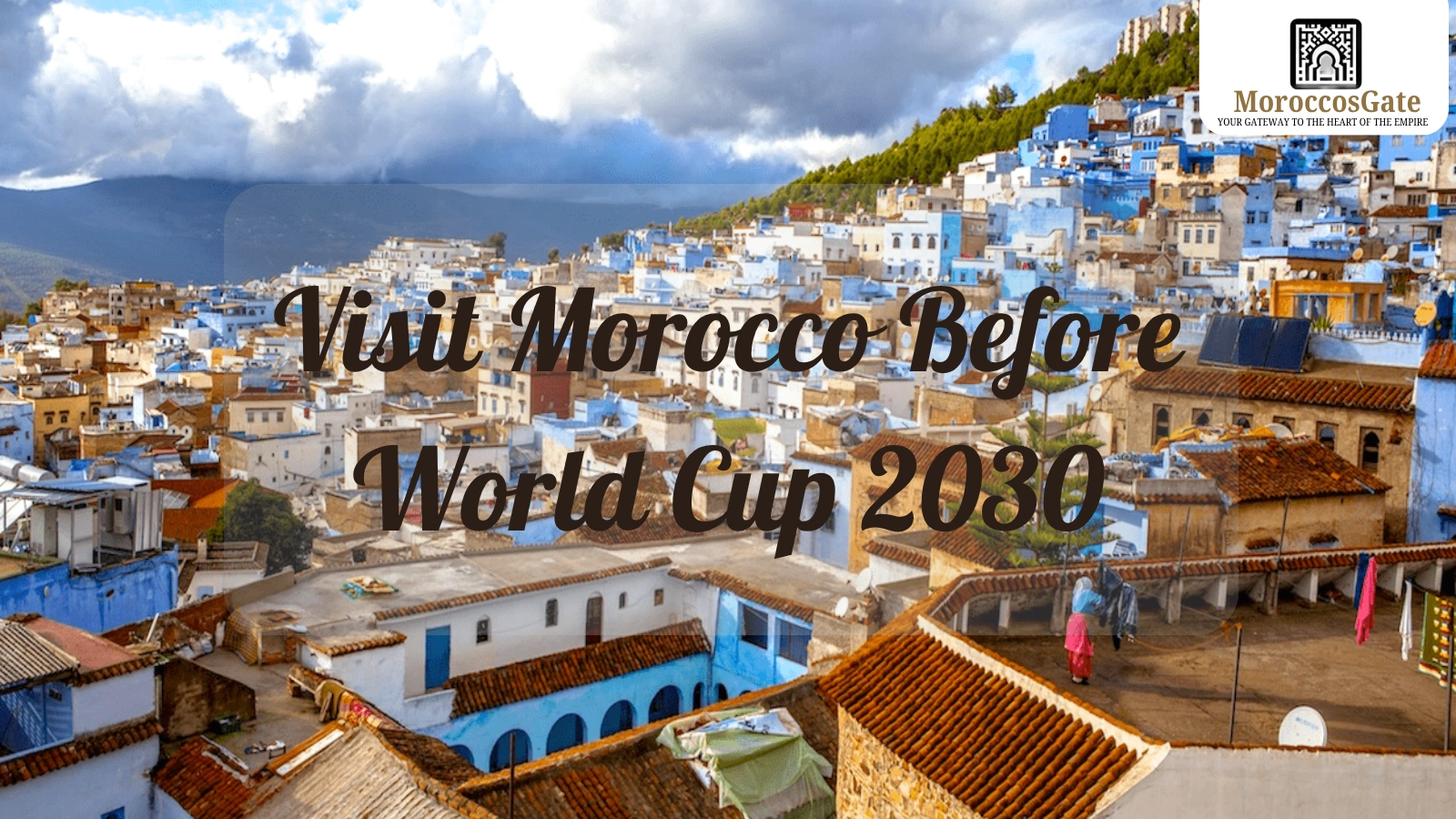
Why You Should Visit Morocco Before the 2030 World Cup (And How to Do It Right)
You should visit Morocco before the 2030 World Cup because prices are rising fast — accommodation in Marrakech and Casablanca has already increased 15–20% since 2024 and will continue climbing 10–15% per year through 2030. Beyond cost, visiting now means smaller crowds, more authentic encounters, and a Morocco that is actively investing in its infrastructure but has not yet been reshaped entirely by World Cup tourism. The window of genuinely affordable, unhurried Morocco travel is closing. 2026 and 2027 are the last years where you experience the best of the country without the price premium and volume that 2030 will bring.
There is a particular kind of travel destination that everyone agrees they should visit “before it changes too much.” Barcelona before it became a theme park. Lisbon before the cruise ships. Dubrovnik before Game of Thrones. These are places that were always extraordinary — and then an event, a TV show, or a viral moment changed the volume dial permanently.
Morocco is at that inflection point right now, and the event is the 2030 FIFA World Cup.
Morocco is co-hosting the 2030 World Cup alongside Spain and Portugal — and the country is investing an estimated $15 billion or more in stadiums, high-speed rail, airports, roads, hotels, and telecommunications infrastructure to prepare. Morocco is targeting 20 million visitors by 2026 and an ambitious 26 million tourists by the end of the decade, up from 17.4 million in 2024. Every year between now and 2030, the country will become slightly more expensive, slightly more crowded, and slightly less like the Morocco that has made it one of the world’s most compelling travel destinations for the past fifty years.
This guide makes the case — strongly, from genuine experience — for visiting Morocco now, before all of that fully arrives. It also gives you everything you need to plan the trip: what to see, where to stay, how much to budget, and which experiences to prioritise before they change.
For a full look at what Morocco will offer during and around the tournament itself, see our dedicated Morocco World Cup 2030 Travel Guide.
The Case for Going Now: 7 Compelling Reasons to Visit Morocco Before 2030
1. Prices Are Rising Every Year — and They Will Not Come Back Down
Let us start with the most practical reason, because it is also the most urgent. Accommodation prices in Marrakech and Casablanca have already increased 15 to 20% since 2024, and hotel prices will continue rising 10 to 15% annually through 2030 as World Cup demand builds.
This is not speculation — it is already happening. The riads that were £45 a night in 2023 are £55 in 2026. The ones that were £90 are nudging £110. The best-value guesthouses inside Fes el-Bali are booked further in advance than they were two years ago. And this is before the real World Cup premium kicks in.
Morocco is investing $4 billion to increase its hotel capacity by 20% ahead of the 2030 FIFA World Cup, adding 25,000 new hotel rooms. More supply will theoretically moderate prices — but it will not reverse the premium that World Cup status commands. The new hotels being built are predominantly 4- and 5-star. Morocco added more than 43,000 new hotel beds by 2025, and 53% of hotels are now 4- or 5-star quality. The country is pitching upmarket, and prices will follow.
The traveller who visits Morocco in 2026 or 2027 will pay less for an identical experience — the same Marrakech riad, the same Sahara desert camp, the same Fes medina guide — than the traveller who waits until 2029. Every year you delay costs you money for the same experience. 2026 offers the last genuinely affordable window before World Cup pricing fully transforms the market.
2. The Crowds Are Still Manageable
Morocco welcomed 17.4 million international tourists in 2024 — a 20% surge from the previous year. By 2030, the government is targeting 26 million. That is nearly 9 million additional tourists arriving in Morocco every year, a 50% increase on current levels.
Where will they go? Marrakech. Fes. Essaouira. Chefchaouen. The Sahara. The places that are already Morocco’s most celebrated destinations will absorb the bulk of this growth — and the tourist experience in those places will change accordingly. Queue times at the tanneries in Fes. Crowds at the Jemaa el-Fna at prime evening hour. Booking windows for the best-value desert camps extending from weeks to months.
In 2026, the Marrakech medina at 9 AM on a Tuesday morning is still something close to the real thing — local traders, school runs, the smell of fresh-baked bread from a side alley, one or two other tourists in sight. By 2029, that same street will feel different. Not ruined — Morocco’s medinas are too large and too genuinely lived-in for that — but different.
Visiting now means getting Morocco at a crowd level that still allows the unhurried, accidental discovery that makes Moroccan travel so extraordinary. The wrong turn that leads to the right courtyard. The conversation with a shopkeeper that takes forty-five minutes and covers six languages. The hammam that has no English-language sign outside.
3. The Infrastructure Is New but Not Yet Overwhelming
Here is the paradox of visiting Morocco before the World Cup: you get the benefits of the infrastructure investment without the downsides of the volume it attracts. Airport capacity is being scaled up nationwide — backed by a €270 million African Development Bank loan — with upgrades planned for Marrakech, Agadir, Tangier, and Fez, targeting a rise in passenger capacity from 38 million to 80 million by the end of the decade.
Casablanca’s Mohammed V Airport is being expanded to handle 20 million passengers annually. Marrakech’s Menara Airport is being upgraded. New flight routes are opening constantly — in 2025 alone, Morocco successfully opened 80 new air routes connecting key source markets, adding more than 12 million seats to its capacity. From Ireland, getting to Morocco is easier and more affordable than at any point in the country’s tourism history.
The Al Boraq high-speed train already runs between Tangier and Casablanca in 2 hours. Extensions to Marrakech (planned operational before 2030) will transform intercity travel. New stations are being refurbished. Tram networks in Rabat and Casablanca are expanding. Getting around Morocco is already better than it was five years ago — and it is improving every year through 2030.
What you get by visiting now is better airports, more flights, and improving rail — without the overcrowding, surge pricing, and logistical strain that 26 million annual tourists will eventually impose on the country’s systems.
4. Accommodation Choice Is at Its All-Time Best — Right Now
The next two to three years represent the single finest window in Morocco’s modern history for accommodation quality and choice. The government’s Cap Hospitality programme is financing the modernisation of 25,000 hotel rooms by 2026. Hilton is set to more than double its footprint in Morocco, with plans to open 15 new hotels across the country. Radisson has announced 25 new properties before 2030. A Waldorf Astoria is opening in Tangier. Nikki Beach is developing a resort in Marrakech, scheduled to open in 2028.
This means that travellers visiting Morocco in 2026 and 2027 have access to a rapidly improving accommodation landscape — more choice, better standards, more competition keeping prices honest — while still being able to book the beloved older riads at pre-World Cup rates. The timing is genuinely optimal.
For the finest riad options across all of Morocco’s major cities, see our curated guide to Morocco’s most beautiful luxury riads.
5. The Cultural Experiences Are Still Genuinely Authentic
This is the most nuanced reason — and arguably the most important. Morocco’s cultural authenticity is resilient. It has survived decades of mass tourism, decades of guidebook attention, and the Instagram era with its medinas, its crafts, and its hospitality largely intact. This is not a fragile thing.
But authenticity is contextual. A Moroccan family hammam experience feels different at 6 AM with five local families than it does at 10 AM with a tour group from a cruise ship. A conversation with a Fes medina guide feels different when he is your sole focus rather than managing a group of fifteen. The Sahara desert at dawn, when you are the only camp in visible range, is a different experience from the same dawn with twelve camps on the horizon.
Volume changes experience without destroying it. And the volume coming to Morocco is going to be enormous by 2029. The people who visit in 2026 and 2027 will have the same experiences available to them — but with more room around each one.
6. You Can Watch Morocco Transform in Real Time
There is a particular pleasure in visiting a country at a moment of genuine historical significance — when something real is happening, and you can see it with your own eyes. The Grand Stade Hassan II, expected to be ready by 2027, is being built in Benslimane near Casablanca and will be one of the largest stadiums in the world, with a design rooted in Moroccan culture — its shape similar to a traditional Moussem-style tent, with surrounding gardens following the pattern of traditional Moroccan patios.
Visiting Morocco in 2026 or 2027 means you can drive past the Grand Stade Hassan II construction site south of Casablanca and see it going up. You can walk the refurbished Prince Moulay Abdellah Stadium in Rabat, still carrying the atmosphere of the AFCON 2025 final. You can see the Al Boraq extension in progress. You can feel the national energy of a country that genuinely believes its moment has arrived — because AFCON 2025 confirmed it, and 2030 is coming.
AFCON 2025 helped tourism beyond the pitch. It drew visitors from across the continent and further away. People stayed longer and moved between host cities. The tournament matched the Tourism Roadmap 2023–2026 and sped up service upgrades. Morocco tested its 2030 systems and passed. The confidence is real, and it is infectious.
7. Morocco Is Genuinely One of the World’s Great Travel Destinations — Full Stop
The World Cup context is important. But let us not lose sight of the underlying fact: Morocco is extraordinary, regardless of 2030. The ancient medinas of Fes and Marrakech. The Sahara Desert at Merzouga. The High Atlas Mountains and the Toubkal summit. The Atlantic coast from Tangier to Agadir. Chefchaouen’s blue-painted alleyways. Essaouira’s windswept ramparts. The cuisine, the hospitality, the music, the architecture — this is not a destination that needs a World Cup to justify a visit. It needs your curiosity and an open ticket.
The 2030 World Cup is a reason to visit sooner rather than later. Morocco is a reason to visit regardless.
What to Prioritise: Experiences to Have Before 2030 Changes Them
The Fes Medina — While It Is Still Genuinely Labyrinthine
Fes el-Bali is one of the most extraordinary urban environments on earth — a UNESCO World Heritage Site of 9,000 alleyways, medieval craft workshops, and ancient madrasas that has operated continuously for over a thousand years. It is currently navigable with a good local guide and a willingness to get a little lost. The experience rewards patience, curiosity, and the willingness to follow something interesting rather than a predetermined route.
The Chouara tanneries, the Bou Inania madrasa, the Kairouyine University (founded 859 AD), the Attarine souk with its cedar and spice — all of these are currently accessible without the management apparatus that overwhelming visitor numbers eventually require. Visit Fes now, when you can still find a quiet corner of the medina in the middle of the morning.
The Fes Festival of World Sacred Music (4–7 June 2026, and annually thereafter) is one of the finest experiences available in the city — sacred music from across the world performed in the floodlit Bab Makina courtyard. See our full guide to the Fes Sacred Music Festival and Morocco’s cultural events.
The Sahara Desert — Before Desert Tourism Scales Up
Merzouga and the Erg Chebbi dunes are already well-known to international travellers, and the best desert camps are already booked weeks in advance during peak season. But in 2026, the experience of a night in a genuine desert camp — with only the sound of the wind and the extraordinary Saharan star field above you — is still entirely achievable for anyone who books ahead.
By 2029, the infrastructure around Merzouga will have expanded significantly. More camps, more tourists, more facilities — all of which improve accessibility but inevitably change the texture of the experience. Visit the Sahara Desert before 2030 if you want the version that still feels like the edge of something vast and genuinely empty.
The Toubkal Summit Trek — While Permits Remain Simple
The 4,167-metre summit of Mount Toubkal — North Africa’s highest peak — is currently accessible to fit hikers via a 2-day guided trek from Imlil, with straightforward booking through licensed local guides. As Morocco’s adventure tourism profile rises ahead of 2030, the possibility of more formalised permit systems and higher demand for guides increases.
Visit now for the most straightforward access to one of Africa’s finest hiking experiences. Our complete guide to the Toubkal hike from Imlil covers everything you need to plan the trek.
Chefchaouen — Morocco’s Most Photographed City
The blue-painted alleyways of Chefchaouen in the Rif Mountains have become one of Morocco’s most famous images worldwide. As a result, tourist volumes in the city are already rising significantly. Visiting in 2026 or 2027 — particularly in shoulder seasons (early March, late October, November) — still gives you early morning hours where the medina’s blue walls are yours to explore in something approaching solitude.
By 2030, Chefchaouen will be on every World Cup visitor’s Moroccan itinerary. It is worth going before then.
Morocco’s Music Festivals — In Their Pre-World Cup Form
Mawazine in Rabat, the Gnaoua World Music Festival in Essaouira, the Fes Festival of World Sacred Music — these are extraordinary events that are already world-class. In the years before 2030, they are also still manageable: ticketed shows still have availability if you plan ahead, accommodation around festival week is tight but bookable, and the events retain the community character that distinguishes a Moroccan moussem from a European mega-festival.
As Morocco’s global profile rises through 2030, these festivals will attract increasingly large international audiences. Visit them now to experience them at their most genuinely Moroccan. See our comprehensive Morocco Music Festivals 2026 guide and our Morocco Summer Beach Festivals guide for everything you need to plan around the festival calendar.
The Rose Festival in El Kelaâ M’Gouna
The annual Festival of Roses in El Kelaâ M’Gouna — held every May in the Dades Valley — is one of Morocco’s most beautiful and least internationally crowded cultural events. The Rose Festival 2026 (6–9 May) is a magnificent reason to plan a spring trip to southern Morocco. See our complete guide at Morocco Rose Festival 2026.
When to Visit Morocco Before 2030: The Best Windows
The good news is that Morocco rewards visits in every season, but some windows are more compelling than others for the pre-World Cup traveller. Here is our honest breakdown, based on years of experience planning Morocco trips from Ireland:
Spring 2026 and 2027 (March–May) — The Best Overall Window
Spring remains Morocco’s finest season and the best time to see the full range of the country’s experiences. The Rose Festival (May), the Fes Sacred Music Festival (June), ideal conditions for the Toubkal trek, and comfortable weather across all six World Cup host cities — all of this is available in spring. Book well ahead: spring 2026 riads in Marrakech and Fes are already filling up.
Autumn 2026 and 2027 (September–November) — Best for Desert and Mountains
The second-best season for most travellers. The Sahara Desert is at its finest in October — warm days, cold clear nights, extraordinary star conditions. The High Atlas trekking season extends through October. Cities like Fes and Marrakech are comfortable and less crowded than spring. The Moga Festival in Essaouira (late September/early October) is one of Morocco’s finest boutique events.
Winter 2026/27 (December–February) — For Adventurous Travellers and Bargain Hunters
Winter offers Morocco’s lowest prices and smallest crowds — the ideal combination for the cost-conscious traveller who does not mind cooler temperatures and the occasional rainy day in the north. Casablanca, Agadir, and the Atlantic coast remain mild. Fes and Marrakech are cool but perfectly manageable. And skiing in the Atlas Mountains (Oukaimeden, Ifrane) is a genuine and genuinely surprising Morocco experience.
For a full breakdown of every month and what to expect, see our complete Best Time to Visit Morocco 2026 guide.
Pre-World Cup Morocco: A Practical Planning Guide
Where to Stay in 2026–2028
Our core recommendation has not changed: stay in a riad. The traditional Moroccan courtyard house — decorated with zellige tilework, carved cedar wood, and the quiet around a central fountain — is the finest accommodation experience Morocco offers, and it is still available at reasonable prices before the World Cup premium fully arrives.
Specific guidance by city:
- Marrakech: Book 3–4 months ahead for the best riads, particularly for spring and autumn. The medina’s Derb Dabachi and Mouassine neighbourhoods offer the finest concentration of quality guesthouses. Prices are rising year on year — locking in a booking for 2026 or 2027 now protects you from further increases.
- Fes: A riad within Fes el-Bali is unbeatable for immersion. The Rcif and Batha areas offer the best locations. Fes remains slightly better value than Marrakech and less heavily booked in advance.
- Essaouira: The medina’s smaller riads are cosy and atmospheric — book 6–8 weeks ahead for festival periods, 2–3 weeks for non-festival travel.
- Tangier: The Kasbah area offers the most atmospheric accommodation. New hotel openings (including a forthcoming Waldorf Astoria) are raising the quality ceiling significantly.
- Casablanca: Hotels rather than riads are the norm — the Ain Diab beachfront and Maarif neighbourhoods offer the best options at various price points.
- Agadir: Corniche beachfront resort hotels for maximum convenience; Talborjt neighbourhood for local atmosphere at better prices.
See our full guide to Morocco’s finest riads for specific property recommendations across all cities.
Budget Reality Check: What Morocco Costs Now vs 2030
Here is an honest comparison of what a mid-range Morocco trip costs in 2026 versus what it will likely cost by 2029, based on the 10–15% annual price inflation that is already underway:
| Category | 2026 (Now) | Est. 2029 (Pre-World Cup) | Change |
|---|---|---|---|
| Mid-range riad (per night) | £55–£90 | £80–£130 | +35–45% |
| Sahara desert camp (per night) | £60–£120 | £85–£170 | +40% |
| Licensed city guide (half day) | £25–£40 | £35–£60 | +40% |
| Toubkal guided trek (2-day) | £80–£150 | £110–£200 | +33% |
| Return flight Dublin–Marrakech | £100–£220 | £130–£280 | +25–30% |
| Restaurant dinner (mid-range) | £12–£25 | £18–£35 | +40% |
Estimates based on current Morocco price inflation trends of 10–15% per annum in major tourist cities. Local food, transport, and souk purchases will increase more slowly. Estimates are illustrative, not guaranteed.
The conclusion is straightforward: a 10-day Morocco trip that costs £1,800 per person in 2026 will cost approximately £2,500–£2,800 for the same experience in 2029. The earlier you go, the more Morocco you get for your money.
Getting to Morocco from Ireland: Current Direct Flight Options
From Dublin, direct flights currently serve:
- Marrakech (RAK): Ryanair and Aer Lingus year-round. Approximately 3.5 hours. From £80–£180 return.
- Casablanca (CMN): Royal Air Maroc direct. Approximately 3 hours. From £120–£250 return.
- Agadir (AGA): Ryanair seasonal (winter sun routes). From £100–£200 return.
- Fes (FEZ): Ryanair direct. From £80–£160 return.
- Tangier (TNG): Ryanair seasonal. From £80–£160 return.
Flight capacity to Morocco is increasing rapidly. Airlines have already secured 14.5 million seats for 2026, representing an expected increase of nearly 20%. More routes and more competition between carriers is keeping fares competitive — but this window will not last indefinitely as 2030 demand pushes fares higher.
Visit our website now and explore the latest flight offers before they’re gone! – deals.moroccosgate.com
Getting Around Morocco: The Rail Advantage
Morocco’s existing rail network — the ONCF — connects Tangier, Kénitra, Rabat, Casablanca, Fes, Meknès, and Marrakech with comfortable, affordable, and reliable services. The Al Boraq high-speed train runs Tangier to Casablanca in approximately 2 hours, with stops at Kénitra and Rabat.
The pre-2030 extension of Al Boraq to Marrakech is under construction and expected to be operational before the World Cup — potentially as early as 2028. When it opens, Tangier to Marrakech by high-speed train will take under 3 hours. Until then, Casablanca to Marrakech on the conventional ONCF network takes approximately 3 hours and is one of the most comfortable and affordable train journeys in Africa.
For destinations not served by rail — the Sahara (Merzouga), the Dades Valley, Chefchaouen — local buses (CTM is the best operator) and private transfers complete the picture. A 10–14 day Morocco itinerary that combines rail, one domestic flight, and a private transfer for the desert sections is entirely achievable and very affordable in 2026.
The Morocco You Will Find: An Honest Portrait
What Has Changed
Morocco is not the Morocco of 2010. More hotels, more flights, more cafés with English menus, more free museum entry, more ATMs, better Wi-Fi in riads, more English spoken in tourist areas, better signage in the medinas, cleaner public spaces in the host cities. These are all broadly positive developments for international visitors, and the 2030 investment programme will accelerate all of them further.
AFCON 2025 was a genuine rehearsal for 2030. Morocco spent about €1.8 billion on stadiums for AFCON 2025, building six new venues and refurbishing three others. The event demonstrated world-class facilities and logistics, with public and private sectors coordinating well. The country proved it can handle major international sporting events. The confidence this created is palpable on the ground.
What Has Not Changed
The medina of Fes at 7 AM, when the bakers are pulling fresh khobz from the communal ovens and the first light is hitting the carved stucco of the Bou Inania madrasa, is the same as it was a hundred years ago. The hospitality of a Berber family offering you mint tea in the Atlas Mountains is unchanged. The sound of the adhan (call to prayer) echoing between canyon walls in the Dades Valley at dusk has not been affected by any infrastructure programme. The smell of the rose fields in the Dades Valley in early May — that extraordinary, almost overwhelming fragrance — is purely seasonal and purely natural and has nothing to do with tourism whatsoever.
Morocco’s soul is durable. What changes around it is the context — the prices, the crowds, the management apparatus around popular attractions. Those things are changing. The soul is not.
The Morocco’s Gate Perspective: Go Now
We have been organising Morocco trips from Ireland since 2015. We have watched the country change, year by year, in ways that are mostly positive and occasionally bittersweet. The improvements are real. The rising prices are real. The increasing crowds at peak season in major cities are real.
Our honest recommendation, from genuine experience: go in 2026 or 2027 if you possibly can. Not because Morocco will be ruined by 2030 — it will not be. Not because it is not worth visiting during or after the World Cup — it absolutely will be. But because the version of Morocco available right now — properly affordable, not overcrowded, with better infrastructure than ever and lower prices than it will ever have again — is a genuinely special window that is closing.
The travellers who visit Morocco in 2026 and 2027 are getting the best of both worlds: a country that has invested in its transport, accommodation, and tourist infrastructure, but has not yet had those investments fully priced in. They are getting Morocco at its most accessible and most authentic simultaneously — and that combination will not be available at the same price in 2029.
Sample Itinerary: 10 Days in Morocco Before the World Cup
Here is the itinerary we recommend most consistently for first-time Morocco visitors planning a trip in 2026 or 2027 — designed to cover the essential experiences before World Cup pricing changes the cost equation:
- Days 1–3: Marrakech — Fly in (direct from Dublin, 3.5 hours). Medina, Jemaa el-Fna, Bahia Palace, Majorelle Garden, hammam, rooftop dinners, souk exploration. Riad accommodation.
- Day 4: Atlas Mountains day trip — Imlil, Berber villages, Asni Market (Saturdays). Or: Aït Benhaddou kasbah (2.5-hour drive, UNESCO World Heritage Site).
- Days 5–6: Fes — Train from Marrakech (approximately 7 hours, with a change at Casablanca) or domestic flight (1 hour). Hire a licensed medina guide for your first morning. Tanneries, madrasas, souk labyrinth, evening in the medina. Riad in Fes el-Bali.
- Day 7: Chefchaouen — Bus from Fes (approximately 4 hours) or private transfer. Blue city exploration, mountain hike above the medina, evening cafe culture.
- Day 8: Tangier — 90-minute drive from Chefchaouen. Kasbah, medina, beaches, seafood lunch. Overnight in Tangier.
- Day 9: Tangier to Casablanca — Al Boraq high-speed train (2 hours). Casablanca afternoon: Hassan II Mosque tour, Corniche walk, seafood dinner.
- Day 10: Fly home from Casablanca.
This 10-day circuit covers four World Cup host cities, the Sahara gateway, Morocco’s most iconic medinas, the Atlantic coast, and the Blue City — at pre-World Cup prices, with all the improved transport and accommodation infrastructure already in place. It is, in our view, the finest value for money available in international travel from Ireland right now.
Morocco’s Gate can arrange every element of this itinerary — and tailor it entirely to your group, interests, and budget. Get in touch to start planning.
Frequently Asked Questions
Q1. Should I visit Morocco before the 2030 World Cup?
A1. Yes — visiting Morocco before 2030 means lower prices, smaller crowds, and the same extraordinary experiences. Accommodation in Marrakech and Casablanca is already rising 10–15% per year. 2026 and 2027 offer the best combination of improved infrastructure and pre-World Cup pricing.
Q2. How much cheaper is Morocco now vs 2029?
A2. Based on current price inflation of 10–15% per year, a mid-range Morocco trip costing £1,800 per person in 2026 will cost approximately £2,400–£2,800 for the same experience in 2029. Accommodation is the category rising fastest, particularly in Marrakech and Casablanca.
Q3. Is Morocco worth visiting even without the World Cup?
A3. Absolutely — Morocco is one of the world’s finest travel destinations regardless of the World Cup. The ancient medinas of Fes and Marrakech, the Sahara Desert, the High Atlas Mountains, the Atlantic coast, and the extraordinary food and hospitality are reasons to visit that have nothing to do with football.
Q4. What is the best time to visit Morocco before 2030?
A4. Spring (March–May) and autumn (September–November) are the best seasons. Spring is ideal for the Rose Festival (May), trekking, and city exploration. Autumn is best for the Sahara Desert and High Atlas hiking. Winter offers the lowest prices and smallest crowds. See our full Best Time to Visit Morocco guide.
Q5. How is Morocco’s infrastructure improving before 2030?
A5. Morocco is investing over $10 billion in infrastructure including Al Boraq high-speed rail extensions (to Marrakech by 2028), airport capacity expansions across all six host cities (targeting 80 million passenger capacity by 2030, up from 38 million), new stadiums, highway improvements, and 5G network deployment targeting 70% coverage by 2030.
Q6. Will Morocco be overcrowded by 2030?
A6. Morocco is targeting 26 million annual tourists by 2030 — a 50% increase on 2024 levels. While this will increase visitor volumes significantly in major cities, Morocco’s medinas and countryside are large enough to absorb growth. However, the experience in the most popular spots will change. Visiting in 2026 or 2027 provides the best ratio of authentic experience to manageable crowds.
Q7. Is Morocco safe to visit before the World Cup?
A7. Yes — Morocco is safe and welcoming for international tourists. As of May 2026, all major destinations are safe and accessible. The country successfully hosted AFCON 2025 across six cities with an excellent safety record. Standard travel precautions apply, and comprehensive travel insurance is recommended.
Q8. Can I visit the World Cup stadiums now before 2030?
A8. Some are already operational. The Ibn Batouta Stadium in Tangier and the renovated stadiums used for AFCON 2025 (Rabat, Fes, Agadir) can be seen on visits to those cities. The Grand Stade Hassan II in Benslimane is under construction and expected to be complete by 2027. Visiting Morocco in 2027 or 2028 will allow you to see the completed facility before the World Cup itself.
Plan Your Pre-World Cup Morocco Trip with Morocco’s Gate
The case for visiting Morocco before the 2030 World Cup is clear: better value, more authentic experiences, improved infrastructure, and the particular pleasure of experiencing a country at a moment of genuine historical excitement — without yet paying the premium that history will eventually command.
Morocco’s Gate has been planning trips from Ireland to Morocco since 2015. We know every city on the 2030 host list, every riad worth booking, every festival worth attending, and every road worth driving. We are here to help you experience Morocco at its absolute best — right now, while the window is still open.
- → Talk to our team and start planning your Morocco trip for 2026 or 2027
- → Browse our curated Morocco travel deals
- → Read our Morocco World Cup 2030 Travel Guide
- → Read the Best Time to Visit Morocco 2026
- → Explore Morocco’s 2026 music festival calendar
- → Discover Morocco’s hidden gems before the crowds arrive
About the Author: Morocco’s Gate Editorial Team
Morocco’s Gate is based between Dublin, Ireland, and Morocco. We have been planning Morocco trips since 2015 and have watched the country transform year by year — more flights, better riads, rising prices, growing crowds, new stadiums. We have trekked to the Toubkal summit in April snow, attended Mawazine in Rabat, eaten tagine at midnight in Fes el-Bali, and stood on the Casablanca Corniche watching the Hassan II Mosque glow above the Atlantic. When we say visit Morocco now, we mean it: this is our honest, experience-based assessment, not a sales pitch. Morocco in 2026 is as good as it has ever been — and it will cost more to experience the same thing in 2029.
Affiliate Disclosure: This article contains affiliate links. Morocco’s Gate may earn a commission when you book tours, accommodation, or travel services through links on this page — at no additional cost to you. All recommendations are based on genuine first-hand experience and editorial judgement. This commission helps us continue producing free, independent Morocco travel content.