
Affiliate Disclosure: This post contains affiliate links. If you book a hotel, tour, festival ticket, or travel service through links on this page, Morocco’s Gate may earn a small commission at no extra cost to you. We only recommend services we genuinely trust and have experienced ourselves. Thank you for supporting our independent Morocco travel content.
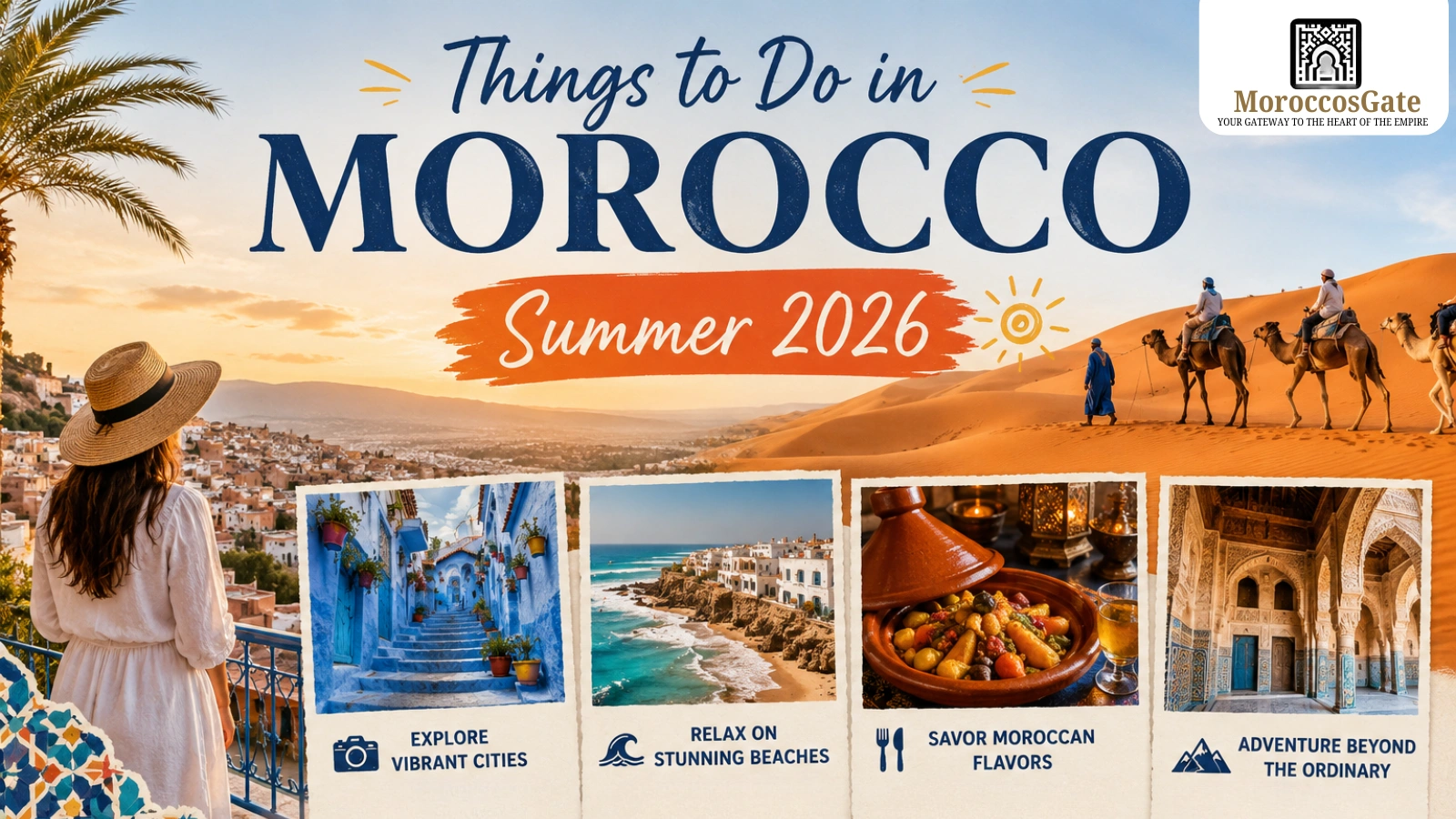
Things to Do in Morocco Summer 2026: The Ultimate Guide to Festivals, Culture & Adventure
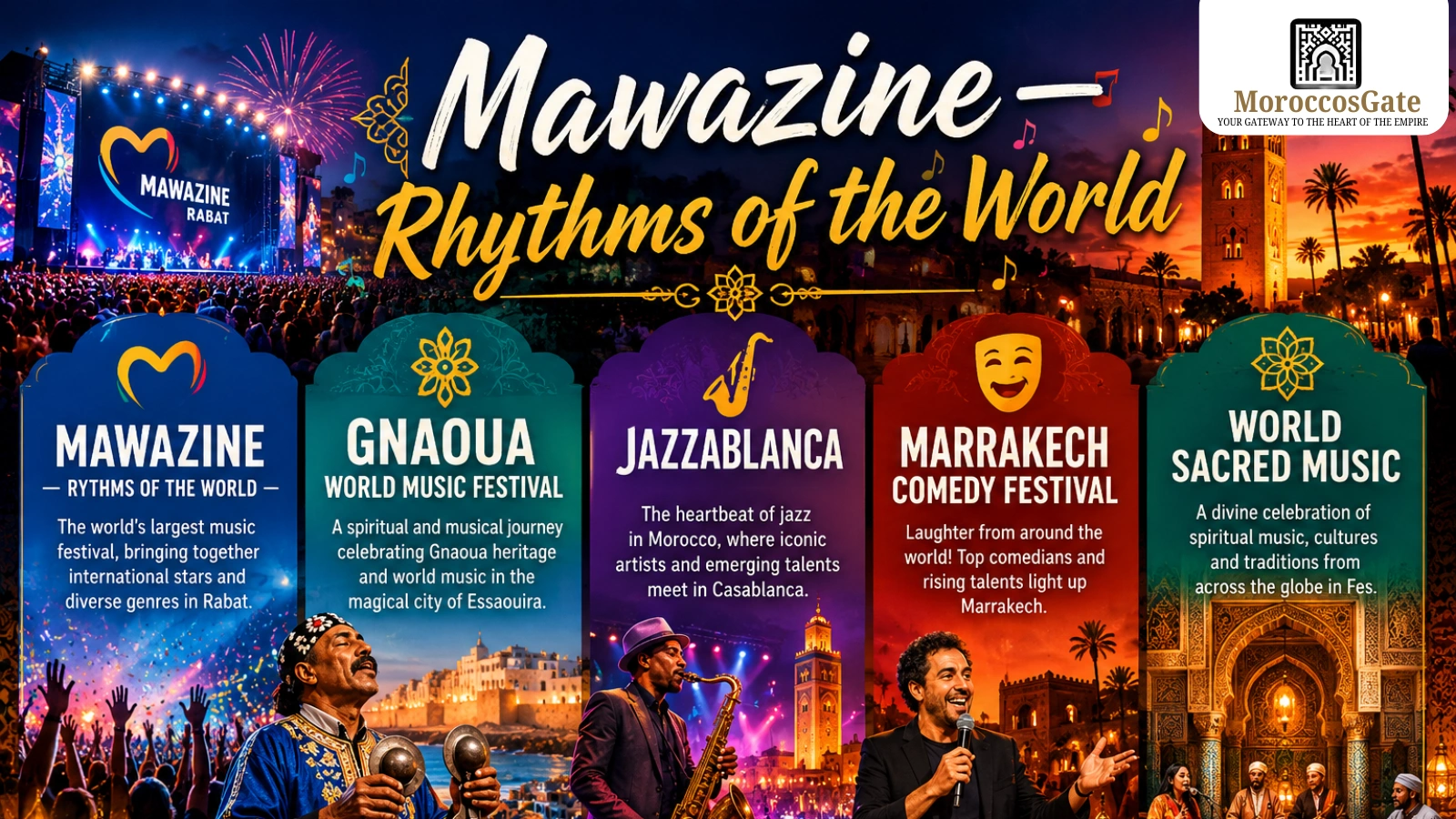
The best things to do in Morocco in summer 2026 include attending Mawazine (19–27 June, Rabat) — the world’s largest music festival with Major Lazer, Rema, Nicky Jam and millions of free concertgoers; the Gnaoua World Music Festival (25–27 June, Essaouira); the Fes Festival of World Sacred Music (4–7 June); the Marrakech Comedy Festival (4–6 June); and Jazzablanca (2–9 July, Casablanca) featuring Robbie Williams, Scorpions, Mika and Jorja Smith. Beyond festivals: Atlantic beach escapes in Agadir and Essaouira, Sahara Desert overnight treks, Atlas Mountains hiking, medina exploration in Fes and Marrakech, and coastal road trips from Tangier to Agadir.
Morocco in summer is a destination that divides sharply across its geography — and that division is precisely what makes it so richly rewarding for those who understand it. Inland cities bake under temperatures that can exceed 40°C. But the Atlantic coast sits under a cooling ocean current that keeps Essaouira, Agadir, and Casablanca in comfortable low-to-mid-20s throughout July and August. And the High Atlas Mountains offer crisp, fresh air and extraordinary trekking conditions at altitude.
Layer on top of that geography one of the richest festival calendars of any country in the world — Mawazine, Gnaoua, Jazzablanca, the Fes Sacred Music Festival, the Marrakech Comedy Festival, the free Timitar in Agadir, the Moga Festival in late September — and Morocco in summer becomes not merely a holiday destination but a cultural event of global significance.
This guide covers every major summer festival and cultural event in Morocco in 2026, alongside the best non-festival activities, city-by-city guides, and practical planning advice to help you make the most of the season. For the year-round festival picture and detailed guides to individual events, see our complete Morocco Music Festivals 2026 guide and our Morocco Summer Beach Festivals guide.

Morocco Summer 2026: Complete Events Calendar at a Glance
| Date | Event | Location | Admission | Vibe |
|---|---|---|---|---|
| 30 May 2026 | Beyond Fears Festival | LODGE K Hotel, Marrakech | Ticketed | Electronic / boutique |
| 4–6 June 2026 | Marrakech Comedy Festival | Palais des Congrès, Marrakech | Ticketed | Comedy / francophone |
| 4–7 June 2026 | Fes Festival of World Sacred Music | Bab Makina & venues, Fes | Ticketed (some free) | Sacred / spiritual / world music |
| 6 June 2026 | Sacred Music Sufi concert (Sanam Marvi & Léon Phal) | Jardin Jnan Sbil, Fes | Ticketed | Sufi / sacred |
| 18 June 2026 | Nostalgia Festival | Velodrome Park, Casablanca | Ticketed | Nostalgia / pop |
| 19–27 June 2026 | Mawazine — Rhythms of the World | OLM Souissi & stages, Rabat/Salé | Mostly free | Global / pop / hip-hop / Arabic |
| 25–27 June 2026 | Gnaoua World Music Festival | Moulay Hassan Sq, Essaouira | Free (intimate venues ticketed) | Gnawa / jazz / fusion / UNESCO |
| 26 June 2026 | The Moment Showcase (WhoMadeWho) | Chez Ali, Marrakech | Ticketed | Electronic / dance |
| 2–9 July 2026 | Jazzablanca — 19th Edition | Anfa Park & Arab League Park, Casablanca | Ticketed | Jazz / pop / rock / world |
| Mid-July 2026 | Festival Timitar | Agadir | Free | Amazigh heritage / world music |
| Mid-July 2026 | Morocco Beach Festival (21st Ed.) | M’diq, Nador, Tangier | Free | Coastal / family / community |
| Mid-July 2026 | Festival Alegria | Chefchaouen | Free / low cost | Culture / arts / music |
| 30 Sept–4 Oct 2026 | Moga Festival | Essaouira (Atlantic beach) | Ticketed | Electronic / wellness / art |
The Big Four: Morocco’s Premier Summer Events in 2026
1. Mawazine — Rhythms of the World, Rabat: 19–27 June 2026
Why it matters
If you only attend one event in Morocco this summer, make it Mawazine. The 21st edition of Mawazine — Rhythms of the World runs from 19 to 27 June 2026 across Rabat and Salé, and it is one of the most extraordinary musical spectacles on the planet. Mawazine 2025 attracted 3.75 million attendees over nine days — a figure that puts Glastonbury, Coachella, and every other major international festival in the shade. And the overwhelming majority of that audience attended for free.
This is the fundamental distinction of Mawazine that no other festival in the world replicates at this scale: most of its concerts — spread across multiple outdoor stages in Rabat and Salé — are entirely free and open to everyone. You do not need a wristband, a campsite booking, or a £300 ticket. You turn up and the music starts.
2026 Lineup — Confirmed Artists
The 21st edition lineup is one of the most diverse and ambitious in Mawazine’s history, spanning global pop, hip-hop, Afrobeats, electronic, reggaeton, Arab classical, and Moroccan music traditions simultaneously:
- ITZY — the K-pop sensation, marking a rare African appearance
- Major Lazer — the global electronic and dancehall supergroup (OLM Souissi, 20 June)
- Nicky Jam — Latin reggaeton star (OLM Souissi, 22 June)
- Rema — Nigerian Afrobeats sensation (Souissi venue, 24 June)
- Tyga — American hip-hop artist
- Ninho — the dominant figure of streaming-era French rap, headlining the opening night (19 June)
- Tamer Hosny — Egyptian pop legend, closing the festival (27 June)
- Oumou Sangaré — Malian wassoulou singing icon
- Dee Dee Bridgewater — American jazz legend
- Hatim Ammor — Morocco’s leading contemporary pop star (Nahda stage, 24 June)
- Asmaa Lamnawar — beloved Moroccan vocalist (22 June)
- Mayada El Hennawy — Syrian classical Arab song icon, opening the Mohammed V Theatre programme
- Lotfi Bouchnak — Tunisian classical Arab music legend (Mohammed V Theatre, 25 June)
- Diamond Platnumz, Ty Dolla Sign, Dionne Warwick, Imany, Samira Said, Manal Benchlikha — plus dozens more across nine stages
The Chellah archaeological site — a Roman and medieval ruin of extraordinary atmosphere — hosts intimate world music and African artist performances throughout the festival, including Senny Camara with her kora-driven West African sound (20 June, 5:30 PM).
Practical Information for Mawazine 2026
- Free concerts: The community stages (Nahda, Bouregreg, Salé Beach, Chellah) are entirely free — no ticket needed. Arrive early for headline shows.
- Ticketed shows: OLM Souissi headline concerts and Mohammed V Theatre shows require tickets. Purchase at mawazine.ma.
- Getting there: Direct flights from Dublin to Rabat (RBA) or Casablanca (CMN, 45 minutes by Al Boraq train). Book accommodation 3–4 months ahead.
- Best strategy: Spend 3–4 days in Rabat around Mawazine. Explore the Kasbah des Oudayas, the Chellah, and the medina by day — attend concerts by night. Then travel to Essaouira for Gnaoua the following weekend (25–27 June overlap).
2. Gnaoua World Music Festival, Essaouira: 25–27 June 2026
Why it matters
The 27th edition of the Gnaoua World Music Festival takes place 25 to 27 June 2026 in Essaouira — overlapping with the final days of Mawazine in a way that makes a strategic combined trip entirely feasible. While Mawazine is global in its ambitions, Gnaoua is rooted: this is a festival built around a specific musical tradition, Gnawa music, which UNESCO recognised as Intangible Cultural Heritage of Humanity in 2019.
Gnawa music — originating in sub-Saharan Africa and deeply embedded in Moroccan spiritual life — uses the guembri (a three-stringed bass lute), qraqeb (iron castanets), and call-and-response chanting to create trance-inducing ceremonial performances of extraordinary power. The festival brings together the finest Gnawa master musicians — the maalems — and pairs them with international jazz, blues, soul, and world music artists in improvised fusions that are genuinely unpredictable and genuinely extraordinary. The 2026 edition features over 400 artists, including 42 maalems.
The 2026 theme is “port cities” — artists coming from maritime regions shaped by cultural exchange, from Lebanon and Cameroon to Brazil, the United States, India, Ethiopia, and Palestine. Confirmed acts include 47SOUL, Yasmine Hamdan, Hoba Hoba Spirit, and Oudaden, alongside the Gnawa maalems at the heart of the programme.
Beyond the main stage at Moulay Hassan Square (free), intimate concerts take place at historic venues including Zaouia Issaoua, Zaouia Sidna Blal, Bayt Dakira, and Dar Souiri (250 MAD per evening). These smaller shows — where a maâlem and a jazz musician sit facing each other in a candlelit courtyard with fifty people watching — are the spiritual heart of the festival and worth every effort to attend.
The Berklee at the Gnaoua programme runs from 22–27 June 2026, offering music workshops and collaborative performances for professional and semi-professional musicians. If you play an instrument and have intermediate to advanced skills, this immersive music education programme is one of the most remarkable experiences available anywhere in the world.
Practical Tips for Gnaoua 2026
- Book accommodation immediately. Essaouira is a small city and fills completely during Gnaoua. Book months in advance — the best medina riads for late June 2026 are already filling.
- Getting there: Fly into Marrakech (RAK) and take a CTM bus or private transfer (2.5–3 hours). Many visitors travel from Rabat/Casablanca after Mawazine.
- Free vs paid: Main stage (Moulay Hassan Square) is free. Historic venue concerts are 250 MAD per night — buy these in advance as they sell out.
- Evening timing: Pack a light jacket — Essaouira’s Atlantic wind makes June evenings cooler than you expect.
For our complete Gnaoua Festival guide, see the dedicated section in our Morocco Music Festivals 2026 guide.
3. Jazzablanca, Casablanca: 2–9 July 2026
Why it matters
Jazzablanca’s 19th edition runs from 2 to 9 July 2026 at Anfa Park and Arab League Park in Casablanca, and it has assembled one of the most impressive international lineups the festival has ever staged. Named the best event in Morocco at the 2025 national event awards, Jazzablanca has grown from a boutique jazz gathering into an eight-night multi-genre spectacular that positions Casablanca alongside the great music capitals of the world.
Confirmed 2026 headliners include Robbie Williams (making his Morocco debut), Scorpions (celebrating 60 years of career with a rare Africa performance), Mika, Jorja Smith, Juanes, Cory Wong, Hiromi, Fantastic Negrito, and many more across the eight nights.
The 2026 edition expands to four concerts per evening, across Anfa Park (main outdoor amphitheatre), Arab League Park, and intimate club venues throughout Casablanca. This format allows you to see extraordinarily different artists on the same night — a jazz piano virtuoso in an intimate club at 8 PM, followed by a stadium pop headliner at 10 PM. The range is unmatched by any comparable festival.
For our complete Jazzablanca guide and the full lineup breakdown, see our Morocco Summer Beach Festivals 2026 guide.
Practical Tips for Jazzablanca 2026
- Book headline tickets early: The Robbie Williams and Scorpions shows at Anfa Park will sell out. Purchase at jazzablanca.com as soon as on sale.
- Stay in Casablanca for 3–4 nights: The city rewards multiple evenings — different venues, different genres, different energy each night.
- Beach days: Casablanca’s Ain Diab beach is 10 minutes by taxi. Spend festival afternoons on the Atlantic before heading to evening concerts.
- Combine with Gnaoua: Travel from Casablanca to Essaouira (2.5 hours) at the end of Jazzablanca week for a complete Atlantic Morocco music experience.
4. Marrakech Comedy Festival: 4–6 June 2026
Why it matters
Morocco’s most anticipated comedy event is back in 2026 in a completely new format. The Marrakech Comedy Festival — the rebranded successor to the iconic Marrakech du Rire founded by Jamel Debbouze — returns on 4, 5, and 6 June 2026 at the Palais des Congrès in Marrakech. The announcement on 25 March 2026 marked the official end of a four-year absence that followed the cancellation of multiple editions.
The festival is now led by Malik Bentalha — French-Moroccan comedian and long-time figure of francophone comedy — who has brought a fresh vision while honouring the spirit of the original. The new venue (Palais des Congrès, capacity approximately 3,000, with better acoustics and technical infrastructure than the El Badi Palace) signals a more professional, polished production. The programming promises a more diverse mix of French, Moroccan, and international comedians. Tickets have been available through Fnac Spectacles since 25 March 2026.
For fans of francophone comedy, the Marrakech Comedy Festival is genuinely unmissable — a chance to see the cream of French and Moroccan stand-up performed live in one of the world’s most beautiful cities, at one of its finest times of year (June in Marrakech is warm, not yet brutal, and the evenings are perfect). The three-day format means a short trip from Ireland or the UK is entirely feasible around the festival.
Practical Tips for Marrakech Comedy Festival 2026
- Dates: 4–6 June 2026, Palais des Congrès, Marrakech.
- Tickets: Available via Fnac Spectacles. Book well ahead — capacity is approximately 3,000 per night and the return of the festival after four years has generated enormous demand.
- Language: Performances are primarily in French. Some Moroccan dialect (Darija) content. Minimal English programming.
- Combine with: The Fes Sacred Music Festival (4–7 June, Fes) — Marrakech and Fes are a 3.5-hour train journey apart, making it feasible to attend both in a single week-long trip.
The Fes Festival of World Sacred Music: 4–7 June 2026
Running at the same time as the Marrakech Comedy Festival, the 29th edition of the Fes Festival of World Sacred Music (4–7 June 2026) is one of the world’s most spiritually resonant cultural events — and one of the finest experiences available in Morocco in the entire year. Held at Bab Makina (the vast floodlit plaza in front of the Royal Palace gates), Jnan Sbil Gardens, and historic venues throughout Fes el-Bali, the festival features more than 160 artists across 18 main performances on the theme “Fes and the Mâalemines: Guardians of the Gesture and Heritage.”
The 6 June 2026 concert at Jardin Jnan Sbil features Sufi singer Sanam Marvi and French multi-instrumentalist Léon Phal — a programme of sacred Sufi music from Pakistan alongside French improvised sound, in one of Morocco’s most beautiful garden settings. This kind of intentional intercultural dialogue is what the Fes Festival does uniquely well.
For travellers planning a Morocco trip in early June, combining the Fes Sacred Music Festival with the Marrakech Comedy Festival on either side of a train journey is one of the finest one-week Morocco itineraries available. For everything you need to plan both, see our full guide to Fes cultural events and Morocco active tourism 2026.
Beyond the Festivals: The Best Non-Festival Things to Do in Morocco in Summer 2026
Atlantic Beach Escapes: Essaouira, Agadir & Taghazout
Morocco’s Atlantic coast is the secret that regular Morocco travellers have known for decades: while Marrakech bakes at 40°C in July, Essaouira basks at a breezy 22°C, Agadir sits at a perfect 26°C, and Taghazout’s surfers are catching Atlantic rollers in the warmth of a North African summer morning without the remotest need for a wetsuit.
Essaouira in summer is incomparable. The medina’s blue-and-white ramparts, the sweeping Atlantic beach, the wind that the Portuguese called the Alize and that has powered the city’s character for centuries — all of this is at its most vivid in summer. The June festivals (Gnaoua, 25–27 June; Moga, coming in late September/October) bookend a summer season of genuine pleasure. Spend a week in Essaouira in July and you will understand why generations of artists, writers, and musicians have made it their home.
Agadir is Morocco’s most developed beach resort and its most straightforward summer destination. Ten kilometres of gently sloping Atlantic sand, a well-developed Corniche with excellent seafood restaurants, direct flights from Dublin year-round, and the free Festival Timitar in mid-July (over a million attendees, three stages, Amazigh and world music) make Agadir the perfect package for those who want beach plus culture without complexity. For our full Agadir and Timitar guide, see our Morocco Summer Beach Festivals 2026 guide.
Taghazout (20 minutes north of Agadir) is Morocco’s surf capital — a small fishing village that has evolved into one of Africa’s premier surf destinations without losing the low-key atmosphere that makes it so appealing. Summer brings consistent Atlantic swell, warm water, and the particular pleasure of surfing in a landscape that looks nothing like Cornwall or the Basque Country but somehow feels equally at home.
Explore Morocco’s Ancient Medinas — Fes and Marrakech
Summer is not the obvious choice for Marrakech — the July heat is genuinely fierce, and the city is at its most comfortable in April and October. But the Marrakech of early morning in summer has a particular quality: the souks before 9 AM, when traders are setting up and the light through the medina alleyways is cool and long, and the Jemaa el-Fna is still quiet, are among the finest walking experiences in Morocco. Summer strategy for Marrakech: early mornings and evenings, with a midday retreat to a riad rooftop or a hammam.
Fes, with its slightly higher altitude, is more manageable in summer than Marrakech — and June in Fes, timed around the Sacred Music Festival, offers excellent conditions for exploring the medina. The Chouara tanneries are at their most photogenic in the early morning light of a summer day. The Bou Inania madrasa, the Kairouyine University, the Nejjarine Museum — all of these reward the traveller who arrives before the midday heat builds.
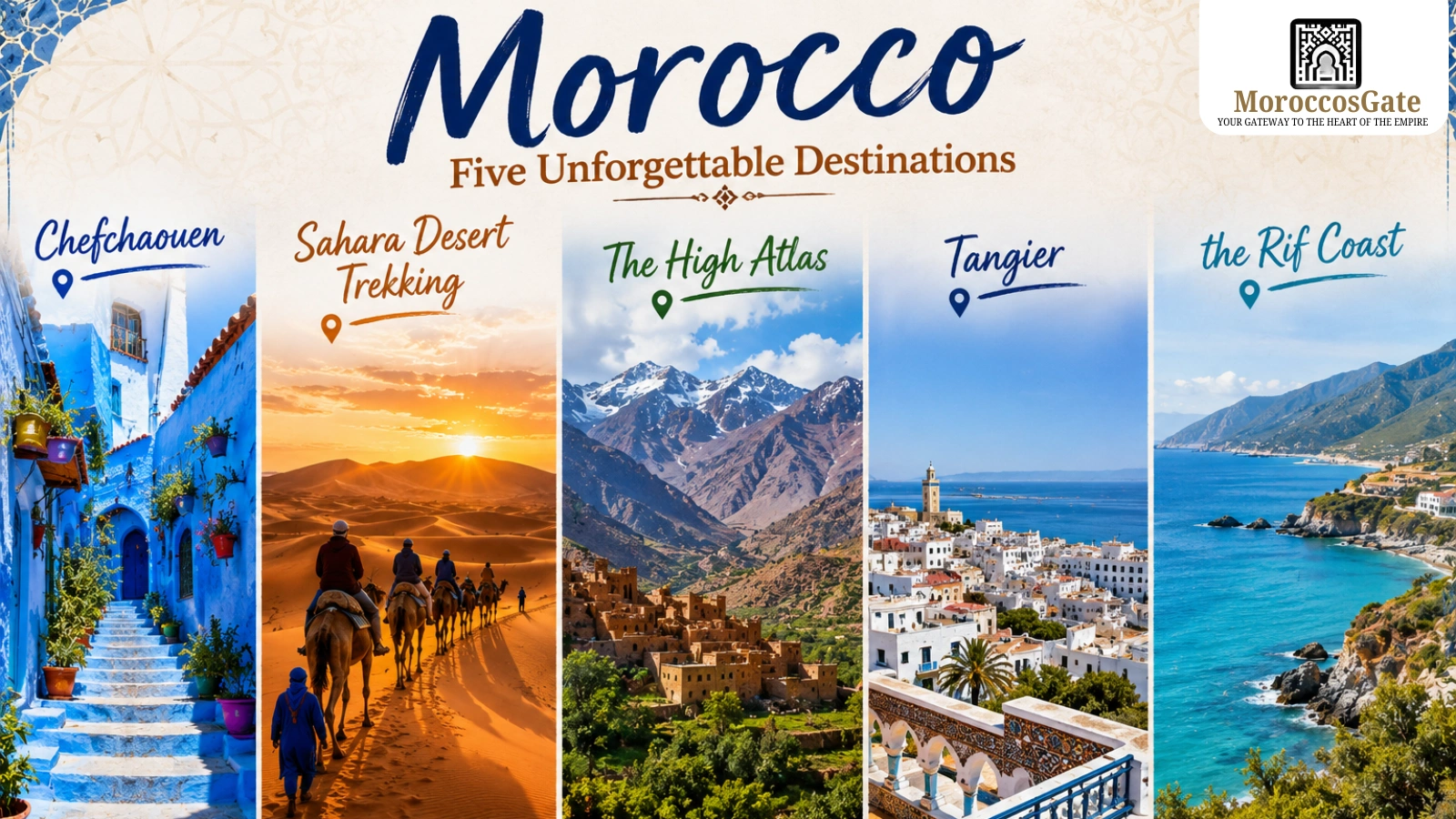
Chefchaouen: The Blue City in Summer
At an altitude of around 600 metres in the Rif Mountains, Chefchaouen stays comfortably below the temperatures of the coastal plains in summer — typically 26–32°C, with cool evenings. The blue-painted alleyways are arguably more beautiful in the long golden light of summer evenings than at any other time of year. The Festival Alegria in mid-July adds a music and cultural programme to the usual pleasures of the city.
Early morning photography in Chefchaouen in July, before the day-tripper buses arrive from Tangier, is one of Morocco’s finest photographic experiences — the blue walls, the flower pots, the morning light, the silence broken only by the adhan. A two-night stay in a small medina riad in Chefchaouen in summer is one of Morocco’s most rewarding short breaks.
Sahara Desert Trekking: The Summer Caveat
The Sahara in July and August is extraordinary — vast, silent, visually magnificent — but temperatures regularly exceed 43°C, making daytime outdoor activities genuinely hazardous. For summer Sahara visits, the practical approach is to travel in the early morning and evening only, stay in well-ventilated desert camps with shade, and plan any camel trekking for sunrise or sunset rather than midday.
The better advice, if you have flexibility: visit the Sahara in spring (March–May) or autumn (September–November) when conditions are perfect. If your trip is fixed in summer, Ouarzazate — the “gateway to the Sahara” — and the extraordinary landscapes of the Dades Valley and Todra Gorge offer summer-safe alternatives to the full desert experience. These dramatic red-rock gorges and ancient kasbah landscapes are fully accessible year-round and retain their extraordinary character without the extreme heat of the open dune fields further south.
The High Atlas: Trekking and Berber Villages
Morocco’s High Atlas Mountains in summer offer some of the finest trekking conditions in North Africa. Mount Toubkal (4,167m — North Africa’s highest peak) is fully accessible in summer on the classic 2-day guided trek from Imlil, and the lower valleys of the Ourika and Azzaden are lush, green, and genuinely beautiful in July and August. Day trips from Marrakech to Imlil, the Ourika Valley waterfalls, or the Berber market at Asni (Saturdays) are among the best escapes from the city heat.
Our complete guide to the Toubkal hike and Atlas Mountains active tourism covers everything you need to plan a summer mountain experience from Marrakech.
Northern Morocco: Tangier, Chefchaouen & the Rif Coast
Northern Morocco is magnificent in summer — and significantly less visited by international tourists than the south. Tangier, where the Atlantic meets the Mediterranean, has cool sea breezes and a fascinating cultural heritage that rewards slow exploration. The Rif coastline between Tetouan and M’diq offers some of Morocco’s most beautiful Mediterranean beaches. The free Morocco Beach Festival events (mid-July through August) bring music to the seafront at M’diq, Nador, and Tangier, creating a genuine festive atmosphere along a coast that most European visitors drive straight past en route to Marrakech.
A northern Morocco summer itinerary — Tangier, Chefchaouen, Tetouan, M’diq, Fes — offers a completely different and genuinely authentic Morocco that is an excellent complement or alternative to the more-travelled south. See our Morocco hidden gems guide for specific recommendations throughout the north.
Summer in Morocco: Practical Planning Guide
What to Expect Weather-Wise
| City | June Avg | July Avg | August Avg | Verdict |
|---|---|---|---|---|
| Casablanca | 22–26°C | 23–27°C | 24–28°C | ✅ Comfortable year-round |
| Essaouira | 20–24°C | 20–24°C | 20–24°C | ✅ Morocco’s coolest summer city |
| Agadir | 22–26°C | 24–28°C | 25–28°C | ✅ Perfect beach weather |
| Tangier / M’diq | 22–28°C | 24–30°C | 25–30°C | ✅ Mediterranean breezes |
| Rabat | 22–28°C | 24–30°C | 25–30°C | ✅ Good for Mawazine evenings |
| Chefchaouen | 24–30°C | 26–32°C | 26–32°C | ✅ Altitude keeps it manageable |
| Fes | 25–33°C | 30–38°C | 30–38°C | ⚠️ Hot — early mornings only in July/Aug |
| Marrakech | 28–36°C | 32–40°C | 32–40°C | ⚠️ Very hot — mornings and evenings only |
| Sahara (Merzouga) | 32–40°C | 36–45°C | 36–44°C | ❌ Extreme — avoid midday in July/Aug |
The Summer Morocco Packing List
- Light, breathable clothing: Linen, cotton, lightweight layers. Avoid synthetics in the heat.
- A light jacket or cardigan: For Atlantic coast evenings (Essaouira, Casablanca, Agadir) and late-night outdoor festival stages.
- Factor 50 sunscreen: Reapply religiously. UV intensity in Morocco in summer is significantly higher than in Ireland or the UK.
- Comfortable walking shoes: Festival grounds mix sand, cobblestone, and grass. Trainers beat sandals for long nights.
- Reusable water bottle: Stay hydrated — Morocco’s summer heat dehydrates fast, especially if you are standing at outdoor festival stages.
- Modest cover-up for medinas: Covering shoulders and knees in traditional areas is respectful and appropriate year-round.
- Cash (Moroccan Dirhams): Many festival food stalls, smaller venues, and souk vendors are cash-only. Always have dirhams available.
- Portable charger: Long festival days drain phone batteries fast. A good power bank is invaluable.
Budget Guide for Morocco Summer 2026
Morocco remains outstanding value by European standards in summer 2026, even with price increases driven by the tourism boom and World Cup preparation. For detailed budget guidance, see our comprehensive Morocco tourism boom 2026 guide. In brief:
- Budget traveller (hostel, street food, free festivals): £30–£50 per day
- Mid-range traveller (riad, restaurant meals, ticketed shows): £70–£120 per day
- Festival spending: Mawazine (mostly free), Gnaoua main stage (free), Jazzablanca headline shows (£25–£90 per show), Marrakech Comedy Festival (£30–£70 per night)
- Return flights Dublin–Morocco summer 2026: £80–£220 depending on city and booking date
The Morocco’s Gate Summer Recommendation
From a decade of attending Morocco’s festivals and advising travellers from Ireland, our honest summer 2026 recommendation is this: build your trip around the late June sweet spot. The Fes Sacred Music Festival (4–7 June) and Marrakech Comedy Festival (4–6 June) open the summer cultural season. Then Mawazine (19–27 June, Rabat) and Gnaoua (25–27 June, Essaouira) overlap in the final week of June in a way that makes a combined Rabat-Casablanca-Essaouira trip extraordinary value and extraordinary experience. Follow that immediately with Jazzablanca (2–9 July, Casablanca) for the full spectrum of Morocco’s summer musical culture.
This is a genuinely exceptional cultural travel window — one that no other country on a short-haul flight from Ireland can match for the combination of quality, diversity, and affordability of experiences it offers. Morocco in summer 2026 is the best it has ever been, and it is still the best value it will ever be. For the full context of why visiting now is smarter than waiting, see our article on visiting Morocco before the 2030 World Cup.
Frequently Asked Questions — Things to Do in Morocco Summer 2026
Q. What are the best things to do in Morocco in summer 2026?
A. The best summer 2026 experiences in Morocco include Mawazine (19–27 June, Rabat), the Gnaoua World Music Festival (25–27 June, Essaouira), Jazzablanca (2–9 July, Casablanca), the Marrakech Comedy Festival (4–6 June), the Fes Sacred Music Festival (4–7 June), Atlantic beach holidays in Agadir and Essaouira, Atlas Mountains trekking from Marrakech, and coastal road trips along the northern Mediterranean coast.
Q. When is Mawazine 2026?
A. Mawazine — Rhythms of the World 2026 runs from 19 to 27 June across Rabat and Salé. The 21st edition features ITZY, Major Lazer, Rema, Nicky Jam, Tyga, Ninho, Tamer Hosny, Dee Dee Bridgewater, Oumou Sangaré, and many more across nine free and ticketed stages. Most concerts are free.
Q. When is the Gnaoua World Music Festival 2026?
A. The 27th edition of the Gnaoua World Music Festival takes place 25 to 27 June 2026 in Essaouira, Morocco. The main stage at Moulay Hassan Square is free. Intimate historic venue concerts cost 250 MAD per evening. Over 400 artists including 42 maalems perform across three days.
Q. When is Jazzablanca 2026?
A. Jazzablanca 2026 runs from 2 to 9 July in Casablanca at Anfa Park and Arab League Park. The 19th edition features Robbie Williams, Scorpions, Mika, Jorja Smith, and Juanes among many confirmed headliners across eight nights of jazz, pop, rock, soul, and world music.
Q. What happened to Marrakech du Rire in 2026?
A. After four years of absence, Marrakech du Rire has returned under a new name — the Marrakech Comedy Festival — and new leadership. Led by comedian Malik Bentalha, the 2026 edition runs 4–6 June at the Palais des Congrès in Marrakech. Tickets are available through Fnac Spectacles.
Q. Is Morocco good for a beach holiday in summer 2026?
A. Yes — the Atlantic coast is Morocco’s ideal summer beach destination. Essaouira (20–24°C), Agadir (24–28°C), and Casablanca (22–26°C) are all comfortably cool thanks to the Atlantic Canaries Current. Inland cities like Marrakech are much hotter (32–40°C in July) and are better visited in early morning and evening in summer.
Q. Can I attend multiple Morocco summer festivals in one trip?
A. Yes — and the 2026 calendar makes it ideal. The Fes Sacred Music Festival (4–7 June) and Marrakech Comedy Festival (4–6 June) open the season. Mawazine (19–27 June) and Gnaoua (25–27 June) overlap in the final week of June. Jazzablanca follows immediately (2–9 July). A 14–16 day trip covering Fes, Rabat, Essaouira, and Casablanca can take in all four major events.
Q. What is the weather like in Morocco in June and July 2026?
A. On the Atlantic coast (Casablanca, Agadir, Essaouira) and in Rabat, summer temperatures are comfortable at 20–28°C — ideal for outdoor festivals and beach days. Inland cities like Marrakech and Fes are significantly hotter (32–40°C in July). The Rif Mountains, including Chefchaouen, stay cooler at altitude (26–32°C).
Start Planning Your Morocco Summer 2026 Trip
Morocco’s summer 2026 offers an extraordinary combination of world-class music festivals, Atlantic beach escapes, ancient medina exploration, mountain adventures, and the particular warmth of a country that is genuinely proud to welcome the world — not least because the 2030 World Cup is coming and Morocco wants to show you exactly what it can do.
Morocco’s Gate has attended every festival on this list and knows every city, beach, and mountain trail covered in this guide. We are here to help you turn a list of events into an extraordinary trip — the right accommodation, the right tickets, the right itinerary connections, and the right moments that make the difference between a holiday and an experience you talk about for years.
- → Talk to our team and start planning your Morocco summer 2026 trip
- → Browse our curated Morocco travel deals
- → Read our complete Morocco Music Festivals 2026 guide
- → Read our Morocco Summer Beach Festivals 2026 guide
- → Read the Best Time to Visit Morocco 2026 guide
Morocco’s Gate is based between Dublin, Ireland, and Morocco. We have attended Mawazine on the Rabat riverfront at 1 AM as two and a half million people danced around us. We have sat in the Essaouira medina courtyard as a maâlem and a New Orleans jazz musician found each other’s musical language at midnight during Gnaoua. We have watched Robbie Williams sell out Anfa Park and walked out of a Jazzablanca jazz club in Casablanca at 3 AM with the Atlantic salt in the air. We plan these festivals, attend them, and share what we find — honestly, specifically, from genuine experience. Morocco’s Gate has been doing this since 2015.