
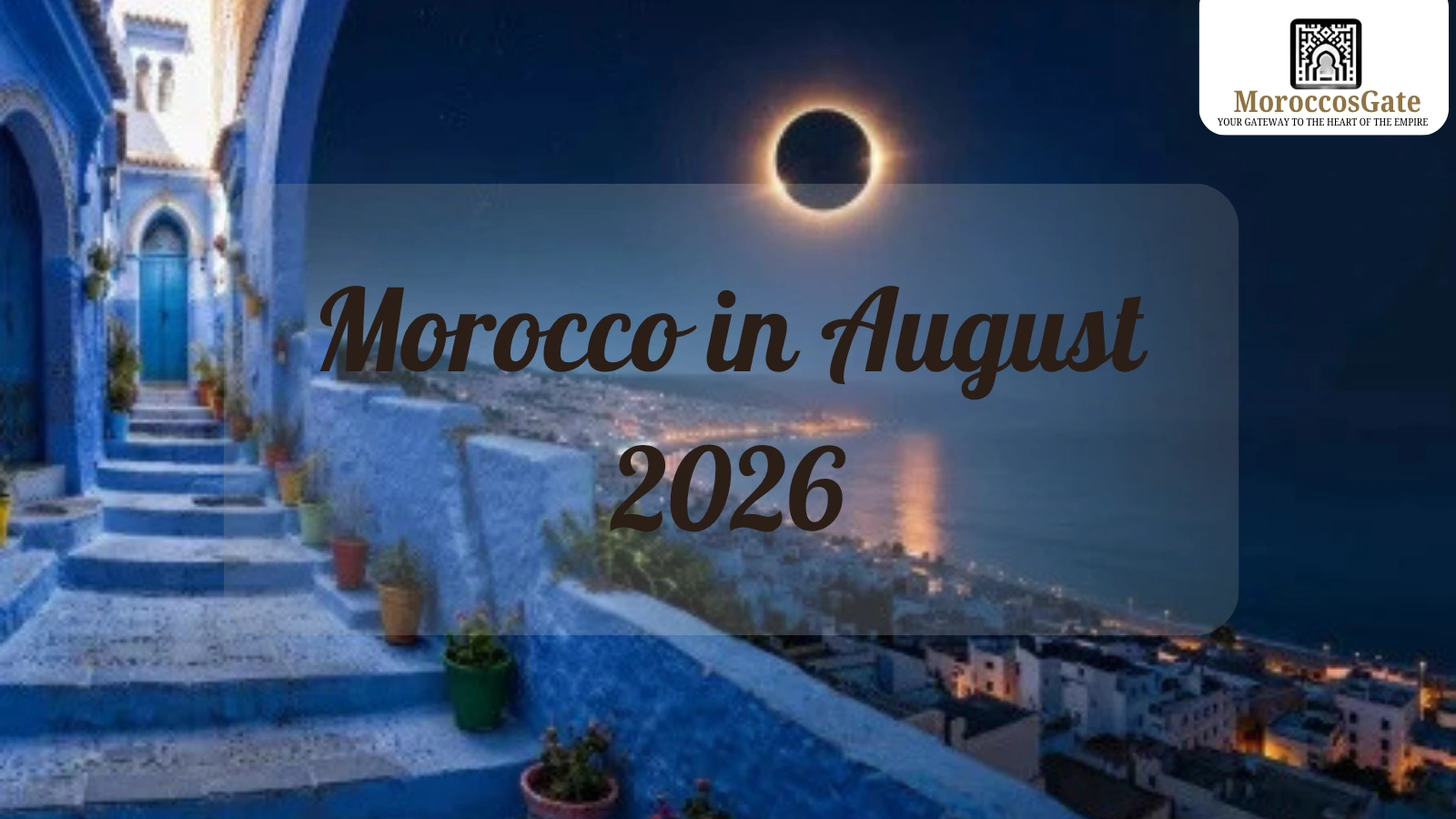
Morocco in August 2026: The Complete Travel Guide (What Nobody Tells You)
Quick Answer: August is Morocco’s hottest month — and one of its most rewarding, if you go to the right places. The Atlantic coast (Essaouira 22–26°C, Agadir 28–30°C) stays cool thanks to trade winds. The northern Rif mountains (Chefchaouen 29–33°C) are manageable and busy with Moroccan domestic tourism at its peak. The Middle Atlas (Ifrane, Azrou) offers genuine cool-weather escape. Inland cities — Marrakech 38–42°C, Fes 35–37°C — are doable only with strict morning-and-evening scheduling. The Sahara is off-limits entirely. August is also cheaper than spring and autumn at most inland hotels, and quieter at the major tourist landmarks. This guide tells you exactly how to make August work.
Affiliate Disclosure: This post contains affiliate links. If you book accommodation, tours, or travel services through links on this page, Morocco’s Gate may earn a small commission at no extra cost to you. We only recommend places and services we genuinely trust.
Is August a Good Time to Visit Morocco?
Let’s be honest from the first paragraph, because most articles about Morocco in August are not.
No sugarcoating: August is Morocco’s most challenging month for travel. Marrakech regularly exceeds 42°C. Merzouga can hit 48–50°C during afternoon hours. The Aït Benhaddou kasbah in direct August sun is an oven. Driving in a non-air-conditioned vehicle is dangerous. The medinas of Marrakech and Fes trap heat in their narrow covered streets from 10am to 7pm.
And yet, thousands of travellers visit Morocco in August every year — and many have excellent trips. The key is geography.
August is Morocco’s peak domestic tourism month. Moroccan families pour out of the cities and onto the northern beaches. The country is alive with a different energy — less international-tourist polished, more genuinely, joyfully Moroccan. The northern coast, the Atlantic shoreline, and the Atlas mountains are at their most vibrant. Hotel prices in the coastal towns are at their annual peak, while prices in the inland cities actually dip — because tour operators know the Sahara is off-limits and scale their Marrakech rates accordingly.
August is a great time to visit Morocco because it is not the high season (which is March to May and September to October) due to higher temperatures across the country. As a result, a visit in August will be cheaper and you’ll encounter fewer crowds at main tourist destinations, and fewer people on the beaches too.
The honest verdict: Morocco in August is excellent for coast-and-mountains travellers, genuinely challenging for those with inland-heavy itineraries, and completely wrong for anyone whose heart is set on the Sahara. Read this guide, plan your route accordingly, and August becomes one of Morocco’s most atmospheric months to visit.
Morocco Weather in August 2026 — Every Region
Understanding the temperature difference between Morocco’s regions in August is not a travel tip — it is a health and safety matter. The spread between the coolest and hottest locations in August can exceed 20°C on the same day.
August Temperature Table — Complete Regional Breakdown
| City / Region | August Day Temp | August Night Temp | Sea Temp | Verdict |
|---|---|---|---|---|
| Essaouira | 22–26°C | 17–20°C | 19–21°C | Excellent |
| Agadir | 28–30°C | 20–22°C | 20–22°C | Very good |
| Taghazout | 27–30°C | 19–21°C | 20–22°C | Very good |
| Tangier | 27–30°C | 21–23°C | 21–23°C | Very good |
| Chefchaouen | 29–33°C | 20–22°C | N/A | Good |
| Rabat | 27–30°C | 20–22°C | 20–22°C | Good |
| Casablanca | 27–29°C | 20–22°C | 21–23°C | Good |
| Ifrane / Atlas | 25–30°C (lower elev.) | 15–18°C | N/A | Good |
| Fes | 35–37°C | 21–23°C | N/A | Heat strategy needed |
| Marrakech | 38–42°C | 22–25°C | N/A | Heat strategy needed |
| Meknes | 34–37°C | 20–22°C | N/A | Heat strategy needed |
| Ouarzazate | 38–44°C | 22–26°C | N/A | Very challenging |
| Merzouga / Sahara | 45–50°C | 25–30°C | N/A | Avoid entirely |
What These Numbers Mean on the Ground
August in Morocco experiences warm temperatures, with average air temperatures ranging from 25°C to 40°C, while sea temperatures along the coast generally range between 21°C and 24°C.
Essaouira at 22–26°C means you can walk the medina at noon in a linen shirt without discomfort. You’ll want a light layer in the evening.
Marrakech at 38–42°C means that between 11am and 6pm, standing in direct sun is genuinely unpleasant and potentially dangerous for those not acclimatised. It does not mean you cannot visit — it means you visit on Morocco’s schedule, not a tourist timetable.
Interior cities at 35–42°C: Marrakech, Fes, and Meknes are only safe for outdoor activity before 11am and after 6pm.
The Sahara at 45–50°C means exactly what it sounds like. Do not visit under any circumstances in August.
August Sunshine and Rain
During August in Morocco, you can expect barely any rain throughout the country, with 10 hours of sunshine daily on average. This is genuinely useful for planning: you will have clear skies almost every day. Pack rain gear only if visiting the far north (Chefchaouen, Tangier) where occasional Atlantic weather systems can surprise.
The Best Places to Visit in Morocco in August
1. Essaouira — August’s Absolute Star
There is no debate about this. Essaouira is Morocco’s best August destination. The Atlantic coast from Agadir to Essaouira and Asilah sits at 25–28°C, cooled by the Alizé trade winds. The alizée — the Atlantic trade wind that blows in from the northwest — keeps Essaouira genuinely cool throughout summer. Coastal cities like Casablanca and Essaouira enjoy pleasant weather, with temperatures averaging around 25° to 28°.
The long Atlantic beach is perfect for kitesurfing, windsurfing, and walking, though the wind makes traditional sunbathing less comfortable than Agadir. The UNESCO medina is walkable all day. Fresh grilled sardines at the port cost 25 MAD. The blue-and-white alleyways, the ramparts over the crashing Atlantic, the art galleries, the surf schools — all at their most accessible in August.
What to book in advance: Essaouira’s riads fill in August, especially at weekends when Marrakech residents escape the heat. Book your accommodation 4–6 weeks ahead.
Getting there: 3-hour CTM bus from Marrakech (approximately 100 MAD / €9). Shared taxis from Marrakech take 2.5 hours and cost 120–150 MAD per seat.
2. Agadir — Best for Families and Beach Comfort
Morocco’s Atlantic coast is the highlight of August travel. Towns like Essaouira and Agadir enjoy refreshing sea breezes and temperatures around 22–28°C, perfect for beach activities and water sports.
Agadir’s 10-kilometre beach is Morocco’s most organised: summer lifeguards, beach parasols for hire, beach clubs, a long promenade of restaurants and cafés, and sea temperatures of 20–22°C — warm enough for extended swimming. Resort hotels with pools, direct international flights, and easy access to all facilities make Agadir the most straightforward Morocco beach choice for families.
The Agadir advantage in August: The city is specifically designed for summer heat. Every restaurant, hotel lobby, and shopping mall is air-conditioned. The beach itself is naturally cooled by Atlantic breezes. You can spend all day outdoors at Agadir without the heat strategy that Marrakech demands.
Getting there: Direct flights from Dublin, London, Amsterdam, Paris, and most European hubs to Agadir Al Massira Airport (AGA). Ryanair, EasyJet, and Royal Air Maroc all operate summer 2026 routes.
3. Chefchaouen — The Mountain Blue City
Chefchaouen in the Rif is comfortable at 32°C. Sitting at 600 metres altitude in the Rif Mountains, Chefchaouen hovers around 29–33°C in August — warm, but nowhere near the inland city heat. The mountain air is drier and fresher than the plains. Evenings cool to 20–22°C, making open-air terrace dinners genuinely pleasant.
August is Chefchaouen’s single busiest month. The north and Chefchaouen: peak for domestic Moroccan tourism. Chefchaouen, Tetouan, Martil, and the northern beaches fill with Moroccan families. Chefchaouen accommodation in particular should be booked ahead for August.
This crowds issue is real — the famous blue medina streets are noticeably busier than spring or autumn. But the energy is wonderful: Moroccan families from Casablanca and Rabat, children playing in the painted alleyways, rooftop cafés full of locals and visitors together. It is a different atmosphere from the quieter months, not a worse one.
Insider timing: Arrive Thursday or Friday and leave before Sunday. Weekends in Chefchaouen in August are genuinely crowded. Midweek is significantly more relaxed.
Getting there: Shared taxis from Tangier take 2 hours (60–80 MAD). CTM bus from Fes takes 4 hours. Chefchaouen has no airport — the closest is Tangier Ibn Battouta (TNG).
4. Tangier — Morocco’s Coolest Northern Gateway
August temperatures in northern Morocco, cities like Tangier and Tetouan, typically range from 22°C to 37°C, with coastal areas experiencing milder temperatures. Tangier sits at the junction of the Atlantic and Mediterranean, giving it the most naturally moderated August climate of any major Moroccan city outside Essaouira. Sea temperatures reach 21–23°C — warm enough for comfortable swimming at Plage Municipale and the beaches stretching east toward Malabata.
The city itself repays more time than most itineraries give it. The restored medina, the Grand Socco, the extraordinary Hafa Café (perched on a cliff above the Strait of Gibraltar, where the Atlantic meets the Mediterranean), the American Legation Museum, and the ferry connection to Spain all make Tangier an excellent August base for 2–3 days.
The Tangier–Asilah August circuit: Take the train south from Tangier to Asilah (45 minutes, 30 MAD) for the International Cultural Festival — murals being painted on the medina walls, evening concerts, Atlantic beach. Return to Tangier same day or stay overnight.
5. The Middle Atlas — Morocco’s Secret Cool Escape
The Atlas Mountains provide a refreshing escape from the heat, with temperatures around 20–25°C. This is Morocco’s most underused August option. The Middle Atlas town of Ifrane — dubbed “Morocco’s Switzerland” for its cedar forests, mock-European architecture, and alpine-feeling streets — sits at 1,650 metres altitude and rarely exceeds 25°C in August. Azrou, a nearby Berber market town with a famous cedar forest populated by Barbary macaque monkeys, reaches similar temperatures.
The cedar forests of the Middle Atlas are genuinely extraordinary in summer: cool, shaded, scented with pine resin, and home to monkeys that approach boldly for shared picnics. A day trip from Fes to Ifrane, Azrou, and the cedar forests costs 250–400 MAD by shared taxi for four and is one of the most refreshing experiences Morocco offers in August.
For hikers, the High Atlas around Imlil and the Toubkal basecamp reaches temperatures of 15–25°C at altitude in August — clear skies, long days, and dry trails make it prime trekking season.
6. Asilah — Atlantic Art Town at Its Annual Peak
August sees Morocco move to the coast. The whitewashed northern town of Asilah hosts its long-running International Cultural Festival, with mural painting, poetry readings, and concerts spilling into the medina’s painted alleyways.
Asilah in August is a genuinely special experience. The Atlantic coast location keeps temperatures around 25–28°C. The International Cultural Festival — now in its fifth decade — brings artists from across Morocco and the world to paint large-scale murals directly onto the whitewashed medina walls. Started in 1978 by two men who looked at Asilah’s crumbling walls and invited artists to paint them. You can watch the murals being created in real time, wander the Portuguese-era ramparts above the crashing Atlantic, attend free evening concerts in the medina squares, and eat some of Morocco’s freshest Atlantic seafood.
The Asilah Arts Festival is one of the longest-running arts festivals in Africa, held annually since 1978 in the picturesque Atlantic coastal town. Free to wander and watch artists at work.
Getting there: 45-minute train or bus from Tangier (30 MAD). Easy day trip or overnight.
7. Rabat — Morocco’s Underrated Capital
Rabat sits on the Atlantic coast and enjoys natural cooling from Atlantic breezes throughout summer. Coastal cities like Casablanca and Essaouira also enjoy pleasant weather in August. Rabat shares this coastal advantage, with August temperatures averaging 27–30°C — warm but very manageable. The UNESCO-listed medina, the Hassan Tower, the Chellah necropolis (remarkable at sunset), the Kasbah of the Udayas, and the Corniche beach make Rabat one of Morocco’s most complete city destinations. It is also the least tourist-pressured of the major Moroccan cities — almost all international visitors go to Marrakech and Fes, leaving Rabat’s historic sites refreshingly uncrowded even in August.
Where to Avoid in August
The Sahara Desert — An Absolute No
This point applies in July too but cannot be overstated. The Sahara Desert is extremely hot in August, with daytime temperatures often surpassing 45°C. Most desert camps in Merzouga close or severely curtail operations. The Sahara Desert is generally not recommended in August due to extreme daytime heat that can exceed 45°C. Most travelers postpone desert tours to spring or autumn.
Sand surface temperatures in the Sahara in August exceed 70°C. Even a 15-minute camel walk in these conditions is genuinely dangerous. Heat exhaustion and heat stroke are not theoretical risks — they are near-certainties for anyone not acclimated to extreme desert conditions. Plan your desert dream for October through April.
The alternative: If you want dramatic desert-adjacent scenery in August without the life-threatening heat, visit Aït Benhaddou — but go before 9am or after 5pm. The famous ksar (fortified village) that appeared in Game of Thrones and Gladiator offers the red-earth Saharan aesthetic from a car, with a brief outdoor walk in the early morning when temperatures are bearable.
Outdoor Marrakech Between 11am and 6pm
Marrakech is not a place to avoid in August — but the Marrakech between 11am and 6pm is. The medinas of Marrakech and Fes trap heat in their narrow covered streets from 10am to 7pm. The Jardin Majorelle in August afternoon sun is a 40°C oven even among the cacti. The souks, in their partially covered but inadequately ventilated alleyways, reach temperatures that drain energy rapidly.
The Marrakech that works brilliantly in August is the one that operates on a North African summer timetable: the medina between 8am and 10:30am when the light is golden and the souks are setting up; the riad pool or hammam from 11am to 5pm; Djemaa el-Fna from 7pm onwards when the square explodes into life, 100 food stalls fire up, storytellers take their positions, and the city enters its real August rhythm.
August vs July: What Is Actually Different?
Travellers often wonder whether to choose July or August. The differences are real but subtle.
| Factor | July | August |
|---|---|---|
| Temperature inland (Marrakech) | 38–40°C | 38–42°C |
| Temperature coast (Essaouira) | 22–26°C | 22–26°C |
| International tourists | Highest | Slightly lower |
| Moroccan domestic tourism | High | Highest (peak) |
| Riad prices inland | Standard peak | Often 10–20% lower |
| Coastal hotel prices | High | Highest |
| Asilah Arts Festival | Starts late July | In full swing |
| National holidays | Throne Day (Jul 30) | Revolution Day (Aug 20) |
| School holidays (Europe) | Full | Full |
| Surf conditions | Flat | Flat (surf season Oct–Apr) |
The practical conclusion: August and July are very similar on the Atlantic coast and in the mountains. August is marginally hotter inland and brings Morocco’s domestic tourism to its absolute peak — particularly in the north. If your itinerary is coast-and-mountains, either month works excellently. If you are choosing between the two specifically for Marrakech, July is marginally cooler and slightly less expensive.
Morocco in August: Festivals and Events 2026
August is one of Morocco’s richest cultural months, concentrated primarily on the northern coast.
Asilah International Cultural Festival
The Asilah Arts Festival is one of the longest-running arts festivals in Africa, held annually since 1978. Artists from around the world descend on the whitewashed Atlantic town of Asilah to paint giant murals on its medina walls. Concerts, poetry readings and theatre alongside the art festival. Attendance: 50,000+ over the full programme.
Entry: Free for public murals and street art; some ticketed events.
This is Morocco’s finest August cultural event. The festival runs for approximately three weeks, with the visual art component (murals being painted live on medina walls) visible every day. Evening concerts in the main square are free and atmospheric. The town’s Portuguese ramparts, the medina, the beach — all add up to one of Morocco’s most complete August experiences.
Practical note: Asilah accommodation fills completely during the festival’s main week. Book at least 6–8 weeks in advance, or stay in Tangier (45 minutes away) and day-trip.
Revolution Day — August 20 (National Holiday)
August 20 is a national holiday commemorating the 1953 uprising against French colonial rule, when Moroccan nationalists united behind exiled Sultan Mohammed V. Celebrations include patriotic parades, public speeches, and cultural events honoring the country’s struggle for independence.
This is a genuine national celebration rather than a tourist event — but it creates wonderful atmosphere in city squares and medinas, with Moroccan families out in force. Banks and government offices close; most tourist sites remain open.
Moussem Moulay Abdellah Amghar — August
One of Morocco’s traditional religious pilgrimages (moussems), held each August on the Atlantic coast between El Jadida and Essaouira. The moussem is primarily a Moroccan cultural and religious event centred on horse fantasia displays (Tbourida) — the thunder of dozens of horsemen charging in formation, firing rifles simultaneously into the air — combined with folk music, markets, and communal celebration. Visitors are welcome to observe respectfully.
Imilchil Marriage Festival — Late August / Early September
The Imilchil Marriage Festival takes place near the quiet village of Imilchil near a tranquil lake in the Middle Atlas Mountains. Up to 30,000 residents of the local region arrive on their horses, donkeys and camels and camp out in their Berber tents to take part in the year’s festivities. Dates shift slightly each year with the Amazigh calendar — check exact 2026 dates locally. The festival offers one of the most extraordinary windows into Berber mountain culture available to visitors, in a setting — the High Atlas plateau above 2,000 metres — that is genuinely cool and dramatic in late August.
How Much Does Morocco Cost in August 2026?
August pricing in Morocco has a clear split: coastal destinations are at peak prices, inland cities are often discounted.
August 2026 Pricing Reality
Atlantic coast (Agadir, Essaouira, Asilah): Peak season. Coastal riads and hotels charge summer maximums. A mid-range riad room in Essaouira costs €55–95 per night in August versus €35–60 in November. Book 6–8 weeks in advance.
Inland cities (Marrakech, Fes): Many tour operators discount August because the Sahara — the anchor of most Morocco classic itineraries — is off the table. Riad prices are lower than April but higher than November. Expect 10–25% lower than spring peak for equivalent Marrakech accommodation.
Chefchaouen and the north: August is genuinely peak season for domestic tourism. Chefchaouen’s limited accommodation stock fills quickly. Book at least 6 weeks in advance for the best riads.
August Daily Budget — Updated for 2026
| Budget Level | Per Day Estimate | Notes |
|---|---|---|
| Budget traveller | €28–45/day | Hostel/cheap guesthouse, street food, buses |
| Mid-range | €75–150/day | Riad with pool, restaurant dinners, day tours |
| Comfortable | €140–220/day | Boutique riad, private transport, guided experiences |
| Luxury | €250–500/day | Luxury riad suite, fine dining, private car |
Prices are per person and exclude international flights. Coastal accommodation is at annual peak — adjust upward by 20–30% for Atlantic coast in August.
Where August Saves You Money
- Marrakech riads are 15–25% cheaper than April peak — the shoulder season pricing of inland cities benefits the budget-conscious.
- Tourist sites are less crowded than spring peak, meaning guided tours at Bahia Palace, Ben Youssef Medersa, and the Marrakech Museum are more relaxed.
- Domestic flight prices (Royal Air Maroc) between Moroccan cities are often lower in August than in the October–November rush.
- Food prices never change seasonally — street food (harira 15 MAD, sandwich 25 MAD, fresh juice 10 MAD) is the same in August as any other month.
August Cost-Saving Tips
- Stay in Tangier instead of Asilah during the arts festival — same train ride (45 minutes, 30 MAD), significantly cheaper accommodation.
- Book Marrakech accommodation early for the afternoon dead zone — riads with pools are worth the mid-range price in August, because the pool is your afternoon. Budget guesthouses without pools are false economy.
- Eat where Moroccan families eat — in August, Moroccan families are on holiday and know every good cheap restaurant. Follow them off the main tourist streets.
- Travel by CTM bus between coastal cities — Agadir to Essaouira costs 80–100 MAD (€7–9), a fraction of taxi prices.
What to Wear in Morocco in August
August dressing in Morocco has a simple core principle: When venturing out into the cities, we recommend wearing natural fabrics and lighter colours, as those tend to lock in less heat.
The August Clothing Formula
Fabric: Linen or cotton exclusively. Beige trousers or a lighter-coloured shirt are a great idea, or a longer dress or skirt will also work well. Polyester, nylon, and synthetic blends trap body heat and become actively unpleasant above 35°C.
Colour: Pale and light — white, cream, beige, light blue, sage green. Dark colours absorb radiant heat from Morocco’s intense August sun.
Coverage: Shoulders and knees covered for medinas, souks, and public areas. This is both cultural respect and practical heat management — linen covering your shoulders protects from direct sun better than bare skin.
Women: Loose linen maxi dresses are the optimal August garment — long, cool, modest, and comfortable in every environment from medina to beach café. Pack 3–4.
Men: Loose linen shirts over lightweight chinos. Roll sleeves down in the medina; roll them up everywhere else.
Everyone in August specifically:
- Wide-brim hat — non-negotiable, worn all day outdoors
- UV400 sunglasses — Morocco’s August sun causes real eye strain without protection
- Lightweight scarf — for shoulder cover in medinas, sun protection for the neck in open landscapes, and Atlantic coast evenings that cool to 17–20°C
- Light layer for evenings — the Atlantic coast, Chefchaouen, and mountain areas all cool significantly after sunset
For a full detailed packing guide for summer Morocco, read our Morocco Packing List 2026: The Complete Summer + Winter Guide.
The August Survival Guide: 10 Essential Strategies
These are the practical strategies that separate an excellent August Morocco trip from an exhausting one. They come from years of combined experience visiting Morocco in its hottest month.
1. Structure your day in three phases — not one continuous push. Morning (7am–11am): outdoors, exploring, active. Midday (11am–5:30pm): riad, pool, café, hammam, air-conditioned museum. Evening (5:30pm–midnight): outdoors again, dinner, souks, Djemaa el-Fna. Fighting this structure is the single biggest mistake August visitors make.
2. Book accommodation with a pool or plunge pool. In August, a riad pool is not a luxury — it is the functional centre of your midday hours. Many mid-range riads (€50–80/night) in Marrakech and Fes have small courtyard plunge pools. Prioritise this above almost any other accommodation feature when booking for an August trip.
3. Drink four litres of water per day — start before you feel thirsty. Heat exhaustion and heat stroke are genuine health risks in August. Thirst is a lagging indicator — by the time you feel thirsty in 40°C heat, you are already mildly dehydrated. Drink consistently throughout the morning. Carry a large reusable water bottle and refill at your riad. Bottled water is 5–10 MAD per 1.5 litres from local shops.
4. Explore Marrakech souks at 8am. The medina at 8am in August is extraordinary. The heat has not yet built. Vendors are arranging their displays. The light is golden and angled. Djemaa el-Fna is quiet and photogenic. By 10am, the heat intensifies and the tourist groups arrive. The two best hours in Marrakech in August are 7am–9am.
5. Always agree on taxi fares before you get in. This applies year-round but particularly in August when visiting from the air-conditioned medina to a taxi in 40°C sun creates pressure to accept any price and get inside quickly. Know the approximate correct fare from your riad before you leave. Petit taxi fares within Marrakech are typically 10–25 MAD for most journeys.
6. Use the hammam strategically. A traditional hammam session (35–80 MAD for a basic hammam; 200–400 MAD for a tourist hammam with scrub and massage) in the early afternoon serves as a complete body temperature reset. You emerge cool, clean, and physically restored for the evening’s activity. The Hammam el-Bacha in Marrakech and Hammam Sidi Azzouz in Fes are authentic and excellent.
7. Never leave your riad for the middle hours without water and a hat. For those visiting Morocco in August, we recommend lots of sunscreen, a hat or cap, and sunglasses. The days are sunny, so you’ll want to make sure you come prepared. Midday excursions do happen — you’ll inevitably need to move somewhere during the heat. Always carry water and always have your hat. Heat stroke can develop faster than you expect in a foreign environment.
8. Reserve the best restaurants for 9pm. In August, the finest dining experience in Morocco happens at 9pm or later, when temperatures have dropped to the low-to-mid 20s and outdoor terrace restaurants come alive. The rooftop terrace dining culture of Moroccan cities — Djemaa el-Fna viewed from above, stars overhead, a breeze from the Atlas — is at its atmospheric best in the cool of an August evening.
9. Plan your itinerary coast-first, city-second. The optimal August itinerary starts at the coast (Essaouira, Agadir, or the north), uses coastal days for relaxed beach and cultural exploration, and saves inland city time (Marrakech, Fes) for no more than 2 days each — managed with the morning-and-evening scheduling described above. Attempting a full classic Morocco itinerary (Marrakech → Sahara → Fes → Chefchaouen) in August is possible but draining.
10. Have a cold Atlas Mountain day trip in your back pocket. From Marrakech, the Ourika Valley (35km) takes 45 minutes and drops 10–15°C from city temperatures. The Ourika river, Berber villages, and waterfall hike are refreshing and genuinely beautiful. From Fes, the Ifrane and Azrou day trip (1 hour by grand taxi) provides cedar forests and macaque monkeys at 25°C. These day trips are the August pressure valve — when the city heat becomes too much, the mountains are always close.
Perfect 7-Day August Itinerary for Morocco
This itinerary is specifically designed around August conditions — coast-first, strategic use of inland cities, mountain escape built in, and Asilah’s cultural festival incorporated.
| Day | Location | Morning (7–11am) | Midday rest | Evening (6pm–late) |
|---|---|---|---|---|
| Day 1 | Arrive Agadir | Rest | Hotel/pool settle-in | Beach promenade, fish restaurant dinner |
| Day 2 | Agadir | Agadir beach swim | Hotel pool | Souk El Had market, sunset on the beach |
| Day 3 | Essaouira | Transfer (3hrs). Port, medina walk | Riad | Seafood dinner at port, Atlantic sunset |
| Day 4 | Essaouira | Kitesurfing lesson or beach walk | Riad / art galleries | Rooftop dinner, medina shopping |
| Day 5 | Tangier + Asilah | Train to Tangier. Medina explore | Cool café | Train to Asilah. Mural festival, concert |
| Day 6 | Chefchaouen | Bus from Asilah via Tetouan | Café/rest | Blue streets evening light, terrace dinner |
| Day 7 | Chefchaouen / Depart | Early medina. Depart via Tangier airport | N/A | N/A |
Flight logistics: Fly into Agadir (AGA) — well connected from Dublin, London, and most European cities. Fly home from Tangier (TNG) — connected to many European hubs. This in/out routing eliminates backtracking and puts you in the coolest parts of Morocco at each stage of the journey.
Cost estimate for this itinerary (mid-range, per person, excluding flights):
| Category | 7-Day Estimate |
|---|---|
| Accommodation (riad, mid-range) | €350–500 |
| Food (mix street food + restaurants) | €120–180 |
| Transport (buses, trains, taxis) | €50–80 |
| Activities + day tours | €60–100 |
| Total | €580–860 |
Frequently Asked Questions
Q1. Is Morocco worth visiting in August?
A1. Yes — Morocco in August is absolutely worth visiting if your itinerary is built around the right destinations. The Atlantic coast (Essaouira, Agadir), the northern cities (Tangier, Chefchaouen, Rabat), and the Middle Atlas mountains are all excellent in August. The Asilah International Cultural Festival is one of Morocco’s finest annual events. August is also cheaper than spring at most inland hotels and less crowded at the major historic sites. The critical rule: avoid the Sahara entirely and build midday rest periods into any inland city itinerary.
Q2. What is the temperature in Morocco in August?
A2. August is Morocco’s hottest month overall. Marrakech averages 38°C in August. Agadir averages 30°C. Fes averages 36°C. Essaouira stays at a comfortable 25°C. The Atlas Mountains provide relief at 20–25°C. Sea temperatures along the coast generally range between 21°C and 24°C in August. The spread between Essaouira (22°C) and the Sahara (48°C) on the same August day is one of the widest temperature ranges in any single country.
Q3. Should I avoid Marrakech in August?
A3. You don’t need to avoid Marrakech in August, but you do need to use it on its own terms. Interior cities at 35–42°C are only safe for outdoor activity before 11am and after 6pm. The practical approach: explore the medina from 7am–10:30am, retreat to your riad pool or a hammam until 5:30pm, then re-emerge for the evening. Marrakech’s evening atmosphere in August — Djemaa el-Fna after 8pm, rooftop restaurants, illuminated souks — is spectacular and worth the heat management.
Q4. Can I go to the Sahara Desert in August?
A4. The Sahara Desert is not recommended in August due to extreme daytime heat that can exceed 45°C. Most travellers postpone desert tours to spring or autumn. If the Sahara is your main Morocco goal, visit between October and April. For desert scenery in August without the extreme heat risk, visit Aït Benhaddou in the early morning before 9am.
Q5. How much does a week in Morocco cost in August?
A5. A budget week in August costs approximately €200–315 per person excluding flights (hostel accommodation, street food, buses). A mid-range week — riad with pool, restaurant dinners, day tours — costs approximately €580–860 per person. Coastal accommodation (Essaouira, Agadir) is at annual peak prices in August. Inland cities (Marrakech, Fes) are often 15–25% cheaper than spring peak. Booking Atlantic coast accommodation 6–8 weeks in advance is essential to secure good rates.
Q6. What is the best beach for families in Morocco in August?
A6. Agadir is the best family beach destination in Morocco in August: organised beach with summer lifeguards, resort hotels with pools, sea temperatures of 20–22°C, direct international flights, and a broad promenade of family-friendly restaurants. For a calmer, more authentic option, the Oualidia lagoon creates flat, shallow water ideal for children regardless of Atlantic swell conditions.
Q7. What festivals are on in Morocco in August 2026?
A7. The main August festival is the Asilah International Cultural Festival — three weeks of live mural painting, concerts, poetry, and art in the whitewashed Atlantic coastal town of Asilah (free entry to public events). August 20 is Revolution Day, a national holiday with parades and celebrations across Morocco. The Moussem Moulay Abdellah Amghar (a traditional Amazigh religious celebration with horseback fantasia displays) also falls in August, near the Atlantic coast between El Jadida and Essaouira.
Q8. Is August busy in Morocco?
A8. It depends entirely on the destination. August is not the high season for international tourism (which runs March to May and September to October) due to higher temperatures. Inland tourist destinations see fewer international visitors, and main tourist sites are less crowded. However, August is the peak of Moroccan domestic tourism — Moroccan families fill the northern beaches and Chefchaouen to capacity. The Atlantic coast is at its most visited.
The balance: fewer European tourists than spring, more Moroccan families than any other month. Chefchaouen and coastal towns feel busy; Marrakech medina feels quieter than April.
Conclusion
The travellers who dismiss Morocco in August are the ones who imagined doing the Sahara in 47°C heat and wisely reconsidered. The travellers who love Morocco in August are the ones who stood on Essaouira’s ramparts at sunset with the Atlantic wind in their face, watched a Moroccan artist paint a blue mural onto Asilah’s white walls at dusk, ate grilled sardines at a harbour restaurant in Agadir for 40 MAD, and walked Chefchaouen’s blue medina at 7am before the August heat arrived.
Those two groups of travellers visited the same country in the same month. The difference was geography and timing.
The Atlantic coast in August is one of Morocco’s finest experiences in any season. The northern towns are alive with a domestic-tourism energy you won’t find in the quieter months. The Middle Atlas is fresh and cool and astonishing. And Marrakech’s evenings — when the heat finally relents and the square fills with 100 food stalls and the smell of charcoal and cumin — are genuinely among the great evening experiences in the world.
Plan around the heat. Avoid the Sahara. Start early, rest at midday, come alive at night. That is the complete Morocco in August formula.
Ready to plan your August trip? Browse our Morocco Beaches Guide 2026, check our Morocco Packing List 2026, and read our Best Summer Activities in Morocco 2026 for everything you need before you go.