
Asilah International Cultural Moussem 2026: The Complete Guide to Morocco’s Greatest Art Festival
Quick Answer: The Asilah International Cultural Moussem is one of North Africa’s longest-running and most celebrated arts festivals, held annually since 1978 in the whitewashed Atlantic coastal town of Asilah, 45 kilometres south of Tangier. In 2026, the 47th edition spans multiple sessions — a summer visual arts session running late June through July, an exhibition continuing through August 31, and an autumn conference session from October 2–18. The festival’s centrepiece is live mural painting: international artists transform the medina’s whitewashed walls into a changing open-air gallery every year. Entry to all public events and murals is free. This guide covers everything — the festival’s history, exactly what to expect, the major August Morocco events happening alongside it, practical travel planning, accommodation, and how to get there.
Affiliate Disclosure: This post contains affiliate links. If you book accommodation or tours through links on this page, Morocco’s Gate may earn a small commission at no extra cost to you. We only recommend places we genuinely stand behind.
What Is the Asilah International Cultural Moussem?
The Asilah International Cultural Moussem — officially the Moussem Culturel International d’Asilah — is an annual international arts festival that has been transforming a small Atlantic fishing town into one of Africa’s great cultural destinations every year since 1978.
The Asilah Art Festival is one of North Africa’s most celebrated cultural events, turning the historic coastal city of Asilah, Morocco, into a vibrant open-air gallery each summer and beyond. From thousands of visitors and international artists to children’s workshops and intellectual seminars, the festival is a powerful testament to the importance of art as a tool for cultural dialogue, urban renewal, and tourism development.
The word moussem — a Moroccan Arabic term for a seasonal gathering, traditionally with religious or agricultural significance — carries weight here. This is not simply a contemporary arts festival imposed on a Moroccan town. It grew organically from within the town itself, driven by Moroccan artists and a Moroccan mayor who saw a crumbling coastal medina and imagined something entirely different. That origin story gives the Asilah Moussem a rootedness and community spirit that distinguishes it from every other art festival in North Africa.
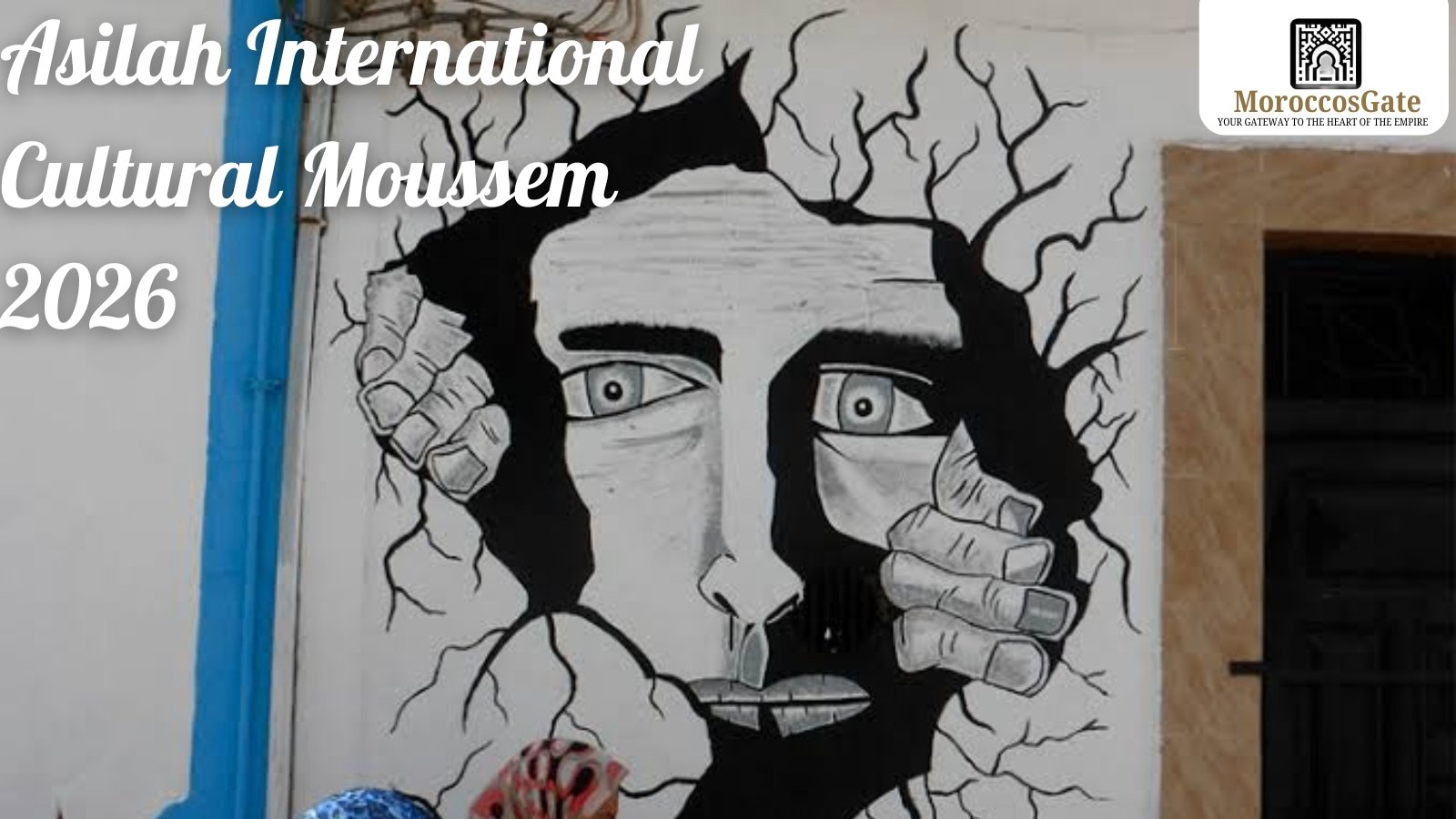
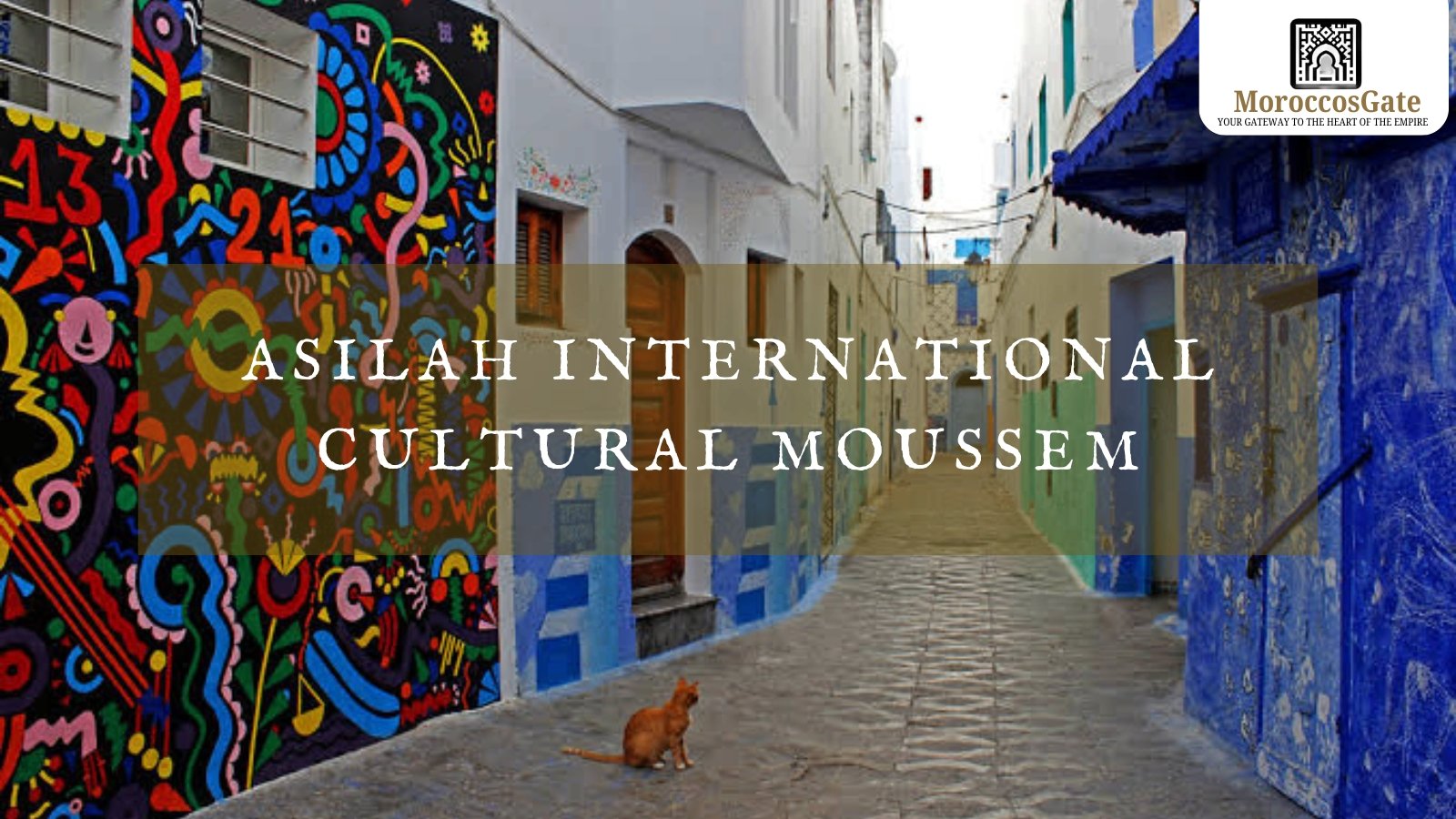
At its heart, the Moussem does one thing that no other festival quite replicates thousands of spectators come to see international artists re-paint the murals every year on the whitewashed houses in the medina. Walls are used as a canvas for the imagination of the artists, which produces a mix of fantasy and geometric designs blending perfectly in Moroccan urban architecture.
You walk into a medina where the walls are alive. An artist from Syria works on a large geometric abstraction on one corner. Across the alley, a Moroccan painter adds layers of ochre and cobalt to a composition that has been developing for three days. Schoolchildren sit on steps watching. A family photographs the progress. The smell of spray paint and sea air mixes in the Atlantic breeze. This is what the Asilah Moussem actually feels like.
Asilah Cultural Moussem 2026: Dates, Sessions and Programme
The 47th edition of the Asilah International Cultural Moussem runs across three distinct sessions in 2026, each with its own focus and programme.
Session 1: Spring Visual Arts (March 27 – April 12, 2026)
Earlier this year, between March 27 and April 12, 2026, the Foundation hosted 16 artists from Bahrain, Syria, Spain, Belgium, Italy, and Morocco to participate in painting, lithography, and engraving workshops, alongside children’s talent and writing labs. The spring session is primarily a working artists’ residency — less public spectacle than the summer session, but open to visitors who want to see the process of mural creation at its most intimate.
Session 2: Summer Visual Arts (June 28 – July 5, 2026) ← Main Mural Season
The Asilah Forum Foundation launched the summer session of the 47th International Cultural Moussem. The session runs through July 5 with a program dedicated to visual arts, youth activities, and artistic workshops. The forum brings together 15 artists from Morocco, Spain, Syria, and Belgium to continue Asilah’s long-running mural tradition.
Key summer 2026 programme events:
- Live mural painting workshops — International and Moroccan artists paint directly on the medina walls, with the process visible to all visitors
- Art seminar: “Asilah Murals: Toward a Visual Identity for the City” — Held July 3 at the Hassan II Center for International Encounters (Mohamed Brini Hall)
- Collective fine arts exhibition — Group exhibition featuring works created during the residency
- Creative workshops for children and young people — Community education programmes open to local families and visitors
- Exhibition: “Asilah in the Shadow of Its Colors” — Opens at the Mohammed Benaissa Gallery and runs through August 31. This means even visitors arriving after the summer session closes can see the year’s artwork in a gallery setting through the end of August.
Ongoing Through August 31: Gallery Exhibition
The “Asilah in the Shadow of Its Colors” exhibition continues at the Mohammed Benaissa Gallery through August 31. Visitors arriving in August for the festival’s wider atmosphere — murals on the walls from the summer session, the gallery exhibition, Atlantic coast swimming, and evening concerts — have a full cultural programme available even after the formal summer session closes.
Session 3: Autumn Conference (October 2 – 18, 2026)
The foundation plans to hold the autumn session of the cultural festival from October 2 to 18, featuring political and economic conferences, musical performances, and additional programming. The autumn session is more intellectually oriented — political dialogues, economic forums, and cultural conferences that have historically attracted heads of state, writers, and intellectuals from across the Arab world and beyond.
2026 Festival at a Glance
| Session | Dates | Focus | Entry |
|---|---|---|---|
| Spring Residency | Mar 27 – Apr 12 | Painting, lithography, engraving workshops | Open to visitors |
| Summer Visual Arts | Jun 28 – Jul 5 | Live murals, exhibition, youth workshops | Free |
| Gallery Exhibition | Jun 28 – Aug 31 | Asilah in the Shadow of Its Colors | Free |
| Autumn Conference | Oct 2 – 18 | Politics, economics, music | Free / some ticketed |
The History Behind the Festival — 47 Years of Art on Walls
To understand why the Asilah Moussem matters — not just as a tourist attraction but as a genuinely significant cultural institution — you need to understand where it came from.
Asilah in 1978: A Town in Decline
The town’s history dates back to 1500 BC, when the Phoenicians used it as a base for trade. The Portuguese conquered the city in 1471 and constructed the massive stone ramparts that still encircle the medina. In 1692, the town was taken by the Moroccans under the leadership of Moulay Ismail. It served as a base for pirates in the 19th and early 20th centuries. From 1912 to 1956, it was part of Spanish Morocco.
By 1978, two years after Moroccan independence had finally consolidated, Asilah was a small, economically struggling coastal town. Its historic medina — those extraordinary 15th-century walls, the twisting whitewashed alleyways, the Palais de Raissouni — was deteriorating. A major plan to restore the town was undertaken in 1978 by its mayor, Mohamed Benaissa.
The Two Men Who Started Everything
The annual Asilah Cultural Moussem was cofounded in 1978 by Mohamed Benaïssa and Mohamed Melehi in collaboration with Toni Maraini and Al Muhit Cultural Association.
Mohamed Benaïssa was Asilah’s mayor — a politician who understood that culture could be an instrument of urban development. Mohamed Melehi was one of Morocco’s most celebrated painters, a central figure in the Casablanca School of Art that had defined Moroccan modernism in the 1960s and 70s.
It all started when two friends, Mohammed Melehi and Mohamed Benaïssa, decided to invite some artists to paint the ruining walls of Asilah village in 1978. The first edition brought artists from Morocco, the Arab world, Africa, Europe, and the Americas. The walls were whitewashed. Canvases appeared where crumbling plaster had been. The medina was transformed.
It served as a significant postcolonial cultural platform, involving activists from the Casablanca Art School and artists from Africa, the Arab world, Asia, Europe, and the Americas. The festival featured outdoor exhibitions, murals, visual art workshops, theater, music, and social and cultural programs aimed at rehabilitating the neglected city of Asilah and integrating art into social progress and daily life.
47 Years of Continuous Tradition
What makes the Asilah Moussem genuinely remarkable is not any single edition but its extraordinary continuity. By continuing to organize this international festival for nearly fifty years with prominent global figures in thought, politics, media, and creativity, the Assilah Forum Foundation remains a cornerstone of the Moroccan cultural landscape and a champion for culturally-driven developmental initiatives.
In 2025, the Asilah Forum Foundation received the Sultan Qaboos Award for Culture, Arts, and Literature — one of the Arab world’s most prestigious cultural honours — in the Private Cultural Institutions category. This recognition reflects five decades of consistent work building one of the world’s most unusual cultural institutions: a festival that genuinely changed a town.
The murals themselves have become part of Asilah’s urban identity. Famous artists from around the world flock into the winding little streets without disturbing the calm traditional life pace of the locals. Walls are used as a canvas for the imagination of the artists, which produces a mix of fantasy and geometric designs blending perfectly in a Moroccan urban architecture. Because the murals are repainted each year, every visit to Asilah is different. The town’s walls are never the same twice.
What to Expect at the Festival: A Complete Experience Guide
The Murals — The Heart of Everything
The mural painting is what draws most visitors, and rightly so. During the summer session, artists work on the medina walls each morning and afternoon, visible to anyone who walks by. There are no ropes, no barriers, no tickets. You can stand two metres from an internationally exhibited painter and watch the work develop in real time over three or four days.
Its most famous feature is a tradition of transforming the whitewashed medina walls of Asilah into large-scale murals and artworks created by international artists, giving the city an ever-changing colourful identity.
The styles vary dramatically between artists and years — a mix of fantasy and geometric designs blending perfectly in Moroccan urban architecture. You will see large-scale geometric abstractions in the tradition of the Casablanca School alongside figurative works, calligraphic Arabic art, contemporary street art influences, and landscape pieces that incorporate the Atlantic light and the Portuguese stonework into the composition.
Best time to watch the artists: Mornings (8am–11am) before the summer heat builds. Artists tend to work in concentrated sessions in the morning and again in the late afternoon.
Best time to photograph the murals: Golden hour — 45 minutes before sunset. The warm Atlantic light hits the whitewashed walls at a low angle and transforms the colours of every mural on the street.
Concerts and Performances
Music and Performances: Enjoy concerts ranging from traditional Moroccan Andalusian music to jazz and reggae in open-air venues. Evening concerts in the medina’s main square and the ramparts area form the social heart of the festival. Many performances are free. The atmosphere — open-air, Atlantic breeze, the sound of music bouncing off painted walls — is the kind of experience that travel writing struggles to adequately describe.
Exhibitions at the Mohammed Benaissa Gallery and Hassan II Centre
The “Mohamed Benaïssa Fine Arts Gallery” hosts a collective exhibition featuring artworks created during 2025 in the art studios of the Palace of Culture. The Hassan II Centre for International Encounters (Centre Hassan II des Rencontres Internationales) hosts seminars, poetry readings, and cultural talks throughout the festival period.
Regular poetry readings are held at the Hassan II Centre and the Raissouni Palace. These are not ticketed events — they are open cultural gatherings that anyone can attend.
Children’s Workshops and Community Programmes
From thousands of visitors and international artists to children’s workshops and intellectual seminars, the festival is a powerful testament to the importance of art as a tool for cultural dialogue, urban renewal, and tourism development.
The children’s workshops are one of the Moussem’s most distinctive features — local Asilah children work alongside international artists, learning techniques and participating in the creative process. This community dimension distinguishes the Moussem from a purely spectator arts festival and gives it genuine roots in the town’s daily life.
Engraving Workshops
A dozen internationally-known engraving artists every year share their experience and skills on two printing frames granted by the Asilah Cultural Association. Every artist passes some of his work to the Association, which has gathered quite a collection. The printmaking tradition runs parallel to the more visible mural painting and produces a body of work that has accumulated over 47 years into a significant archive of international printmaking.
The Town of Asilah: What to See Beyond the Festival
Asilah rewards time beyond the festival programme. Located on Morocco’s northern Atlantic coast, Asilah remains wonderfully under the radar despite being just an hour from Tangier. The town’s combination of history, art, food, and Atlantic coast scenery makes it one of Morocco’s most complete small-town destinations.
The Portuguese Ramparts
The most visible chapter of Asilah’s past began in 1471, when Portuguese forces captured the town and constructed the massive stone ramparts that still encircle the medina. Those walls, along with the Bab Homar gate bearing the Portuguese armillary sphere, remain fully intact today.
Walking along the ramparts provides a stunning view of the Atlantic waves crashing against the stone. The ramparts walk takes approximately 30 minutes at a leisurely pace and offers the finest views in Asilah — the Atlantic stretching to the horizon in one direction, the whitewashed medina with its festival murals in the other. Go at sunset. This is non-negotiable.
The Medina and Mural Alleyways
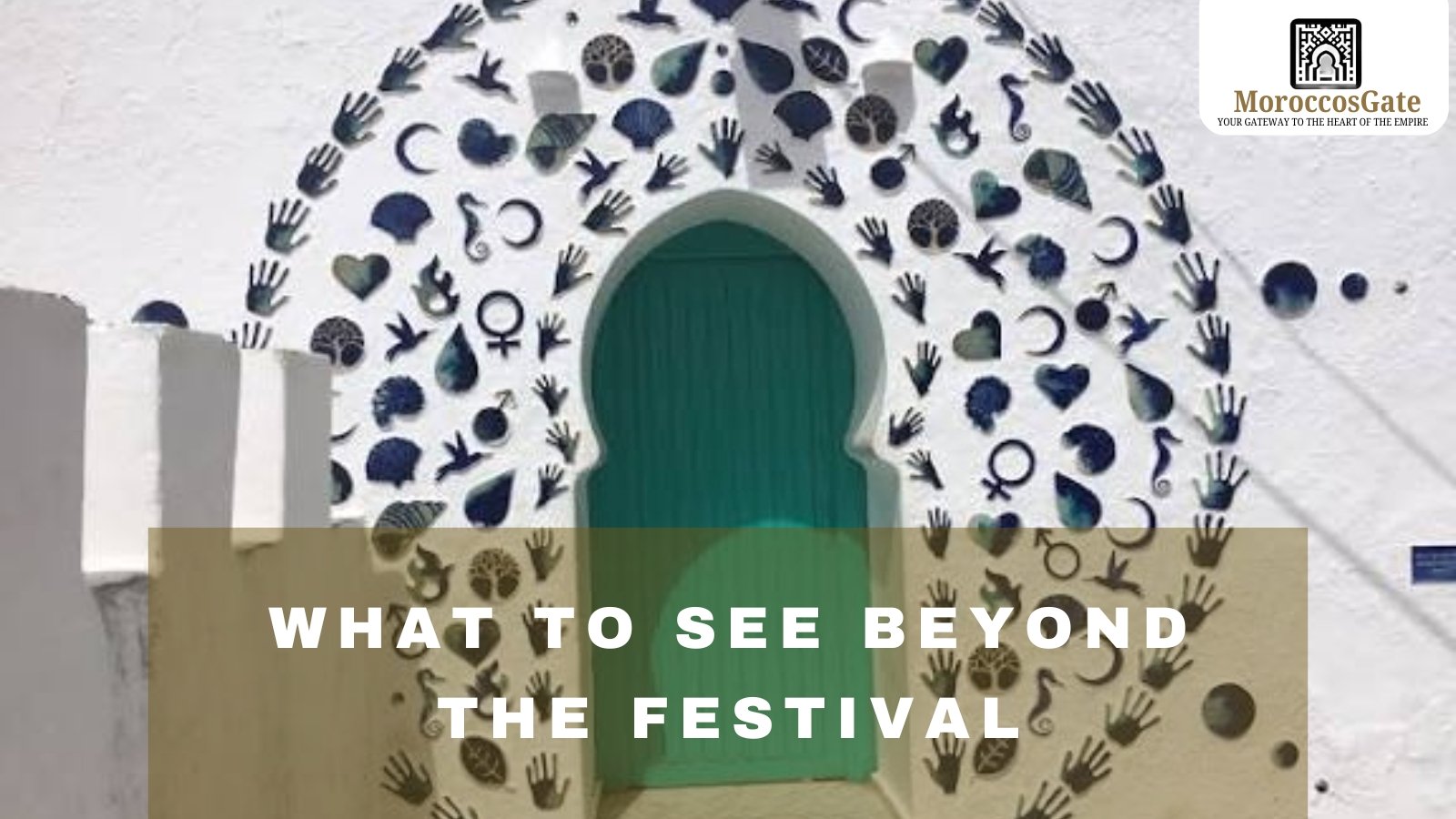
Walk through the medina and you’re essentially touring an open-air gallery. Every corner reveals another mural — some painted last summer, some layered over years of accumulated artworks. Unlike the frenetic medinas of Marrakech or Fes, Asilah is exceptionally clean, quiet, and breezy. Locals genuinely outnumber tourists in the alleyways. Cats sleep on painted doorsteps. Children play football in small squares. The medina feels lived-in and relaxed in a way that larger Moroccan medinas can struggle to maintain.
Palais de Raissouni
The Palais de Raissouni is a beautiful example of Hispano-Moorish architecture. It once belonged to a famous pirate and pasha. It now serves as a cultural centre during the arts festival. The palace is the most significant historical interior in Asilah — its Andalusian courtyard and decorated rooms provide context for the town’s complex layered history of Moroccan, Portuguese, Spanish, and pirate occupation.
Asilah’s Beaches
Asilah has several Atlantic beaches stretching south from the medina. The beaches are longer and less crowded than those at Tangier and far less commercialised than Agadir. In summer, the Atlantic water reaches 20–22°C — cool but swimmable — and the beaches stay uncrowded even at the height of festival season. The combination of beach morning and festival evening makes Asilah one of Morocco’s finest summer combinations.
The Port and Seafood
Asilah’s working port brings in daily catches of Atlantic fish, sardines, and seafood. The port-side restaurants serve some of the freshest grilled fish on Morocco’s Atlantic coast — a plate of sardines with bread and preserved lemon costs 30–50 MAD. For dinner, the restaurants around the medina’s main square serve Moroccan fish tagines, seafood pastilla, and the local specialty of grilled sea bream at prices significantly lower than Marrakech or Essaouira equivalents.
Major August Events in Morocco 2026 — The Complete Picture
The Asilah Moussem sits within a rich August cultural calendar across Morocco. Here is the complete picture of major August 2026 cultural events.
Prominent cultural events held in August in Morocco include the Asilah International Cultural Moussem, the Moussem of Moulay Abdellah Amghar, and the Nomadic Festival near Marrakech.
Asilah International Cultural Moussem — Asilah, August
The Asilah Arts Festival transforms the coastal town of Asilah into an open-air gallery where international artists paint vibrant murals on the medina walls, accompanied by concerts and poetry readings. As detailed above, the gallery exhibition “Asilah in the Shadow of Its Colors” at the Mohammed Benaissa Gallery continues through August 31. Visitors in August can see the completed summer murals in situ on the medina walls and visit the gallery for the formal exhibition — both free of charge.
- Attendance: Over 50,000 visitors across the full programme.
- Entry: Free for all public murals, street art, and most events. Some ticketed evening concerts.
- Location: Asilah, Atlantic coast, 45km south of Tangier.
Moussem of Moulay Abdellah Amghar — Near El Jadida, August
The Moussem of Moulay Abdellah Amghar is a massive historic coastal gathering near El Jadida featuring traditional fantasia horse-riding, religious processions, and folk music.
Every August, for one week, a moussem — a Muslim religious festival — is held in the city of Tit in El Jadida province to honour Sheikh Moulay Abdellah Amghar. The major attraction for tourists is the Fantasia, with 1,800 riders firing their rifles and racing toward the crowd in unison, stopping just short.
The Fantasia (Tbourida) is Morocco’s most dramatic traditional equestrian display — dozens of horsemen in traditional white djellabas charging in disciplined formation, discharging their muskets simultaneously in a single thunderous volley at the precise moment they rein their horses to a halt. The Moussem of Moulay Abdellah Amghar is one of the largest Fantasia gatherings in Morocco, drawing riders from across the country and an audience of tens of thousands.
This is a religious pilgrimage and Moroccan cultural event, not a tourist performance. Visitors are welcome to attend and observe respectfully. Dress modestly (shoulders and knees covered). Photography is generally permitted of the Fantasia but ask before photographing individuals, particularly women.
Getting there: El Jadida is approximately 100km south of Casablanca. The moussem site (Moulay Abdellah, near Tit) is about 12km from El Jadida town. Grand taxis from El Jadida to the site during the moussem week.
Nomadic Festival — Near Marrakech, August
The Nomadic Festival near Marrakech is a boutique two-day outdoor electronic and desert-inspired music gathering held on the outskirts of Marrakech.
The Nomadic Festival brings international DJs and electronic music producers to an outdoor venue in the dramatic landscape outside Marrakech, combining music performances with art installations, wellness workshops, and poolside daytime sessions. International DJs and producers perform alongside visual art installations, workshops, and wellness activities. Pool parties during the day and desert-stage sets under the stars create a unique festival atmosphere. Weekend passes from 1,800 MAD; day passes from 700 MAD.
This is a different Morocco cultural experience from the Asilah Moussem — contemporary, internationally oriented, and aimed at a younger global audience. The desert-edge setting, the star canopy above the outdoor stage, and the Marrakech landscape make it visually extraordinary even by international festival standards.
Note on Marrakech in August: Marrakech reaches 38–42°C in August. The Nomadic Festival is designed around this — daytime pool sessions, evening and night performances when temperatures drop. Come prepared for the heat.
Revolution Day — August 20 (National Holiday)
Morocco celebrates Revolution Day on August 20 with various nationwide civic events. August 20 commemorates the 1953 uprising against French colonial rule, when Moroccan nationalists united behind exiled Sultan Mohammed V. Celebrations include patriotic parades, public speeches, and cultural events honouring the country’s struggle for independence.
On Revolution Day, banks, government offices, and schools close. Most tourist sites and restaurants remain open. Major cities — Casablanca, Rabat, Marrakech — hold official civic celebrations with parades and speeches. The day has a genuinely patriotic atmosphere across Morocco that provides interesting cultural context for visitors.
Youth Day — August 21 (National Holiday)
Morocco celebrates Youth Day on August 21 with various nationwide civic events. The day following Revolution Day is designated Youth Day, celebrating Moroccan youth and culture. Combined with Revolution Day on the 20th, the August 20–21 weekend creates a two-day national holiday with heightened cultural activity across the country.
Practical note: Both Revolution Day (Aug 20) and Youth Day (Aug 21) are public holidays. Plan any banking, administrative, or government-related tasks for before or after this period. Tourist experiences — restaurants, tours, festivals, museums — are generally unaffected.
How Much Does It Cost to Attend?
One of the Asilah Moussem’s greatest qualities is its accessibility.
The Asilah Arts Festival charges no admission. Free to wander and watch artists at work.
The murals are on public walls, visible on every street of the medina at all hours. The mural painting process is viewable without any ticket or booking. Most concerts and performances in the main square are free. The gallery exhibitions at the Hassan II Centre and Mohammed Benaissa Gallery are typically free or charge a nominal entry fee of under 20 MAD.
Cost Summary — Attending the Asilah Moussem
| Item | Cost |
|---|---|
| Entry to medina murals | Free |
| Watching mural painting live | Free |
| Gallery exhibitions | Free – 20 MAD |
| Most evening concerts | Free |
| Some ticketed evening performances | 50–150 MAD |
| Engraving workshop participation | Ask at the Hassan II Centre |
| Children’s workshops | Free (for local children; ask about visitor participation) |
Daily Living Costs in Asilah
Asilah is significantly cheaper than Marrakech or Essaouira for food and daily expenses:
- Grilled sardines at the port: 30–50 MAD
- Tagine at a local restaurant: 60–90 MAD
- Mint tea at a medina café: 10–15 MAD
- Fresh juice: 10–20 MAD
- Full lunch at a tourist restaurant: 100–180 MAD
- Petit taxi across town: 10–20 MAD
Where to Stay in Asilah — Accommodation Guide
Book Early: Accommodation in Asilah fills up quickly during the festival, so plan your lodging months in advance. This advice is not exaggerated. Asilah is a small town with limited accommodation stock. During the festival summer session and through August, the best riads and guesthouses sell out weeks in advance.
In Asilah (Recommended for Festival Immersion)
Riads and guesthouses in the medina are the optimal base — walking distance to every festival event, the murals, the ramparts, and the port restaurants. Budget for €40–80 per night for a private room in a mid-range medina riad in August.
Key properties frequently mentioned by visitors:
- Dar Menara — Atlantic cliff views, quiet and comfortable
- Dar Bouanani — Boutique riad with spa, higher-end option
- Hôtel Al Alba — Mid-range with good location and breakfast available
Book directly with the property or via Booking.com. Book at least 6–8 weeks in advance for August stays.
In Tangier (Alternative Base — 45 Minutes Away)
If Asilah accommodation is fully booked, Tangier is the logical alternative. The train between Tangier and Asilah takes 45 minutes and costs approximately 30 MAD. Day-tripping to the festival from Tangier is entirely practical — the first train from Tangier leaves early enough to arrive for morning mural-watching.
Tangier offers significantly more accommodation variety than Asilah, including large hotels, boutique riads, and international chains that never fully sell out even in peak season.
How to Get to Asilah from Tangier, Casablanca, and Marrakech
Asilah’s location on the main Tangier–Casablanca railway line makes it one of the most accessible small towns in Morocco.
From Tangier (Closest City)
By train: The ONCF train from Tangier Ville station stops at Asilah. Journey time: approximately 45 minutes. Fare: approximately 30 MAD (€2.80). Trains run regularly throughout the day — check oncf.ma for current 2026 timetables.
By grand taxi: Shared grand taxis from Tangier to Asilah depart from the Tangier taxi rank near the port. Cost: approximately 30–40 MAD per person. Journey time: 40–45 minutes.
By car: Asilah is 46km south of Tangier along the A1 coastal road. Driving time: approximately 35–40 minutes. Parking available outside the medina walls.
Nearest airport: Tangier Ibn Battouta Airport (TNG) — 45km from Asilah. Grand taxi from the airport to Asilah costs approximately 200–250 MAD (negotiate before getting in). Tangier is served by Ryanair, EasyJet, and Royal Air Maroc from multiple European and Moroccan cities.
From Casablanca
By train: Direct ONCF train from Casablanca to Asilah. Journey time: approximately 4.5–5 hours. Fare: 120–180 MAD in second class. The train is the most comfortable option for this distance.
By car: Approximately 340km along the A3 and A1 highways. Driving time: 3.5–4 hours. The Casablanca–Tangier motorway (A1) is modern, fast, and well-maintained.
From Marrakech
By train: Take the train from Marrakech to Casablanca Casa Voyageurs (approximately 3 hours, 100–150 MAD), then change for the northbound Casablanca–Tangier service stopping at Asilah. Total journey: approximately 7.5–8.5 hours. An overnight sleeper from Marrakech to Tangier (with connection to Asilah) is a practical option for those coming from the south.
By car: Approximately 600km along the A7, A3, and A1. Driving time: 5.5–6.5 hours. A long drive but Morocco’s motorway network is efficient.
By air + train: Fly Marrakech to Tangier via Royal Air Maroc (approximately 1 hour), then train or taxi to Asilah. This is the fastest option if timing matters.
Practical Tips for Visiting the Moussem
1. Arrive for the morning mural-watching session. Artists work their most concentrated sessions from approximately 8am to midday. The morning light on the medina is also beautiful for photography, and the alleyways are quieter than the afternoon. Set your alarm and start early.
2. Bring cash — Asilah’s medina is largely cash-only. Outside the larger restaurants and hotels, card payments are not widely accepted. Carry 300–500 MAD in small bills daily for food, café stops, small art purchases, and tips.
3. Respect the artists’ working space. The artists are working in public, but they are genuinely working — not performing for tourists. Keep a respectful distance. Do not touch the walls or finished murals. Ask before photographing an artist at very close range. The warm relationship between visiting artists and the Asilah community has been maintained for 47 years precisely because visitors have generally respected this boundary.
4. Stay at least two nights. While you can see the town’s highlights in a day, once you experience Asilah’s beauty and seaside setting, you’ll wish you stayed longer. Two nights gives you one full day for the festival programme (morning murals, afternoon beach, evening concert) and one morning for the Portuguese ramparts at sunrise before catching your train or taxi.
5. Book accommodation in advance — seriously. Festival cities fill up fast, especially for major events. Book 2–3 months ahead. Prices rise significantly during events — budget accordingly or stay in nearby towns. For Asilah in summer 2026, 6–8 weeks in advance is the minimum. 3 months is better for the best riad options.
6. Wear comfortable walking shoes. Asilah’s medina is paved in Portuguese-era stone — uneven, charming, and hard on thin-soled shoes after three hours. Bring comfortable sandals with support or light trainers.
7. The best photography is in the medina alleyways, not the main square. The most visually extraordinary murals are often on secondary streets and alleyways rather than the main medina thoroughfare. Get lost intentionally — wander into side streets and dead ends. The best walls are often where fewer people are looking.
8. Evening concerts — arrive early for headline performances. Free concerts attract massive crowds. For headline shows, arrive 1–2 hours before the scheduled start time. The main square fills quickly on festival evenings.
9. Combine with Tangier for a complete northern Morocco experience. Tangier and Asilah are natural partners: 45 minutes apart by train, complementary in atmosphere. Tangier offers the Grand Socco, the medina, the Hafa Café above the Strait of Gibraltar, and the American Legation Museum. Asilah offers the festival, the Atlantic calm, and the painted medina. Two nights in each makes an excellent northern Morocco circuit.
10. Check the festival programme directly with the Asilah Forum Foundation. Specific event dates and times shift between editions. The Asilah Forum Foundation (the organising body) publishes the official programme. Contact them directly or check their official communications for confirmed 2026 autumn session dates and specific event timings.
Frequently Asked Questions
Q1. What is the Asilah International Cultural Moussem?
A1. The Asilah International Cultural Moussem is an annual arts festival held in the Atlantic coastal town of Asilah in northern Morocco. The annual Asilah Cultural Moussem was co-founded in 1978 by Mohamed Benaïssa and Mohamed Melehi. It served as a significant postcolonial cultural platform involving artists from Africa, the Arab world, Asia, Europe, and the Americas. The festival featured outdoor exhibitions, murals, visual art workshops, theater, music, and social and cultural programmes aimed at rehabilitating the neglected city of Asilah and integrating art into social progress and daily life. Now in its 47th year, it is one of North Africa’s longest-running and most respected cultural festivals.
Q2. When does the Asilah Cultural Festival take place in 2026?
A2. The 47th Asilah International Cultural Moussem runs across three sessions in 2026: a spring residency (March 27 – April 12), a summer visual arts session with live mural painting (June 28 – July 5), a gallery exhibition continuing through August 31, and an autumn conference session (October 2–18). The summer session is the most visited, with the live mural painting process and public evening concerts drawing the largest attendance. Visitors in August can see the completed murals on the medina walls and visit the Mohammed Benaissa Gallery exhibition (free entry) through the end of August.
Q3. Is the Asilah Arts Festival free?
A3. Many of the festival’s events are free of charge. The murals on the medina walls are permanently visible and always free. Watching the mural painting process costs nothing. Gallery exhibitions at the Hassan II Centre and Mohammed Benaissa Gallery are free or charge a nominal fee under 20 MAD. Most evening concerts in the medina squares are free. Some ticketed evening performances charge 50–150 MAD.
Q4. How do I get to Asilah from Tangier?
A4. Asilah is 45km south of Tangier and easily reached by train (approximately 45 minutes, 30 MAD) or shared grand taxi (approximately 45 minutes, 30–40 MAD per person). Tangier Ibn Battouta Airport (TNG) is the closest international airport, served by Ryanair, EasyJet, and Royal Air Maroc from multiple European cities. A grand taxi from Tangier airport directly to Asilah costs approximately 200–250 MAD.
Q5. Where should I stay for the Asilah festival?
A5. Book early — accommodation fills up quickly during the festival. Riads and guesthouses within Asilah’s medina are the best option for festival immersion — walking distance to all events, the murals, the ramparts, and the port. Budget €40–80 per night for a mid-range medina riad in summer. If Asilah accommodation is full, Tangier (45 minutes away by train) offers much greater availability and easy day-trip access to the festival.
Q6. What other major events happen in Morocco in August 2026?
A6. August is one of Morocco’s richest cultural months. Alongside the Asilah Moussem, the major August 2026 events include: the Moussem of Moulay Abdellah Amghar near El Jadida (one of Morocco’s largest Fantasia horse-riding gatherings, with up to 1,800 riders); the Nomadic Festival on the outskirts of Marrakech (boutique electronic music and arts festival with desert-stage performances); Revolution Day on August 20 (national holiday commemorating the 1953 uprising against French rule); and Youth Day on August 21. The Imilchil Marriage Festival in the Middle Atlas Mountains also falls in late August or early September.
Q7. Is Asilah worth visiting outside of the festival?
A7. Yes — strongly. Asilah offers a rare combination of well-preserved Portuguese fortifications, a thriving street art scene, uncrowded Atlantic beaches, and some of the freshest seafood on Morocco’s coast. Unlike larger tourist cities, the pace here stays relaxed and the medina never feels overwhelming. The murals are visible year-round (each year’s murals remain on the walls until the following summer). The Portuguese ramparts, the Palais de Raissouni, the Atlantic beaches, and the port restaurants are all excellent regardless of the festival calendar. Spring (April–May) and autumn (September–October) offer the most comfortable temperatures and fewer crowds.
Conclusion
The Asilah International Cultural Moussem is, at its core, a simple idea made extraordinary through repetition: give artists walls, give the town access to the process, and trust that beauty and community will follow. Since its creation in 1978, the festival has helped transform Asilah from a small coastal town into a dynamic cultural hub where ancient walls become canvases, ideas flow freely, and community spirit thrives.
Forty-seven years later, the formula holds. The walls are still being painted. The medina is still alive with the smell of pigment and sea air. Children still sit on doorsteps watching artists from four continents work in the alleyways above the Atlantic. The evening concerts still fill the squares. And Asilah — a coastal town that rewards those who venture slightly off the beaten path with something increasingly rare in modern travel: genuine tranquillity mixed with artistic soul — is still, quietly, one of the most beautiful places in Morocco.
August in Asilah means the summer murals are complete and vivid on every wall, the “Asilah in the Shadow of Its Colors” gallery exhibition runs through the 31st, the Atlantic beaches are warm and uncrowded by international tourists, and the port restaurants serve grilled sardines every evening. Alongside the Moussem of Moulay Abdellah Amghar’s extraordinary Fantasia to the south and Revolution Day’s nationwide celebrations on August 20, Morocco in August has a cultural richness that most travel guides completely miss.
Go to Asilah. Walk the medina in the early morning. Watch a Syrian artist paint the wall of a 500-year-old Portuguese-era building. Eat sardines at the port. Walk the ramparts at sunset. Come back next year to see what the walls look like when they change again.
Ready to plan your Asilah trip? Read our Morocco in August 2026 Complete Travel Guide, our Best Beaches in Morocco 2026, and our Morocco Packing List 2026 for everything else you need before you go.
About the Author
Morocco’s Gate is an Ireland-based Morocco travel resource run by a team of specialists with over a decade of combined experience visiting and writing about Morocco — including multiple visits to Asilah during the Cultural Moussem. For custom trip planning or questions, visit moroccosgate.ie/contact.