
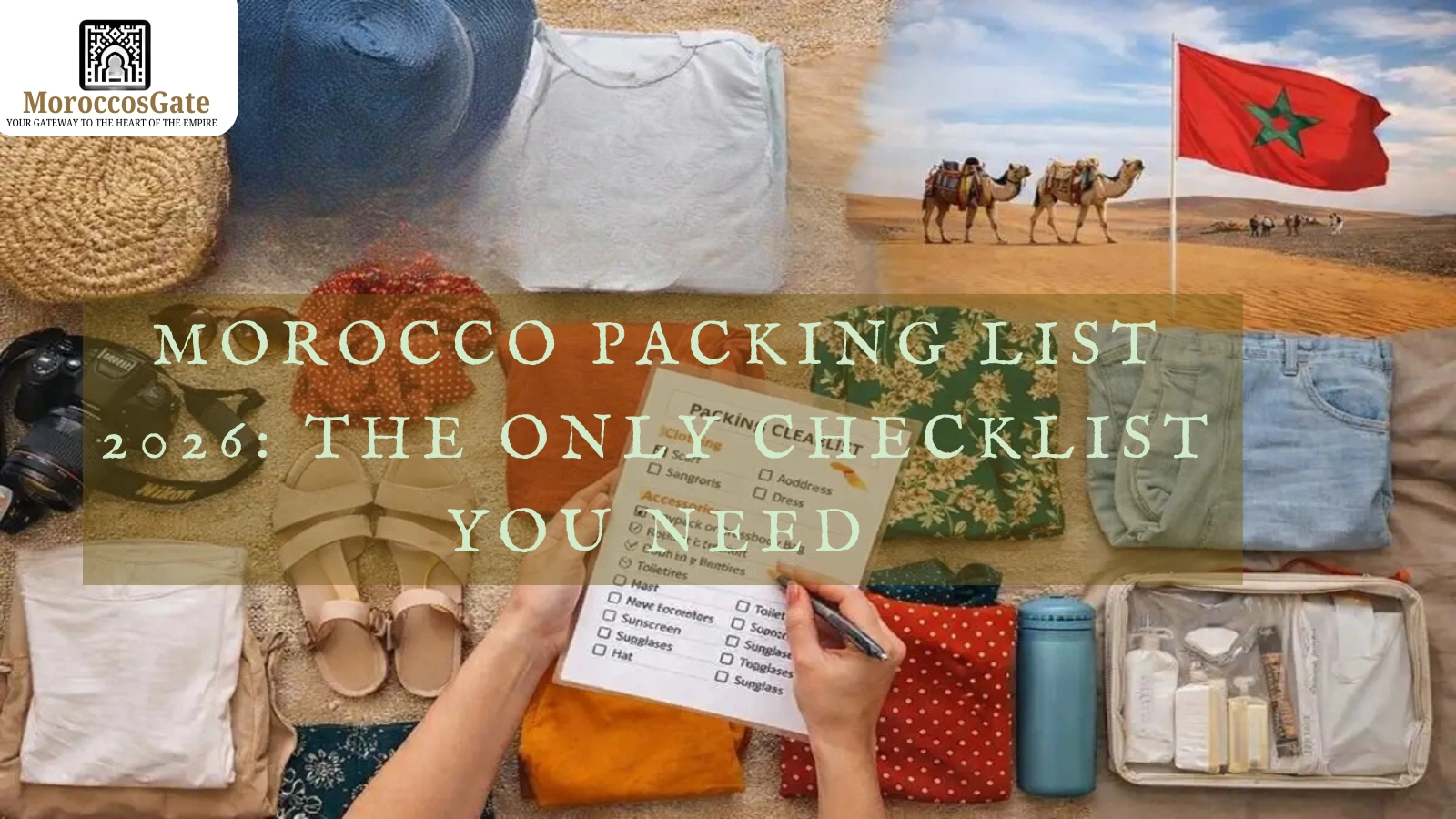
Morocco Packing List 2026: The Only Checklist You Need (Summer + Winter Versions)
Quick Answer: What to pack for Morocco depends on two things: the season you’re visiting and the regions on your itinerary. Summer visitors need lightweight linen, SPF 50+, a wide-brim hat, and a light layer for Atlantic coast evenings. Winter visitors need a warm coat, thermals for the Atlas Mountains, and waterproofs for northern cities. Both seasons require modest clothing that covers shoulders and knees for medinas, mosques, and rural areas. This complete packing list covers every essential — clothing, toiletries, documents, electronics, and what NOT to bring — with separate summer and winter checklists you can use right now.
Affiliate Disclosure: This post contains affiliate links. If you purchase travel gear or book services through links on this page, Morocco’s Gate may earn a small commission at no extra cost to you. We only recommend products we genuinely use and trust.
The Most Important Thing to Understand Before You Pack
Most Morocco packing lists get one thing fundamentally wrong: they treat Morocco as a single climate. It is not — not even close.
The desert in summer can hit 48°C. The Atlas Mountains in winter can drop below freezing. On the same day in January, Marrakech might be a pleasant 18°C in the sunshine while Ifrane in the Atlas Mountains sits under snow at –5°C, and Agadir on the Atlantic coast is a mild, t-shirt-friendly 22°C. Understanding which Morocco you’re visiting determines 90% of what goes in your bag.
The second thing most lists miss is the cultural dimension. Both men and women should cover their shoulders and knees. Women should also cover their cleavage. You don’t need to wear a headscarf. This applies in medinas, markets, mosques, and rural areas — not on beach resorts or in your hotel. Getting this right means more comfortable interactions with locals, more relaxed days in the souks, and far fewer unwanted stares or comments.
With those two foundations in place, here is everything you need — organised by season, region, and traveller type.
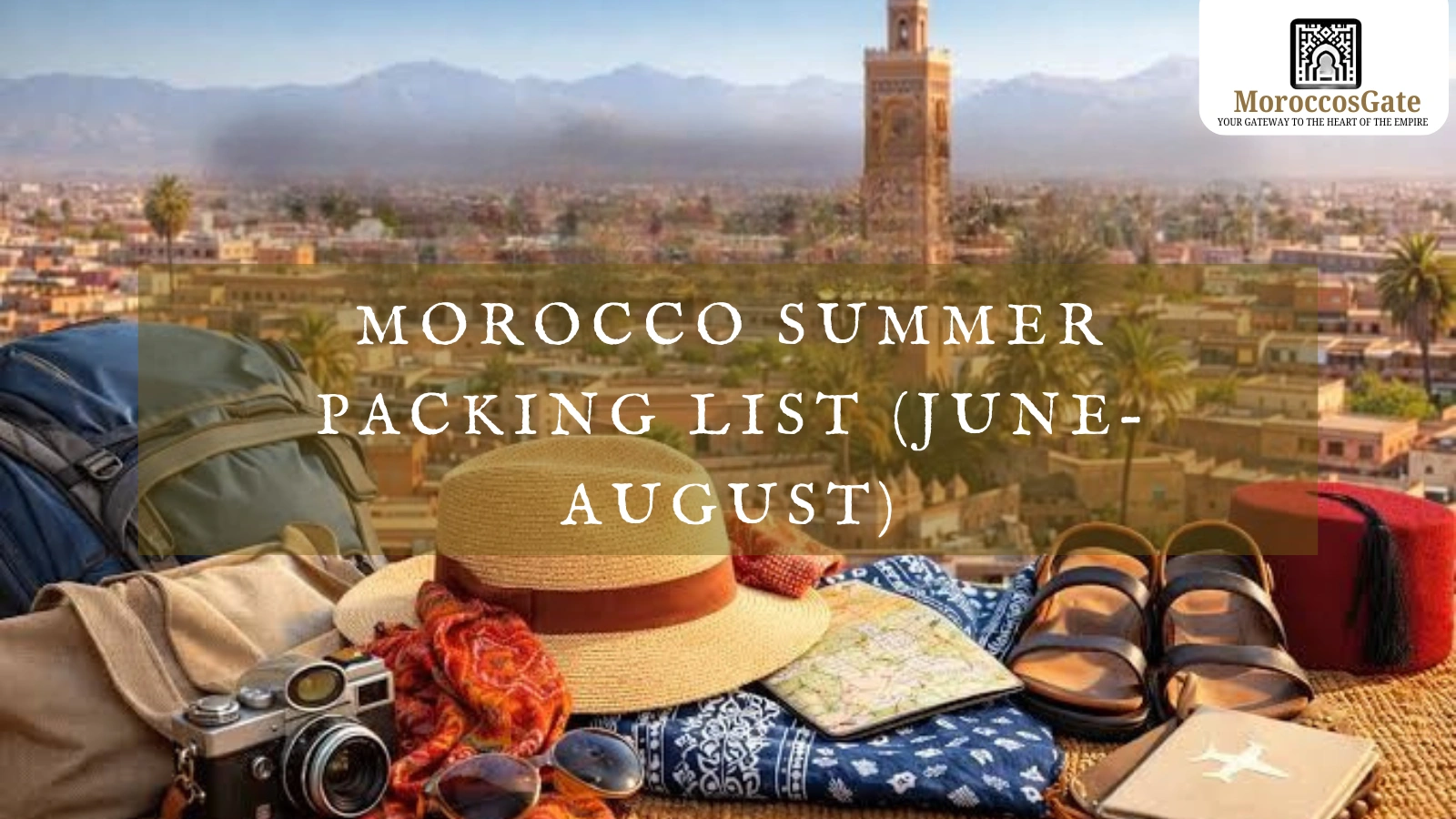
Morocco Summer Packing List (June–August)
Summer in Morocco is the season of extremes. Interior cities like Marrakech and Fes can exceed 40°C — sometimes 45°C. The Sahara can reach 50°C. Coastal cities are far more comfortable thanks to Atlantic breezes.
Your packing strategy in summer depends entirely on your itinerary. Coastal Morocco (Essaouira, Agadir, Taghazout) needs light, beach-ready clothing. Inland Morocco (Marrakech, Fes) needs the same lightweight fabrics but with modesty coverage for medinas. The Sahara in summer requires serious sun and heat protection.
☀️ Summer Clothing Essentials
For Women:
- 3–4 lightweight linen or cotton maxi dresses — A loose linen maxi dress is the ideal summer Morocco outfit. Long, flowing, breathable, and modest enough for medinas without adjustment. Choose pale colours (white, beige, sage) that reflect rather than absorb heat.
- 2 pairs of lightweight linen trousers — For days when a dress isn’t practical (hiking, camel trekking, motorbike taxis). Wide-leg styles allow airflow.
- 3–4 lightweight cotton or linen tops with sleeves — Loose fit, not skin-tight. Avoid spaghetti straps and crop tops for medina exploration.
- 1 long-sleeve lightweight layer — For evenings on the Atlantic coast (Essaouira regularly drops to 16°C at night even in July) and air-conditioned riads.
- 1 swimsuit — For beaches and riad pools. A one-piece or bikini is both fine at beach resorts. Bikini tops as streetwear are not appropriate in town.
- 1 lightweight scarf or pashmina — The single most versatile item in your bag. Use it as a beach coverup, sun protection for your shoulders, modesty cover when entering a mosque, and warmth on cool evenings. Buy locally in Marrakech for 50–100 MAD.
For Men:
- 3–4 lightweight linen shirts — A pale linen shirt over light chinos is hard to beat for summer Morocco. Roll the sleeves up during the day, roll them down in rural areas and mosques.
- 2 pairs of lightweight chinos or linen trousers — Men might get away with long shorts, although in some rural regions these are considered to be underwear. Trousers are always the safer choice.
- 1–2 pairs of shorts — Acceptable at beach resorts and modern city areas. Not appropriate in medinas, mosques, or rural villages.
- 2–3 breathable t-shirts — For beach days and casual evenings.
1 long-sleeve lightweight layer — For Atlantic coast evenings and air conditioning in riads and restaurants.
Everyone:
- Wide-brim hat — Essential for the Sahara, Atlas hikes, and any summer travel. A straw hat or UPF-rated cotton hat offers genuine sun protection. The single item most visitors wish they’d brought from home.
- Quality sunglasses with UV400 protection — UV-protective lenses are a must, not a luxury. Morocco’s light is intensely bright, especially in the desert and at altitude. Polarised lenses are worth the extra cost.
☀️ Summer Shoes
- Comfortable sandals with arch support — Medina cobblestones are uneven and relentless. Flat sandals without support become genuinely painful after four hours in a souk. Choose sturdy leather or supportive sports sandals, not fashion flip-flops.
- Lightweight closed shoes or trainers — For Atlas Mountain day trips, hiking, and cooler evenings. Also the safer choice in very crowded medinas where you need grip on uneven stone.
- Beach flip-flops — For pool areas and beach days only. Keep these separate from your medina footwear.
☀️ Summer Sun and Heat Protection
- SPF 50+ sunscreen — bring a large supply from home — Good-quality sunscreen can be expensive or hard to find outside major cities. Bring enough from home for the whole trip — especially for the desert. The Moroccan sun at 31°N latitude is far more intense than northern European sun, and locals understandably have limited stock of high-factor sunscreen for tourists.
- Cooling face mist — Sounds indulgent, genuinely essential in 45°C Sahara midday. A small spray bottle filled with water provides immediate relief and weighs almost nothing.
- Reusable insulated water bottle — Aim for 3–4 litres per day in summer heat. Tap water in Morocco is not safe to drink in most areas. Refill from large bottled-water dispensers available in riads and hotels (typically free or 5 MAD per refill).
- After-sun lotion — Even with sunscreen, Morocco’s summer sun burns. After-sun is rarely available in small towns.
- Lip balm with SPF — Often forgotten, always regretted in the desert.
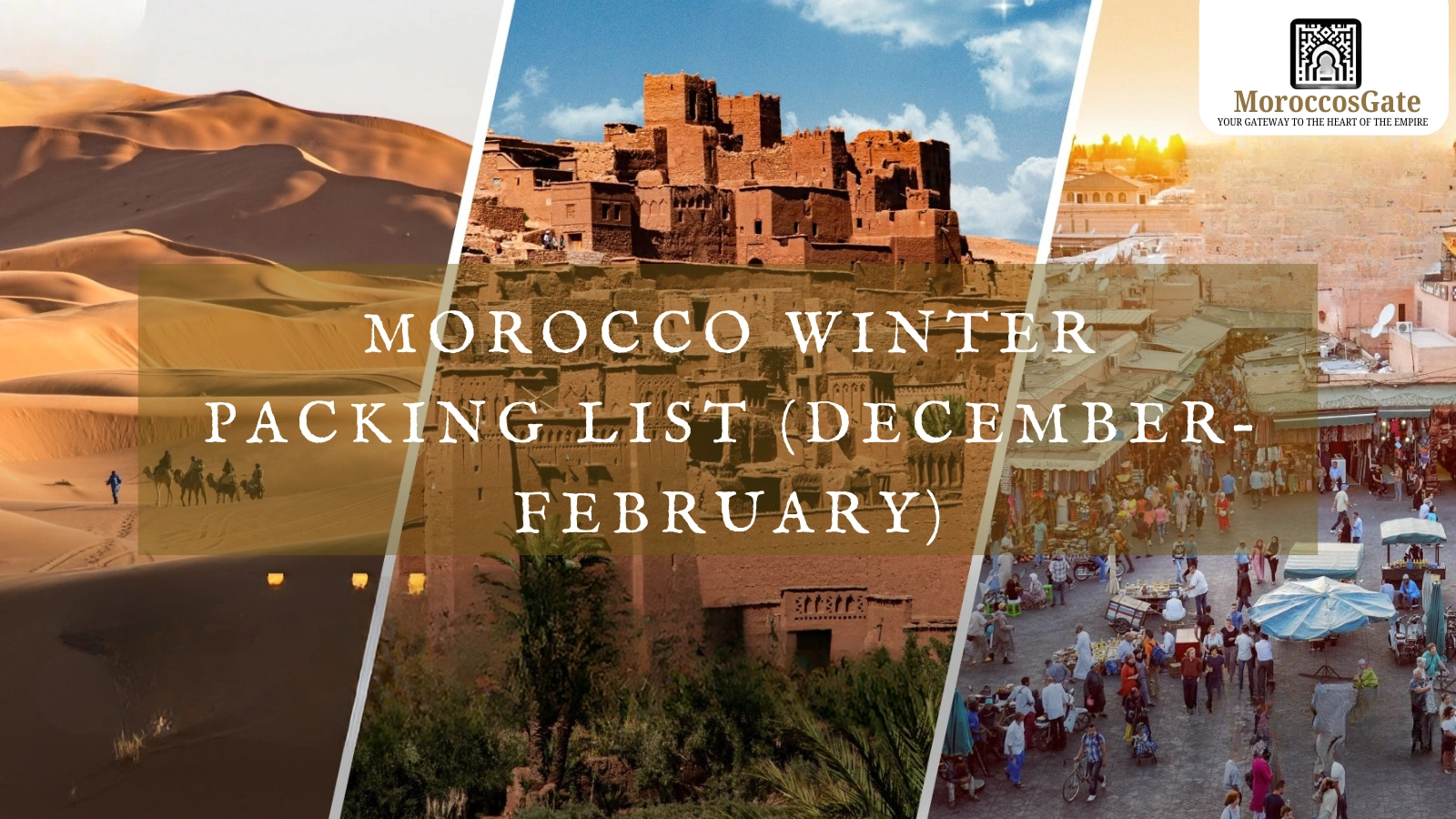
Morocco Winter Packing List (December–February)
Winter Morocco surprises almost everyone. The sun can feel warm during the day, especially in Marrakech, Rabat, and southern Morocco. But mornings and evenings are cold. Traditional riads, guesthouses, and mountain towns can feel colder than travelers expect because many Moroccan buildings are designed to stay cool. This is perfect in summer. In winter, it means you need layers.
The coastal cities stay genuinely mild — Agadir averages 22°C in December — while the Atlas Mountains can be under significant snow and the desert nights drop close to freezing. Morocco in winter is far colder than most visitors from warm countries expect — and warmer than visitors from northern Europe expect.
❄️ Winter Temperature Reference
| Region | December Day | December Night |
|---|---|---|
| Agadir (coast) | 20–22°C | 13–16°C |
| Marrakech | 18–22°C | 8–12°C |
| Fes | 14–18°C | 5–9°C |
| Chefchaouen | 12–16°C | 5–8°C |
| Atlas Mountains | 5–10°C | –2–5°C |
| Sahara Desert (night) | 18–22°C day | 3–8°C night |
❄️ Winter Clothing Essentials
Core Layers (everyone):
- Thermal base layer (top and bottom) — For Atlas Mountain trekking, desert nights, and northern Morocco. Even if you don’t think you’ll need them, pack one set. Desert nights near Merzouga in December regularly drop to 3–5°C.
- 2–3 warm mid-layers (fleece or wool sweater) — A lightweight down jacket or fleece works well for the city. In Marrakech and Fes, a good fleece is sufficient most of the time. Layer it under a jacket on colder days.
- Warm outer jacket — You’ll want at least a medium-weight jacket for visiting the coast and full winter wear — a warm coat, hat, gloves, and boots — for the mountains. For Marrakech and the south, a mid-weight jacket is adequate. For Chefchaouen, Fes, and the Atlas, a proper winter coat is essential.
- Down jacket — For the Atlas Mountains or if you’re camping in the Sahara in winter. Compresses small and adds significant warmth.
- Waterproof rain jacket — Winter is the rainy season in many areas, so pack your rain jacket and umbrella. Northern Morocco (Tangier, Chefchaouen, Fes) receives meaningful winter rainfall. An umbrella plus a waterproof jacket is the combination that works.
- Compact travel umbrella — An unexpectedly useful item to bring to Morocco.Rain in Fes medina soaks you quickly on narrow covered streets where a jacket alone doesn’t protect.
For women (winter additions):
- 2–3 long-sleeve modest tops — Warmer fabrics (cotton jersey, merino wool) instead of linen. Loose-fit, shoulder-covering.
- 1–2 warm maxi skirts or woollen trousers — The maxi dress principle still applies in winter, just in heavier fabric.
- Warm tights or leggings — Worn under skirts or dresses for warmth without bulk.
For men (winter additions):
- 2–3 warm shirts and a wool sweater — Layerable and city-appropriate.
- Smart casual trousers — Chinos in a heavier fabric than summer.
Everyone (winter extras):
- Warm hat (beanie) — In some regions, night temperatures fall near freezing, so pack a beanie, scarf, and gloves for evenings.
- Gloves — Lightweight liner gloves work for most city visits. Proper warm gloves for Atlas trekking.
- Warm socks — Riads can be cold and often have tiled floors with minimal insulation. Bring warm socks even if you wouldn’t think of them in summer.
- Closed, waterproof walking shoes — For the Atlas Mountains, pack closed shoes, a warm layer, a jacket or fleece, and clothes that are easy to layer. Leather boots or waterproof trainers for medina puddles and mountain paths.
Morocco Dress Code: What to Wear and Where
This is the section most travellers either overthink or completely ignore. The reality is nuanced and practical.
The Core Rule
Men and women should keep their upper body — especially shoulders, chest, and midriff — as well as their knees covered at all times as a sign of respect to the local culture. This applies in medinas, souks, mosques, rural villages, and public squares. It does not apply at beach resorts, hotel pools, or modern city districts (Casablanca Maarif, Marrakech Guéliz, Agadir beachfront).
By Location
Medinas and Souks (all cities):
Shoulders covered, knees covered, no midriff. A long maxi dress or linen trousers and a sleeve top is the standard. The quickest local solution if you’ve underpacked: lightweight scarves are sold everywhere in Moroccan medinas for 30–80 MAD and serve perfectly as an impromptu wrap.
Beach Resorts (Agadir, Essaouira beach):
Swimwear is appropriate on the beach itself. When walking from the beach into town, cover up with a sarong, dress, or shorts and a t-shirt. Walking through town in a bikini draws strong negative attention.
Mosques:
Dress code applies inside mosques — long sleeves and long pants or skirts; women may bring a headscarf. Remove shoes before entering. Many mosques in Morocco are not open to non-Muslim visitors, so check in advance.
Rural Villages and Atlas Mountains:
The most conservative environment. Rural people will be visibly embarrassed if you dress in skin-showing clothing. In their view, you’re walking around in your underwear. Full modest coverage here is a mark of genuine cultural respect, not just rule-following.
Modern City Districts:
In major cities — Agadir, Casablanca, Rabat, Marrakech — women and men often dress as they would in New York or any other Western city. The locals are used to seeing tourists. That said, erring toward modest coverage is always socially smoother and rarely uncomfortable given Morocco’s climate options.
The Practical Colour Rule
In summer, choose pale and light colours — white, cream, beige, light blue, pale grey. These reflect sunlight and keep you significantly cooler than dark clothing. In Morocco’s medinas, pale colours also show dirt quickly, so bring a dark layer for dusty souk days.
Essential Documents and Money
Documents Checklist
- Passport — Valid for at least 6 months beyond your travel dates. EU, UK, Irish, US, and Canadian passport holders enter Morocco visa-free for up to 90 days.
- Printed and digital copies of passport — Store digital copies in your email and Google Photos/iCloud. Keep one paper copy separate from your passport.
- Travel insurance documents — Print your policy number and emergency contact. Morocco has good private hospitals (especially in Casablanca and Marrakech) but medical costs without insurance add up fast.
- Flight and accommodation confirmations — Print at least the first night’s accommodation address and confirmation. Morocco immigration occasionally asks for proof of accommodation.
- Vaccination record — No vaccinations are mandatory for Morocco entry in 2026, but having your general vaccine record is useful.
- International driving permit — If you plan to rent a car. Your EU/Irish/UK driving licence is accepted in Morocco, but an international permit is useful for rural police checkpoints.
Money Essentials
- Moroccan Dirham (MAD) cash — The Dirham is a closed currency — you cannot buy it before arriving. Exchange at the airport on arrival (rates are fair at official exchange desks), or withdraw from ATMs in the city. As of July 2026, approximately 1 EUR = 10.8 MAD and 1 GBP = 12.8 MAD.
- Carry 300–500 MAD cash daily — ATMs work well in cities but are sparse in smaller towns, rural areas, and beach villages. Street food, small medina shops, petits taxis, and tips all require cash.
- Two payment cards (different networks) — Mastercard and Visa are both widely accepted in hotels, larger restaurants, and supermarkets in cities. Bring two cards from different banks in case one is declined.
- Money belt or hidden pouch — For your passport copy, emergency cash (€50–100), and backup card. Wear it under clothing in busy medina areas like Djemaa el-Fna in Marrakech.
- Small bills in MAD — When you exchange or withdraw, ask for smaller denominations (20 and 50 MAD notes). Taxi drivers and medina vendors frequently claim they have no change for 200 MAD notes.
Electronics and Gadgets
- Power adapter (Type C and E plugs) — Morocco uses Type C and E plugs (same as continental Europe, different from UK and Irish Type G). If you’re travelling from Ireland or the UK, you need an adapter. Buy before you go — airport adapters in Morocco are overpriced.
- Portable power bank — For long travel days, desert camps (no electricity), and riads with limited sockets. A 20,000mAh bank charges a phone three to four times.
- Moroccan SIM card (buy on arrival) — A Moroccan SIM card is essential for maps, translation, and WhatsApp communication with riad hosts. Maroc Telecom and Inwi both sell prepaid SIM cards at the airport for 30–50 MAD with generous data included. Google Maps works offline if you download the Morocco map before travelling to areas with poor signal.
- Universal travel adaptor — If you carry multiple devices, a multi-port USB travel adaptor with a single Type C/E plug saves space.
- Camera and extra SD cards — Morocco is extraordinarily photogenic. Bring more storage than you think you need. Extra SD cards are available in city electronics shops but at higher prices than home.
- Laptop or tablet (optional) — If you’re working remotely, Morocco has excellent coworking spaces in Marrakech, Casablanca, and Agadir. Most riads offer wifi that is functional for email but unreliable for video calls.
- Google Maps Morocco — Download before you travel. Works without signal for navigation in rural areas, medina streets, and mountain routes.
- Google Translate (Arabic and French) — Download both Arabic and French language packs. Darija (Moroccan Arabic) is the spoken language, French is the written administrative language. Most tourism-facing Moroccans speak English, but French is invaluable in rural areas and smaller towns.
Toiletries and Health Essentials
What to Bring from Home
- SPF 50+ sunscreen (large supply) — As noted above: hard to find in quality outside major cities. Bring enough for the entire trip.
- Insect repellent — Mosquitoes are present in Morocco, particularly in the Sahara and around water in summer. DEET-based repellent or a plant-based alternative.
- Water purification tablets or filter bottle — In many parts of the country, tap water is not safe to drink. A filtered water bottle (LifeStraw, Grayl) means you can refill from any tap and avoid single-use plastic. Strongly recommended for sustainability.
- Imodium and rehydration salts — Traveller’s stomach is common in Morocco, particularly in the first few days as your system adjusts to different spices and bacteria. Activated charcoal capsules are useful if you end up eating something your stomach doesn’t agree with. Pack both activated charcoal and standard anti-diarrhoeal medication.
- Antihistamine tablets — For dust allergies in the Sahara and medinas, insect bites, and unexpected allergic reactions to spices.
- Pain relief (paracetamol and ibuprofen) — Available in Moroccan pharmacies (called pharmacies, clearly marked with a green cross) but bring a starter supply.
- Blister plasters (Compeed) — Medina cobblestones are blister factories, especially on day one before your feet adapt. Pack these; they’re genuinely unavailable in small towns.
- Hand sanitiser — Toilets aren’t always stocked in smaller restaurants and rural areas. A pocket bottle is essential.
- Tissues or a travel toilet roll — Many public toilets and café bathrooms don’t provide paper. A small pack saves repeated uncomfortable moments.
- Prescription medications (double supply) — Bring twice what you need, stored in two separate bags. Moroccan pharmacies are well-stocked but may not carry specific foreign formulations.
- Small first-aid kit — Plasters, antiseptic wipes, and a bandage for medina stumbles and hiking scrapes.
Toiletries Available in Morocco
These are easy to buy in Moroccan supermarkets (Carrefour, Marjane, Label’Vie) or pharmacies — no need to overpack:
- Shampoo and conditioner
- Body wash and soap
- Toothpaste and toothbrush
- Deodorant (though bring a travel size for the first day)
- Moisturiser (standard brands widely available)
- Razors and shaving cream
- Feminine hygiene products (widely available in cities; bring a supply for rural areas)
Morocco Packing List for Female Solo Travellers {#female-solo}
Morocco is a wonderful destination for solo female travellers — genuinely safe, deeply hospitable, and endlessly interesting. Packing correctly is a specific advantage that makes the experience dramatically more comfortable.
Clothing specifically for solo women:
- Longer hemlines as the default — Ankle-length or mid-calf is the most comfortable length for medina exploration. It’s cooler in summer (less direct sun on legs), warmer in winter, and requires zero adjustment when entering any environment.
- Neutral and darker colours for crowded medinas — Pale colours show the dust of busy souks. In Marrakech’s medina specifically, a mid-toned linen or cotton works better than white.
- A lightweight cardigan or long-sleeve wrap for evenings — Covers bare arms quickly when transitioning from a restaurant to the street after dark.
- A wedding ring (real or fake) — This is personal preference. Some solo female travellers find wearing a ring (and occasionally mentioning a husband) significantly reduces persistent vendor attention in souks. Entirely optional and not universally necessary.
- Headscarf (1–2) — Not required by Moroccan law, but having one available for mosque visits and rural areas is respectful and practical. A lightweight cotton square serves the purpose.
Practical items for solo women:
- Door wedge or portable door alarm — For additional security in budget accommodation. Riads in medinas are generally very safe, but a door wedge costs nothing and provides peace of mind.
- Personal alarm keyring — Small, loud, and universally understood. For solo evening walks or dark medina alleyways.
- Photocopy of passport stored separately — Keep one copy in your accommodation safe, one in your day bag, and one in your email.
For a complete guide to safety, solo navigation, and honest practical advice for women visiting Morocco, read our dedicated Morocco Solo Female Travel Safety Guide 2026.
What NOT to Pack for Morocco
Space in your bag is finite. These are the items Morocco travellers consistently pack and then wish they hadn’t.
Don’t pack:
- Revealing or tight clothing as your main wardrobe — A couple of beach outfits is fine. A suitcase of mini dresses and crop tops makes medina days uncomfortable.
- Expensive jewellery — Leave flashy or expensive jewellery at home. Morocco is not particularly high-theft, but visible expensive watches, necklaces, and rings attract unwanted attention in souks. The markets are full of beautiful Moroccan silver and beadwork at 50–200 MAD — wear that instead.
- A huge towel — Almost every riad and hotel provides towels. For beach days, a thin microfibre towel weighs nothing.
- Full-size toiletry bottles — Unless you’re checking a bag, decant everything into 100ml bottles. Morocco’s supermarkets stock everything you’ll need to replenish.
- A hairdryer — Provided by all but the most basic accommodation. Voltage in Morocco is 220V (same as Europe) so European hairdryers work without adapters.
- Multiple pairs of jeans — Heavy, slow to dry, and miserable in summer heat. One pair if you must (for cool winter evenings), zero pairs for a summer trip.
- Your entire medicine cabinet — Moroccan pharmacies are well-stocked and remarkably cheap. Paracetamol, ibuprofen, antihistamine, and most common medicines are available over the counter for a fraction of home prices.
- Drone (without a permit) — Drones require a permit from Morocco’s Civil Aviation Authority (ANAC) to fly legally. Flying without one risks confiscation and fines at border security. Leave it home unless you’ve obtained the permit in advance.
Morocco Packing List by Region
Pack your core list, then add these region-specific items:
| Region | Summer Extras | Winter Extras |
|---|---|---|
| Marrakech medina | Cooling mist, extra sunscreen | Warm layer for evenings, umbrella |
| Atlas Mountains (day trip) | Trainers, light fleece | Warm coat, gloves, waterproof boots |
| Atlas Mountains (trekking) | Hiking boots, trekking poles | Thermal layers, down jacket, crampons |
| Sahara Desert | Cooling mist, dust scarf, closed shoes | Thermal layers, sleeping bag liner, warm hat |
| Essaouira / Atlantic coast | Light evening layer, windproof jacket | Medium jacket, waterproof layer |
| Fes medina | Comfortable walking shoes, small daypack | Warm layers, umbrella |
| Chefchaouen | Light layer for mountain evenings | Warm coat, proper boots |
| Agadir beach | Swimwear, beach towel, reef-safe sunscreen | Light jacket for evenings only |
| Mediterranean north (Al Hoceima, Saidia) | Swimwear, snorkel gear | Light jacket |
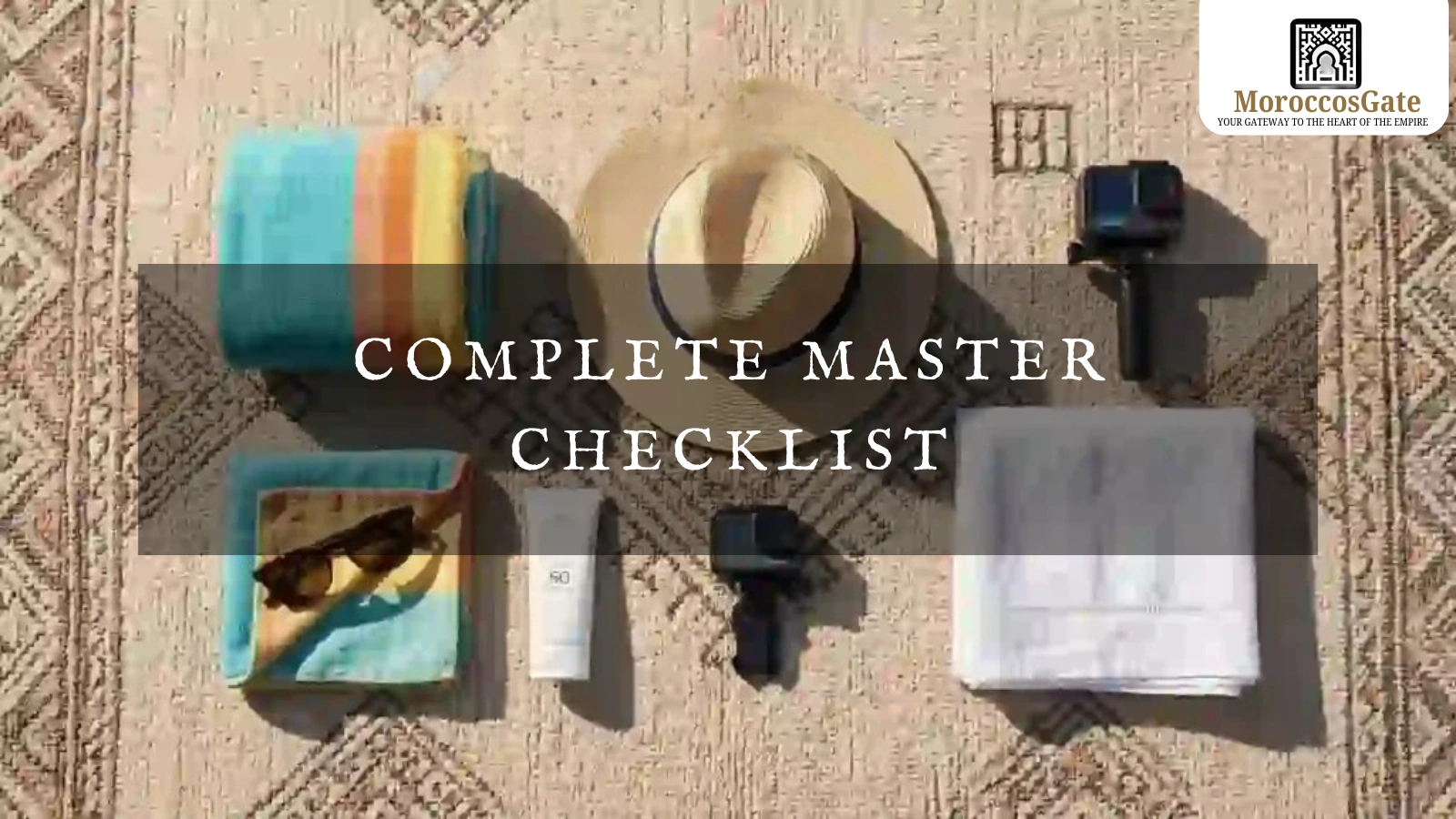
Complete Master Checklist (Print This)
Use this checklist before every Morocco trip. Tick each item as you pack it.
✈️ Documents and Money
- Passport (valid 6+ months beyond travel dates)
- Printed + digital passport copies
- Travel insurance documents (policy number + emergency contact)
- Flight confirmations (printed)
- Accommodation confirmations (first night printed)
- Driving licence + international permit (if renting a car)
- Two payment cards (different networks)
- Cash in EUR to exchange on arrival (ATMs accept cards for MAD)
- Money belt / hidden pouch
- Emergency cash (€50–100) stored separately
👗 Clothing (Summer)
- 3–4 lightweight linen/cotton tops with sleeves (women)
- 3–4 lightweight linen shirts (men)
- 2 pairs lightweight linen/cotton trousers
- 2 maxi dresses or linen skirts (women)
- 1 swimsuit / swimming trunks
- 1 lightweight scarf / pashmina
- 1 long-sleeve light evening layer
- Wide-brim hat
- UV400 sunglasses
- Comfortable sandals with arch support
- Lightweight trainers or closed shoes
- Beach flip-flops
🧥 Clothing (Winter — additions to above)
- Thermal base layer (top + bottom)
- 2 warm mid-layers (fleece / wool sweater)
- Warm outer jacket (mid-weight for south; heavy for north/mountains)
- Down jacket (for Atlas/desert nights)
- Waterproof rain jacket
- Compact travel umbrella
- Warm hat (beanie)
- Gloves (lightweight for cities; warm for mountains)
- Warm socks (3–4 pairs)
- Warm tights or leggings (women)
- Waterproof walking boots
🌞 Sun and Heat (Summer)
- SPF 50+ sunscreen (large supply from home)
- After-sun lotion
- Cooling face mist spray bottle
- Lip balm with SPF
- Reusable insulated water bottle (1L+)
💊 Health and Toiletries
- Insect repellent (DEET or plant-based)
- Imodium / anti-diarrhoeal medication
- Rehydration salts (ORS sachets)
- Activated charcoal capsules
- Antihistamine tablets
- Pain relief (paracetamol + ibuprofen)
- Blister plasters (Compeed)
- Hand sanitiser (pocket size)
- Travel pack of tissues
- Prescription medications (double supply, split across bags)
- Small first-aid kit (plasters, antiseptic wipes, bandage)
- Water filter bottle or purification tablets
- Sunscreen (see Sun section above)
📱 Electronics
- Type C / E power adapter (for UK/Irish plugs)
- Portable power bank (20,000mAh recommended)
- Phone charging cable (bring spare)
- Camera + extra SD cards
- Universal multi-port USB travel adaptor
- Google Maps Morocco downloaded offline
- Google Translate (Arabic + French) downloaded offline
🎒 Practical Gear
- Small daypack (15–20L) for souks and day trips
- Packable rain cover for daypack
- Small padlock for riad rooms or lockers
- Microfibre beach towel (thin, dries fast)
- Reusable shopping bag (plastic bags banned in Morocco since 2016)
- Packing cubes (dramatically improve bag organisation)
- Headtorch or phone torch for power cuts in old medinas
- Pen (for immigration forms on arrival)
👩 Female Solo Travellers (additional)
- Door wedge or portable door alarm
- Personal alarm keyring
- Headscarf (1–2 lightweight cotton squares)
- Longer hemline clothing as main wardrobe
- Second copy of passport stored separately from first
Frequently Asked Questions
Q1. What should I pack for Morocco in summer?
A1. For a summer Morocco trip, the essentials are lightweight linen or cotton clothing that covers shoulders and knees, a wide-brim hat, SPF 50+ sunscreen (bring from home — hard to find in quality in Morocco), a reusable water bottle, comfortable sandals with proper arch support, and a light layer for Atlantic coast evenings. Light linen or cotton clothing exclusively — synthetic fabrics are miserable in the heat. Pack pale colours to reflect rather than absorb sunlight.
Q2. Do I need to cover up in Morocco?
A2. Yes, in medinas, mosques, markets, and rural areas. Both men and women should cover their shoulders and knees. Women should also cover their cleavage. You don’t need to wear a headscarf. At beach resorts (Agadir beachfront, Essaouira beach) normal swimwear is fine on the beach itself. The practical solution is a lightweight linen outfit that covers you in medinas and a swimsuit underneath for beach days — transition between the two with a sarong or shorts and a t-shirt.
Q3. Is Morocco cold in winter? What should I pack?
A3. Morocco in winter is far colder than most visitors from warm countries expect. Coastal cities like Agadir stay mild at 18–22°C in December, but Fes, Chefchaouen, and the Atlas Mountains are genuinely cold — down to 5°C or below at night. Pack a proper warm jacket, thermal base layers for mountain visits, a warm hat and gloves, and a waterproof rain jacket. The Sahara Desert nights in December drop to 3–5°C — a sleeping bag liner and warm hat are essential for desert camps.
Q4. Can I buy things I forget in Morocco?
A4. Yes — major cities are well stocked. Marrakech, Casablanca, Fes, and Agadir all have Carrefour and Marjane supermarkets with standard toiletries, clothing, medicine, and electronics. The things to bring from home that are genuinely hard to replace in Morocco: high-factor sunscreen (quality varies and prices are high), specific prescription medications, specialist outdoor gear, and blister plasters. Everything else is available.
Q5. What power adapter do I need for Morocco?
A5. Morocco uses Type C and E plugs (round two-pin, same as continental Europe) at 220V. If you’re travelling from Ireland or the UK (Type G, three flat pins), you need an adapter. From the USA or Canada (Type A, two flat pins), you need both an adapter and a voltage converter for non-dual-voltage devices. Most modern electronics (phones, laptops, cameras) are dual-voltage and only need the plug adapter.
Q6. How much cash should I carry in Morocco?
A6. Take both a small amount of cash in Moroccan Dirham and at least one backup credit or debit card. A daily cash budget of 300–500 MAD is practical for street food, petits taxis, small medina purchases, and tips. ATMs work well in all major cities. In rural areas, smaller beach towns (Imsouane, Mirleft), and at desert camps, cash is often the only option. Always carry small bills — vendors and taxi drivers regularly claim not to have change for 100 or 200 MAD notes.
Q7. Should I bring a voltage converter for Morocco?
A7. Morocco runs at 220V / 50Hz (same as Europe). Most modern devices — phones, laptops, tablets, camera chargers — are dual-voltage (100–240V) and only need a plug adapter. Check your device charger: if it says “Input: 100–240V” you only need the plug adapter, not a voltage converter. Older single-voltage appliances (some hair straighteners, certain travel irons) will need a converter.
Q8. What should female solo travellers pack specifically for Morocco?
A8. In addition to the standard list: prioritise longer hemlines as your default clothing choice (ankle or mid-calf length is most comfortable and requires no adjustment in any environment), bring a lightweight headscarf for mosque visits, and consider a door wedge for budget accommodation. A personal alarm keyring adds inexpensive peace of mind for evening walks. A wedding ring (real or prop) is optional but some solo women find it reduces persistent souk vendor attention.
At the End
The Morocco packing list is ultimately simpler than most guides make it look. Two foundations cover everything: pack for your actual climate (which differs dramatically across the country and between seasons), and pack for the cultural environment (modest coverage for medinas, rural areas, and mosques).
Get those two things right, and the rest fills itself in. Lightweight linen for summer. Warm layers for winter. Comfortable walking shoes always. SPF 50 always. A good reusable water bottle always. And one lightweight scarf that does more work in a Morocco trip than almost anything else in your bag.
The items most Morocco travellers wish they’d brought that they didn’t: blister plasters (day one in the medina), SPF 50 sunscreen, and a wide-brim hat. The items most Morocco travellers wish they’d left behind: heavy jeans, excessive jewellery, and full-size toiletry bottles.
Pack light, pack right, and spend your energy in Morocco on the things that matter — the food, the souks, the medinas, and the extraordinary landscapes that make this one of the world’s great travel destinations.
Ready to start planning? Read our Morocco in July 2026 Complete Travel Guide, our 10-Day Morocco Itinerary 2026, and our Best Beaches in Morocco 2026 for everything else you need before you go.
About the Author
Morocco’s Gate is an Ireland-based Morocco travel resource run by a team of Morocco specialists with combined experience across every region covered in this guide. We’ve packed for summer in the Sahara, winter in the Atlas, beach weeks in Essaouira, and medina days in Fes — everything on this list has been tested on the ground. For custom trip planning or questions, visit moroccosgate.ie/contact.