
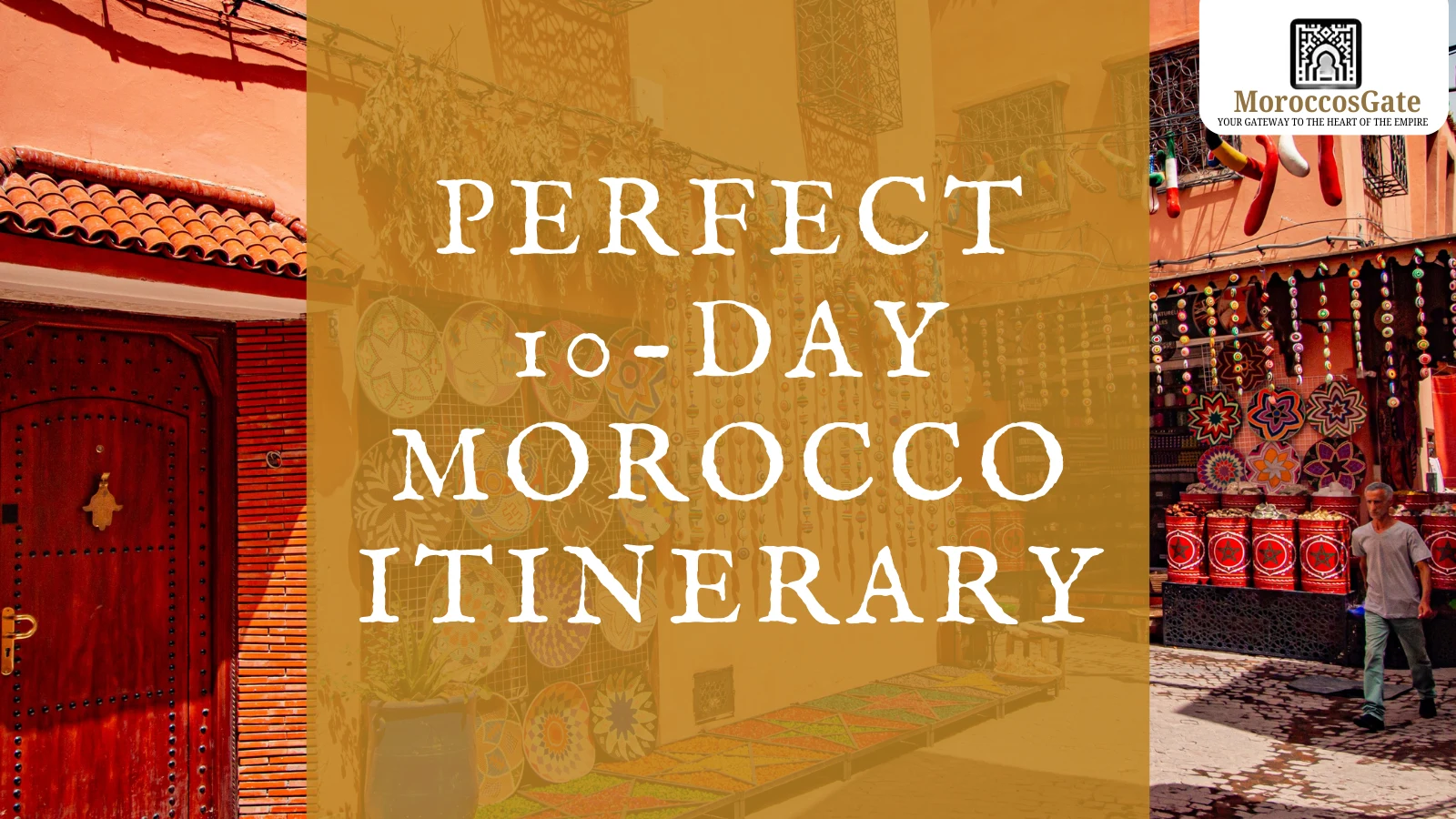
How to Plan the Perfect 10-Day Morocco Itinerary: A First-Timer’s Guide
The Sensory Opening (Evocative Lede)
- Open with a short, vivid paragraph written in second person (“You step off the plane and…”).
- Layer sensory details: the scent of cumin and cedar shavings drifting through a medina alley, the pink-gold light hitting the Atlas Mountains at dusk, the silence of the Sahara broken only by wind across the dunes.
- Tonal goal: aspirational but grounded — this is not a fantasy; this is what your trip will actually feel like.
Why 10 Days Is the Sweet Spot
- Acknowledge the common debate: “Is 10 days enough for Morocco?“
- Explain that fewer than 7 days forces painful cuts (usually the desert or the north); more than 14 days leads to travel fatigue for first-timers covering long distances.
- Position 10 days as the Goldilocks window: enough time to experience four Imperial Cities (Casablanca, Rabat, Meknes, Fes), the Sahara Desert, the dramatic gorges, and Marrakech without back-to-back 8-hour drives.
- Briefly mention that this itinerary averages 3–4 hours of driving per day, with two longer travel days broken up by scenic stops.
What This Guide Covers (The Promise)
- State explicitly: “This guide walks you through the most popular first-timer route — a one-way loop from Casablanca (CMN) to Marrakech (RAK) — day by day.”
- Bullet-point preview of what readers will get:
- A tested, day-by-day itinerary with driving times
- Pre-trip logistics (visas, currency, transport)
- Cultural tips only a local guide would share
- Accommodation style recommendations (riads vs. hotels)
- A downloadable summary map (content upgrade / lead magnet opportunity)
Book Your Flight Ticket Now.
Explore more Flights Deals go to : deals.moroccosgate.com/flight-deals/
Quick-Glance Itinerary Summary (Skimmable Element)
| Day | Destination | Highlight | Drive Time |
|---|---|---|---|
| 1 | Casablanca | Hassan II Mosque | NA |
| 2 | Rabat → Chefchaouen | Blue City streets | ~4.5 hrs |
| 3 | Chefchaouen → Volubilis → Meknes → Fes | Roman ruins | ~5 hrs (with stops) |
| 4 | Fes | Medina deep dive | NA |
| 5 | Fes → Middle Atlas → Merzouga | Cedar forests, Ifrane | ~7 hrs (with stops) |
| 6 | Merzouga (Sahara) | Camel trek & desert camp | NA |
| 7 | Merzouga → Todra Gorge → Dades Valley | Gorge hike | ~4 hrs |
| 8 | Dades → Ouarzazate → Ait Benhaddou | Film studios, Kasbah | ~3 hrs |
| 9 | Ait Benhaddou → Marrakech | Tizi n’Tichka Pass | ~4 hrs |
| 10 | Marrakech | Souks, Majorelle Garden | NA |
PRE-TRIP ESSENTIALS — BUILDING TRUST
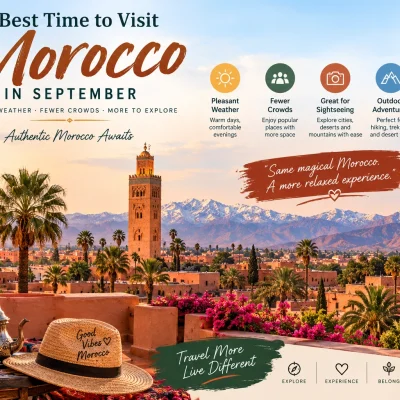
Best Time to Visit Morocco
- Recommend Spring (March–May) and Autumn (September–November) as the primary windows.
- Spring: wildflowers in the Atlas, comfortable desert temperatures (25–30°C / 77–86°F), fewer crowds than April shoulder.
- Autumn: post-summer cool-down, harvest season in the valleys, golden light ideal for photography.
- Shoulder considerations:
- June and early September are workable but hot in the desert (40°C+); advise early-morning camel treks.
- December–February: cooler, possible snow on Atlas passes (Tizi n’Tichka can close temporarily); great for Marrakech and coastal cities but limit desert comfort.
- Ramadan note: Explain that Morocco remains very tourist-friendly during Ramadan, but restaurant hours shift and some local businesses close during daytime. Note that it’s a unique cultural experience if travelers are respectful.
- Visual element: Small climate chart graphic showing temperature ranges and rainfall by month for Marrakech, Fes, and Merzouga.
Entry Requirements & Practical Info
- Visa: 90-day visa-free entry for US, EU, UK, Canadian, and Australian passport holders (advise checking latest requirements on the Moroccan consulate website for other nationalities).
- Currency: Moroccan Dirham (MAD). Note that MAD is a closed currency — cannot be purchased abroad easily. Advise:
- Withdraw from ATMs upon arrival (widely available at airports and cities).
- Carry cash for small towns, souks, and tips; credit cards accepted at larger hotels and restaurants in cities.
- Typical daily budget ranges: budget (€50–70/day), mid-range (€100–180/day), comfort (~€200–350/day).
- Language: Darija (Moroccan Arabic) and Amazigh (Berber) are native; French is widely spoken in cities and tourism; English increasingly common in tourist areas but limited in rural zones.
- SIM card / connectivity: Recommend purchasing a local SIM (Maroc Telecom or Inwi) at the airport for ~50–100 EUR with data. Alternatively, mention eSIM options (Airalo, Holafly) for convenience.
- Travel insurance: Strongly recommend comprehensive coverage that includes adventure activities (camel trekking) and remote area evacuation.
Getting There: Flights & Airports
- Primary gateways:
- Casablanca Mohammed V (CMN): Largest international hub; best for this itinerary’s start point. Direct flights from NYC (JFK), London (LHR/LGW), Paris (CDG/ORY), and many European cities.
- Marrakech Menara (RAK): Growing number of direct European routes (especially budget carriers like Ryanair, easyJet). Ideal as a departure airport for this one-way route.
- Open-jaw booking tip: Explain the concept of flying into CMN and out of RAK (or vice versa) to avoid backtracking. Note that this sometimes costs slightly more but saves an entire day of travel.
- Domestic flights: Royal Air Maroc operates Casablanca–various cities, but for a 10-day road itinerary, flights are unnecessary.
Get international direct flight with discount got to: deals.moroccosgate.com
Getting Around: Transport Options Compared
- Option A: Private Driver/Guide (Recommended for First-Timers)
- Why: Eliminates navigation stress, provides live cultural commentary, handles mountain passes and desert roads, allows flexible stops.
- Cost range: ~€100–180/day for a driver with air-conditioned vehicle (4×4 for desert segments).
How to vet: licensed tourism transport, read reviews, confirm vehicle type, clarify what’s included (fuel, tolls, parking). - Tipping norms: 100–200 EUR/day for a driver.
- Option B: Self-Driving (Rental Car)
- Pros: Total flexibility, lower cost for groups.
- Cons: Driving culture is aggressive by Western standards, GPS unreliable in medinas, parking is chaotic in old cities, desert roads require 4×4 experience.
- Best for: Experienced international drivers comfortable with mountain switchbacks; not ideal for first-timers
- Rental tips: Book from international agencies at the airport; inspect vehicle thoroughly; get full insurance
- Option C: Public Transport (Trains + Buses)
- Trains (ONCF): Excellent and affordable for the Casablanca–Rabat–Meknes–Fes corridor. First-class tickets are ~€10–20. Morocco’s new Al Boraq high-speed train connects Casablanca to Tangier in 2 hours.
- Buses (CTM / Supratours): Reliable for longer routes but slow; limited for off-the-beaten-path gorges and desert
Grand taxis: Shared Mercedes sedans connecting smaller towns; adventurous but cramped. - Verdict: Public transport works for the northern cities but becomes impractical for the desert and gorge segments (Days 5–9).
- Visual element: Comparison table — Private Driver vs. Rental Car vs. Public Transport — rated on cost, convenience, flexibility, and safety.
Cultural Etiquette Quick Guide
- Dress code:
- Morocco is moderate but conservative outside tourist zones. Advise covering shoulders and knees, especially in medinas, rural areas, and near mosques.
- Swimwear only at pools/beaches.
- Headscarf not required for female travelers but carrying a scarf is useful for mosque visits and sun protection.
- Greetings: “Salaam alaikum” goes a long way; handshakes are common but some conservative men/women may not shake hands with the opposite gender — follow their lead.
- Photography: Always ask before photographing people, especially in rural Berber communities. Some vendors may request a small tip.
- Tipping culture: Expected and appreciated — 10–15% in restaurants, 20–50 EUR for small services (luggage help, guided explanations at historical sites), 50–100 EUR for riad staff per stay.
- Alcohol: Available in licensed restaurants, bars, and some riads in cities; not served in traditional establishments or smaller towns. Respectful discretion advised during Ramadan.
- Mosque access: Non-Muslims cannot enter mosques in Morocco, with the sole exception of the Hassan II Mosque in Casablanca (guided tours available).
Packing Essentials (Brief List or Link to Cluster Post)
- Layers (desert nights drop to 5–10°C even when days are 30°C+)
- Comfortable walking shoes with grip (cobblestone medinas are uneven)
- Scarf/shawl (versatile: sun cover, mosque visits, sand protection)
- Sunscreen, sunglasses, hat
- Plug adapter (Type C/E, European two-pin)
- Small daypack for medina wandering
Explore all hot deals just by click: deals.moroccosgate.com
THE DAY-BY-DAY ITINERARY
DAY_1: Arrival in Casablanca — Morocco’s Modern Gateway
Quick Stats Box:
- Overnight: Casablanca
- Driving: None (airport transfer only, ~30 min)
- Top Highlight: Hassan II Mosque
Content Points:
- Arrival logistics: Navigating CMN airport — passport control, ATM withdrawal, SIM card purchase, meeting your driver or arranging a taxi (insist on the meter or agree on a price: ~200–250 EUR to city center).
- Hassan II Mosque:
- Emphasize that this is the only mosque in Morocco open to non-Muslims — a truly rare opportunity.
- Architectural facts: third-largest mosque in the world, 210m minaret (tallest religious structure on Earth), retractable roof, built partially over the Atlantic Ocean.
- Guided tour schedule: typically 9am, 10am, 11am, 2pm (confirm locally); ~130 EUR entry; tours last ~1 hour; dress modestly, remove shoes.
- Photography tip: the best exterior shot is from the seaside corniche at golden hour.
- Afternoon/Evening:
- Stroll the Corniche (beachfront promenade) for a feel of modern Moroccan life.
- Walk through the Habous Quarter (Nouvelle Medina) — a quieter, more orderly introduction to Moroccan architecture before tackling the chaos of Fes.
- Optional: Rick’s Café — a tourist-oriented but charming recreation inspired by Casablanca (the movie). Worth a drink if not a full meal.
- Dinner recommendation: Seafood at the Central Market area or a rooftop restaurant in the Corniche — introduce readers to their first tagine or pastilla.
- Accommodation style: Modern hotel or business-style riad (Casablanca is more cosmopolitan than traditional).
- Insider tip: “Don’t over-invest time in Casablanca. One afternoon and evening is sufficient. The real magic begins tomorrow.”.
Day_2: Rabat & the Journey to Chefchaouen — From Capital to Blue City
Quick Stats Box:
- Overnight: Chefchaouen
- Driving: Casablanca → Rabat (~1 hr) → Chefchaouen (~3.5 hrs)
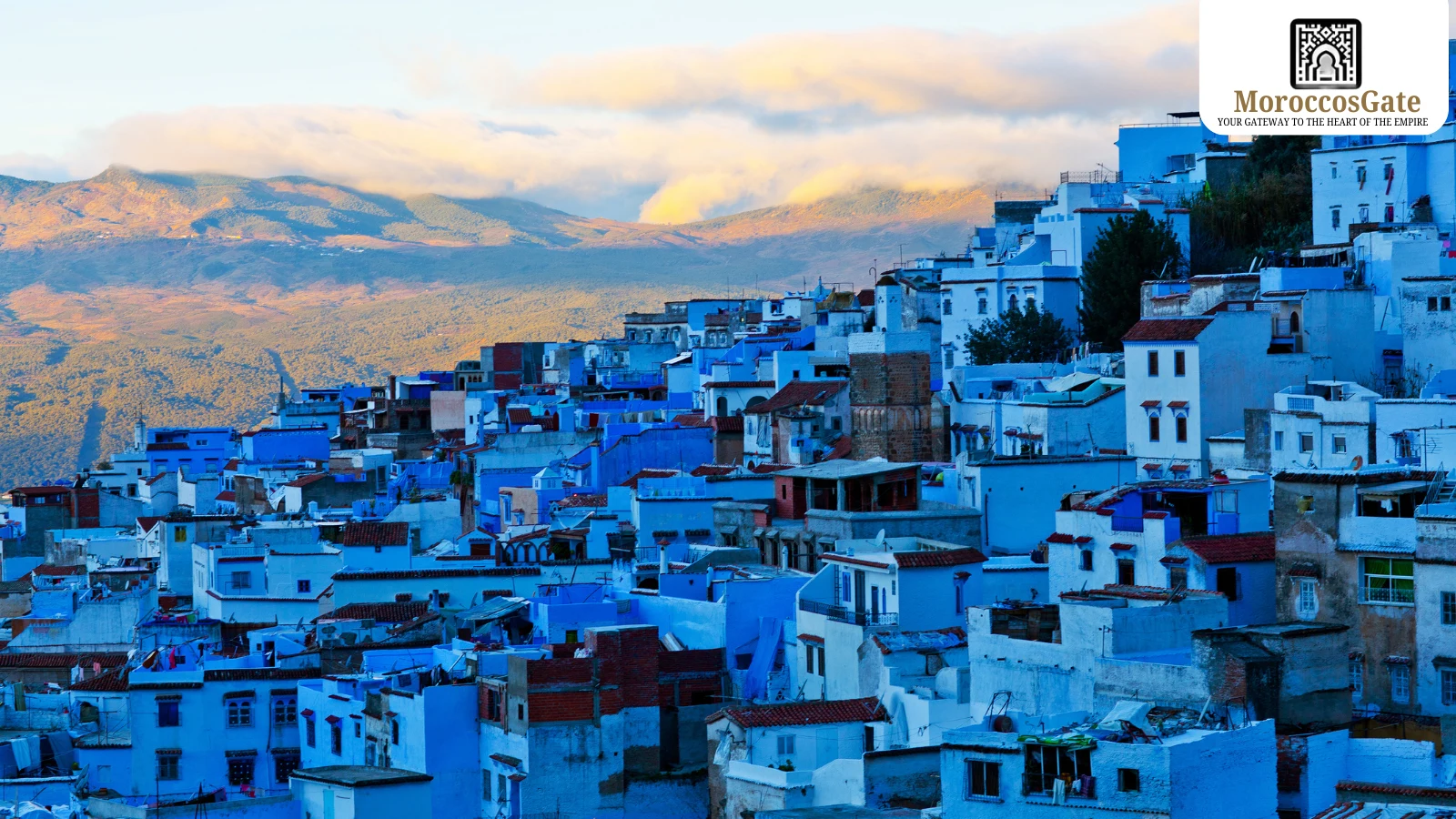
- Top Highlight: First glimpse of Chefchaouen’s blue medina at dusk
Content Points:
- Morning in Rabat (2–3 hours):
- Hassan Tower & the Mausoleum of Mohammed V: Unfinished 12th-century minaret from the Almohad dynasty + stunning modern mausoleum with intricate zellige tilework; free entry, guards in traditional dress, respectful photography allowed outside the mausoleum.
- Kasbah of the Udayas: A compact, photogenic fortress overlooking the Bou Regreg river; Andalusian Gardens inside are a serene 15-minute stop; blue-and-white painted streets foreshadow Chefchaouen.
- Why Rabat matters: It’s the political capital but often skipped — a brief stop gives context to Morocco’s governance and modernization.
- Drive to Chefchaouen:
- Route: A1/A2 highway north through rolling farmland, then winding Rif Mountain roads.
- Scenery shift: From flat agricultural plains to dramatic green mountains — a visual preview of Morocco’s geographic diversity.
- Stop suggestion: Quick lunch in Ouezzane (a small town known for olive oil and a relaxed pace) or pack sandwiches.
- Arrival in Chefchaouen (Late Afternoon):
- Explain the town’s backstory: Founded in 1471 as a fortress; the blue paint tradition has several origin theories (Jewish refugees, mosquito repellent, spiritual symbolism).
Evening activity: Check into a riad, then walk the medina as the late-afternoon light turns the blue walls electric. Wander to Plaza Uta el-Hammam for mint tea and people-watching. - Photography tip: The best light for blue-wall photos is in the morning (8–10am) before shadows deepen — set an alarm for Day 3 if photography-focused.
- Explain the town’s backstory: Founded in 1471 as a fortress; the blue paint tradition has several origin theories (Jewish refugees, mosquito repellent, spiritual symbolism).
- Accommodation: Small family-run riad within the medina (many have rooftop terraces with Rif Mountain views; budget options available from ~€30–50/night).
- Dinner: Rooftop restaurant overlooking the square; try rfissa (a Chefchaouen specialty with lentils, fenugreek, and shredded msemen bread).
- Insider tip: “Chefchaouen is a place to slow down. Resist the urge to see everything in one evening — the magic is in the aimless wandering.”.
DAY_3: Chefchaouen → Volubilis → Meknes → Fes — A Day of Layers
Quick Stats Box:
- Overnight: Fes
- Driving: ~5 hours total (broken into 3 segments with stops)
- Top Highlight: Walking through the Roman ruins of Volubilis
Content Points:
- Early Morning in Chefchaouen:
- Sunrise photography walk through the medina (near-empty streets, golden light on blue walls).
- Quick breakfast at the riad, then depart by 8:30–9:00am.
- Volubilis (UNESCO World Heritage Site) — Mid-Morning Stop:
- Drive time from Chefchaouen: ~3 hours.
- What it is: The best-preserved Roman ruins in North Africa; a former provincial capital of the Roman Empire dating to the 3rd century BC.
- What to see: The Triumphal Arch of Caracalla, remarkably intact floor mosaics (Orpheus, Diana, Hercules), the Basilica, and olive press reconstructions.
- Practical: Entry ~70 EUR; hire a local guide at the entrance (~150 EUR for ~1 hour) for context — worth it. Bring water and sun protection (no shade).
- Time needed: 1–1.5 hours
- Why it matters for the itinerary: It shatters the assumption that Morocco is “only” Islamic architecture — it reveals millennia of layered civilizations.
- Meknes — Lunch Stop (1.5–2 hours):
- Drive time from Volubilis: ~30 minutes.
- Known as the “Versailles of Morocco” due to Sultan Moulay Ismail’s 17th-century ambition to rival Louis XIV.
- Must-see: Bab el-Mansour — arguably the most impressive gate in all of Morocco; massive, tiled, and impossibly grand
Walk through Place el-Hedim (Meknes’s main square, a quieter version of Marrakech’s Jemaa el-Fnaa). - Optional: Heri es-Souani (royal granaries and stables designed for 12,000 horses — eerie, vast, architecturally stunning).
- Lunch recommendation: Try Meknes wine — the region is one of Morocco’s few wine-producing areas; pair with a lamb tagine at a restaurant near the square.
- Arrival in Fes (Late Afternoon):
- Drive time from Meknes: ~1 hour on the highway.
- Check into a riad inside the medina — this is essential for the Day 4 experience.
- Riad selection tip: Choose one near Bab Boujloud (the blue gate) for easier navigation, or one deeper in the medina for a more immersive (but potentially disorienting) experience.
- Evening: Rooftop dinner at the riad or a short walk to a medina restaurant; early night — tomorrow is a full day.
Insider tip: “Day 3 is the longest driving day in the first half of the trip. The Volubilis and Meknes stops break it up perfectly, but leave Chefchaouen early to avoid feeling rushed.”.
Share Your Taxi/Cab and get more Cheap.

DAY 4: Fes — Deep Dive into the World’s Largest Car-Free Urban Zone
Quick Stats Box:
- Overnight: Fes
- Driving: None
- Top Highlight: The sensory overload of Fes el-Bali medina
Content Points:
- Why Fes deserves a full day:
- Fes el-Bali (the old medina) is a UNESCO World Heritage Site and the world’s largest contiguous car-free urban area — 9,400+ alleyways, home to ~150,000 people.
- It is the spiritual and intellectual heart of Morocco; it can feel overwhelming, which is why a licensed local guide is strongly recommended (half-day: ~300–500 EUR; full-day: ~500–800 EUR).
- Morning Itinerary (with guide):
- Bab Boujloud (Blue Gate): The iconic entry point into the medina — tiled in blue on one side, green on the other (representing Fes and Islam respectively)
- Bou Inania Madrasa: One of the few religious buildings in Fes open to non-Muslims; jaw-dropping carved stucco, cedar wood, and zellige tilework.
- The Tanneries (Chouara Tannery): The most famous sight in Fes — ancient stone vats filled with colored dyes where leather is still processed by hand using medieval techniques.
- Viewing tip: Visit from a surrounding leather shop’s terrace (free, but you’ll be offered goods to buy — no obligation). Take mint to hold under your nose; the smell is intense.
- Best time: Morning light for photography; the vats are most colorful when freshly filled.
- Al-Qarawiyyin University: Founded in 859 AD by Fatima al-Fihri, recognized by UNESCO and Guinness as the oldest continuously operating university in the world. Non-Muslims cannot enter, but the courtyard is visible from the doorway and the exterior architecture is stunning.
- Nejjarine Museum of Wooden Arts & Crafts: A beautifully restored caravanserai (fundouk) with a rooftop terrace offering medina panoramas.
- Lunch: Eat inside the medina — recommendations:
- Budget: Street food at a stall near Talaa Kebira (try a bocadillo — Moroccan sandwich with kefta).
- Mid-range: A traditional restaurant serving pastilla (the sweet-savory pigeon/chicken pie dusted with cinnamon and powdered sugar — a Fes specialty).
- Splurge: Riad-restaurant with a set Moroccan menu (multiple courses, often featuring mechoui — slow-roasted lamb).
- Afternoon Options (choose based on energy):
- Option_A (Culture): Visit the Mellah (historic Jewish quarter) and the Ibn Danan Synagogue — a reminder of Morocco’s once-thriving Jewish community.
- Option_B (Artisan): Arrange a pottery workshop in the Fes pottery district on the hills above the medina — watch artisans hand-paint geometric designs and try your own.
- Option_C (Panoramic): Drive/taxi to the Merenid Tombs on the hill overlooking the medina for a sunset panorama — the entire medina spreads below like a living map.
- Evening: Dinner at a rooftop riad; optional: attend a traditional Andalusian music performance (Fes is the custodian of this tradition).
Insider tip: “Getting lost in Fes is inevitable and part of the experience. But if you’re genuinely stuck, ask a shopkeeper to point you toward Talaa Kebira (the main downhill artery) or Bab Boujloud. Avoid following anyone who ‘offers to help’ and then demands payment.”.
DAY_5: Fes → Middle Atlas → Merzouga — The Road to the Sahara
Quick Stats Box:
- Overnight: Merzouga (desert edge)
- Driving: ~7 hours total (with multiple stops)
- Top Highlight: The dramatic landscape transformation from green mountains to red desert
Content Points:
- Why this is a driving day worth savoring:
- This is not a “transit day” — it’s one of the most scenic drives in Morocco. The landscape morphs through four distinct ecosystems in a single day: Mediterranean green → Alpine forest → arid steppe → Saharan dunes.
- Stop_1: Ifrane — “Morocco’s Switzerland” (~1 hour from Fes):
- A jarring contrast: neat European-style chalets, flower boxes, a famous stone lion statue, and even a ski resort nearby.
- Built during the French Protectorate era as a hill station.
- Quick photo stop + coffee: 20–30 minutes.
- Stop_2: Azrou Cedar Forest (~30 min from Ifrane):
- Ancient Atlas cedar forest home to Barbary macaques (North Africa’s only primate species; endangered).
- Short walk among the trees; the monkeys are habituated but do not feed or touch them.
- Time: 30–45 minutes.
- Stop_3: Midelt — Lunch (~1.5 hours from Azrou):
- A crossroads town at the base of Jebel Ayachi (3,747m); known for apple orchards and mineral shops.
- Good lunch stop — simple roadside restaurants serving hearty harira (tomato-lentil soup) and brochettes.
- The Ziz Gorge & Ziz Valley (Afternoon):
- After Midelt, the road descends through the Tizi n’Talrhemt Pass and into the stunning Ziz Gorge — a dramatic canyon with a river-fed palm oasis below.
- Stop at the Panoramic Viewpoint (signposted) for one of the trip’s best photos: red canyon walls, green palms, blue sky.
- The Ziz Valley unfolds into Errachidia and onward to Erfoud — the landscape turns increasingly Saharan: flat, red, scattered palms.
- Arrival in Merzouga (Late Afternoon/Early Evening):
- First sight of the Erg Chebbi dunes — a wall of orange-gold sand rising up to 150m on the horizon.
- Check into a hotel/auberge on the edge of the dunes (pre-arrange with your desert camp provider).
- Prepare for the next morning’s early start or, if arriving with time, take a sunset 4×4 excursion to a nearby Berber village.
Insider tip: “This is the longest driving day of the trip. A private driver handles it comfortably with stops, but if self-driving, ensure your vehicle is fueled in Midelt — gas stations become sparse after Errachidia.”.
DAY_6: Sahara Magic — Merzouga & the Erg Chebbi Dunes
Quick Stats Box:
- Overnight: Desert bivouac camp (luxury or traditional Berber tent)
- Driving: Minimal (4×4 + camel transport)
- Top Highlight: Watching the sunset from a dune crest, followed by a night of stars and Berber music
Content Points:
- Morning Options (before the main event):
- Option_A: Visit a Gnawa music village near Khamlia (~15 min from Merzouga) — Gnawa is a spiritual/musical tradition rooted in sub-Saharan African heritage; musicians perform in a small community center (donation-based; deeply moving).
- Option_B: Fossil hunting near Erfoud — the region is rich in 360-million-year-old marine fossils (trilobites, ammonites); visit a fossil workshop to see how they’re excavated and polished.
- Option_C: Relax at the hotel, swim in the pool (many desert-edge hotels have pools — a surreal experience with dunes in the background).
- Afternoon: The Camel Trek (~4:00–5:00 PM departure):
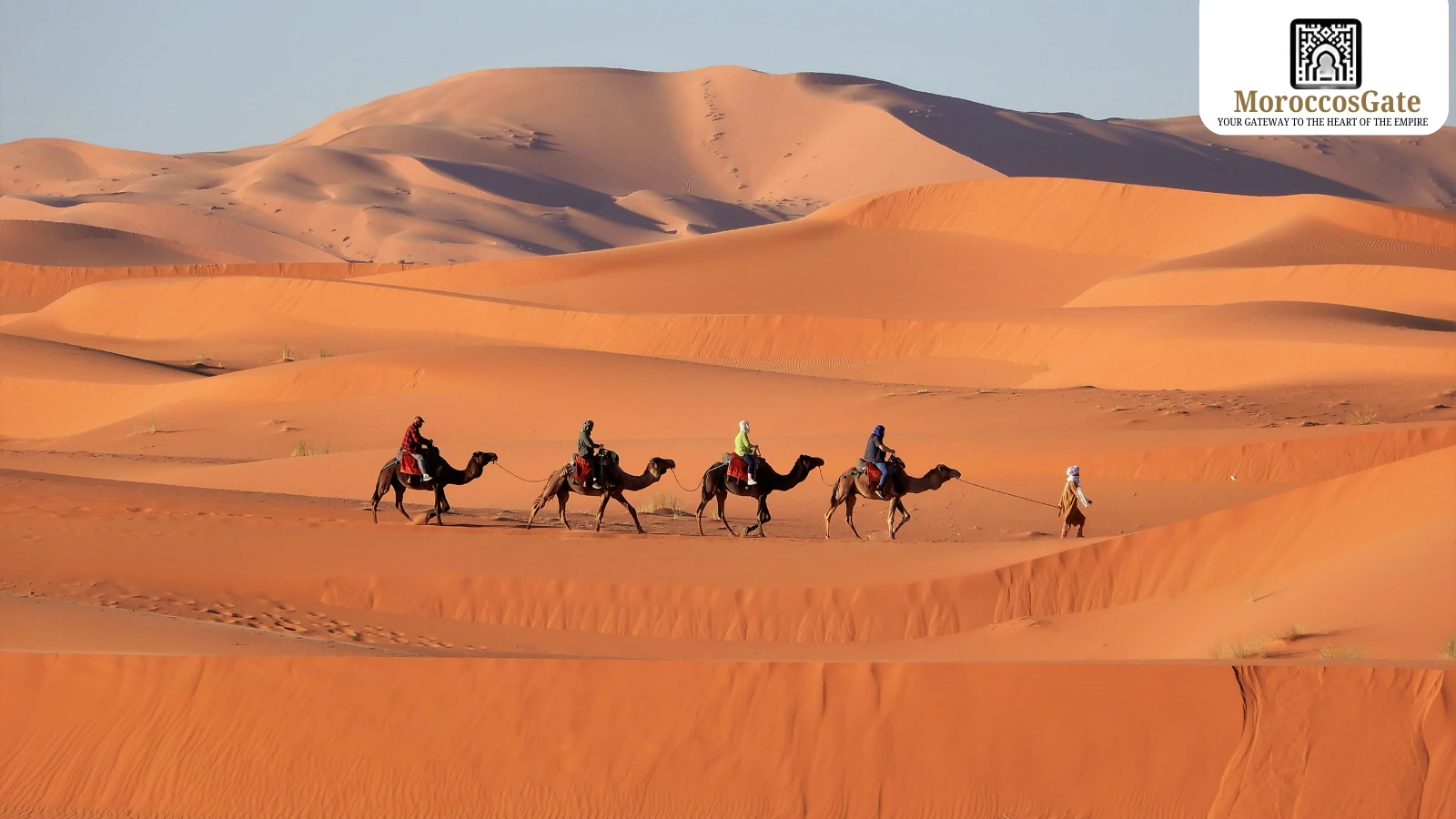
- Mount dromedary camels (one-humped; gentle but awkward gait — warn readers!) at the edge of Erg Chebbi.
- Trek duration: 1–1.5 hours into the dunes to reach the bivouac camp.
- The dunes change color as the sun drops: gold → amber → deep orange → rose → purple.
- Reach the summit of a high dune for the sunset — this is the trip’s emotional pinnacle. Silence, vastness, perspective.
- Photography: Bring a phone/camera with plenty of storage. A sand-proof bag/ziplock for your device is essential — fine Saharan sand gets into everything.
- Evening at the Desert Camp:
- Camp types:
- Standard Berber camp: Traditional nomad-style tents, shared facilities, communal area with carpets and cushions (~€40–80 per person including dinner and breakfast).
- Luxury desert camp: Private tents with en-suite bathrooms, king beds, solar-powered lighting, sometimes even air conditioning (~€150–400+ per person).
- Advise booking through a reputable operator; ask for reviews and recent photos.
- Dinner: Traditional Berber meal — usually a vegetable tagine cooked in a sand oven, couscous, salads, fruit, and mint tea.
- After dinner: Berber drumming circle around the fire; stargazing (Erg Chebbi has Bortle Class 1–2 skies — among the darkest in the world; Milky Way is visible to the naked eye).
- Sunrise: Wake at ~5:30am to climb a dune and watch the sun rise over the dune sea — rivaling the sunset in beauty.
- Camp types:
Insider tip: “The desert gets cold at night, even in summer. Temperatures can drop below 10°C (50°F) from November to March. Bring a warm layer and socks. The camps provide thick blankets, but a personal fleece makes a big difference.”.
Keep Glowing and Keep Traveling.
DAY_7: Sahara → Todra Gorge → Dades Valley — The Road of a Thousand Kasbahs
Quick Stats Box:
- Overnight: Dades Valley (Dades Gorge area)
- Driving: ~4–5 hours total
- Top Highlight: The towering walls of Todra Gorge
Content Points:
- Morning: Sunrise & Return from Desert Camp
- Camel ride back to Merzouga (~45 min) or 4×4 pickup; shower and breakfast at the hotel.
- Depart by 9:00–9:30am.
- The Route: The “Road of a Thousand Kasbahs”
- Explain that this stretch of road (N10) between Merzouga and Ouarzazate is lined with crumbling kasbahs (fortified Berber residences) and ksour (fortified villages) — many centuries old, made of rammed earth (pisé), slowly eroding back into the landscape.
- The name is poetic but accurate — the density of historical structures is remarkable.
- Todra Gorge (Mid-Morning/Midday):
- A narrow canyon where 300m-high limestone cliffs press in to just 10 meters apart at the narrowest point.
- Short walk along the gorge floor (flat, easy, ~30–45 minutes); a river runs through the base.
- Rock climbing: Todra is a world-renowned climbing destination — mention it for adventurous readers, but emphasize it’s not necessary to enjoy the gorge.
- Lunch: Small restaurants at the gorge mouth serve simple but fresh tagines; eat riverside if possible.
- Photography: The gorge floor is in shadow by midday — best light is early morning or late afternoon. Since most travelers arrive midday, note that the shadows can be dramatic in photos.
- Afternoon: Dades Valley & Dades Gorge
- Continue west along the Dades Valley — palm groves, almond orchards (spectacular in February bloom), and more kasbahs.
- Dades Gorge switchbacks: A famous section of serpentine road carved into red rock — one of Morocco’s most photographed drives. Even if not staying deep in the gorge, drive up to the viewpoint for the switchback panorama.
- Ait Youl Kasbah or similar: Stop at a traditional kasbah-turned-guesthouse for mint tea and a view.
- Accommodation: Kasbah-hotel or guesthouse in the Dades Valley — many are family-run, perched above the valley with terraces overlooking the river and orchards.
- Dinner: Hotel restaurant (most guesthouses in this area serve excellent home-cooked Berber meals — tajine with almonds and prunes is a regional specialty).
Insider tip: “The Dades Valley is one of Morocco’s most underrated areas. If you have flexibility, spending a second night here to hike in the gorge or visit a Berber village is deeply rewarding. But on a 10-day itinerary, one night captures the essence.”.
DAY_8: Dades Valley → Ouarzazate → Ait Benhaddou — Hollywood of Africa
Quick Stats Box:
- Overnight: Ait Benhaddou area
- Driving: ~3 hours total
- Top Highlight: Walking through the ancient kasbah of Ait Benhaddou
Content Points:
- Morning Drive: Dades to Ouarzazate (~1.5 hours)
- Continue along the “Road of a Thousand Kasbahs” westward.
- The Valley of Roses (Kelaat M’Gouna): If traveling in April/May, the valley is filled with Damascene roses harvested for rosewater and cosmetics; the annual Rose Festival is a vibrant local event. Even outside season, stop at a rosewater cooperative to buy products directly.
- Skoura: A lush palm oasis with the Kasbah Amridil (featured on the 50 EUR banknote) — a quick photo stop.
- Ouarzazate — “The Door of the Desert”:
- A modern administrative city that became Morocco’s film capital due to its dramatic landscapes and reliable sunshine.
- Atlas Studios (or CLA Studios): Tour the sets used in Gladiator, Kingdom of Heaven, Game of Thrones (Yunkai, Pentos), The Mummy, Babel, and many others. Guided tours ~60–80 EUR, ~1 hour.
- Taourirt Kasbah: A sprawling 19th-century fortress in the center of town, partially restored by UNESCO — good for a 30-minute walkthrough.
- Lunch in Ouarzazate: Simple but good options near the main avenue; try a tanjia (slow-cooked meat urn, traditionally from Marrakech but found here too).
- Ait Benhaddou (UNESCO World Heritage Site) — Afternoon:
- Drive from Ouarzazate: ~30 minutes.
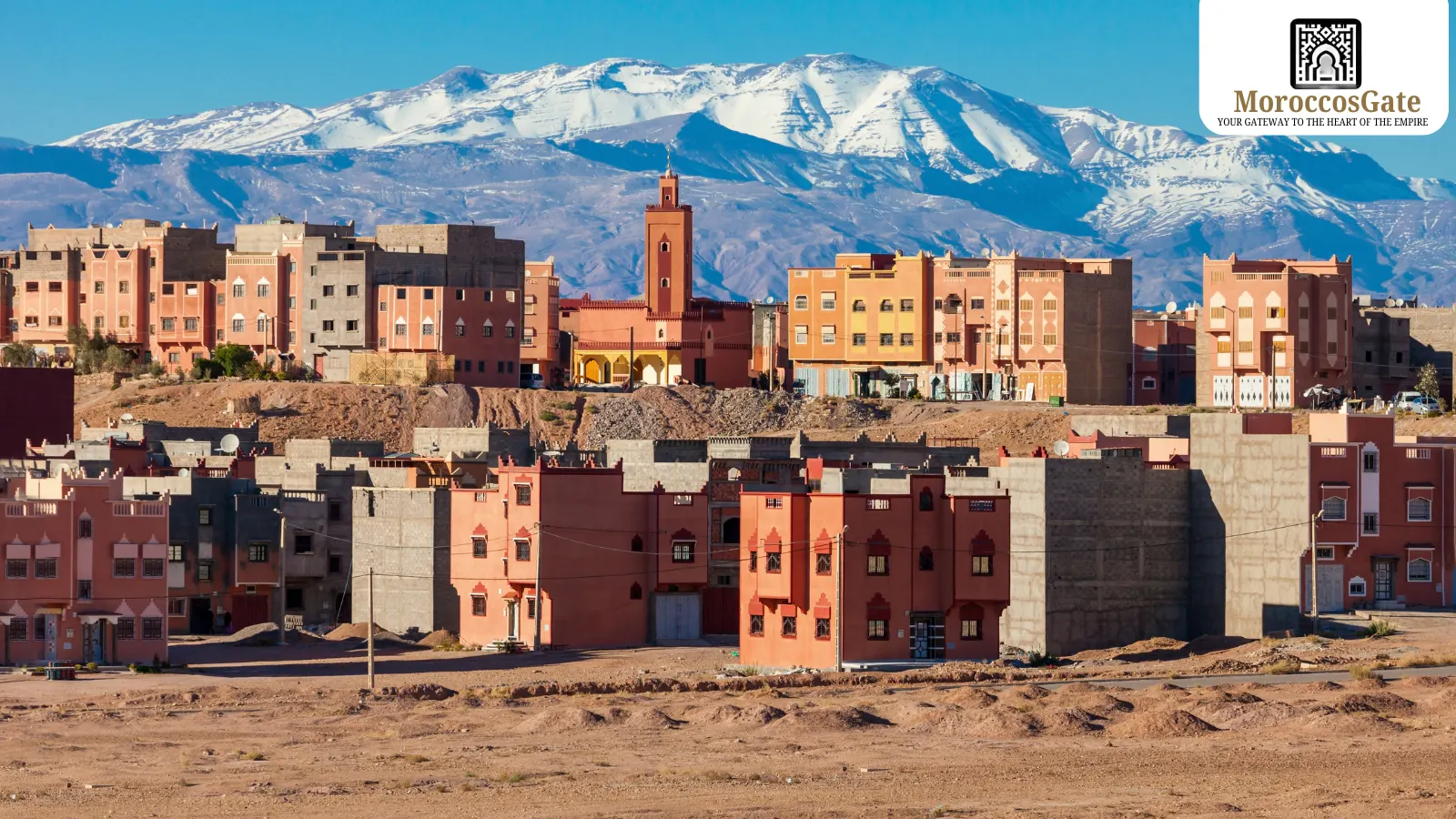
- What it is: A stunning ksar (fortified village) of packed-earth buildings rising from the banks of a shallow river, backed by barren hills. It is perhaps the most iconic image of Morocco after the Sahara and the blue streets of Chefchaouen.
- Film history: Featured in Lawrence of Arabia, Gladiator (as the gladiator training camp), Game of Thrones (as Yunkai — “Yellow City”), The Mummy, and 20+ other productions.
- Walking the ksar: Cross the river (stepping stones or a footbridge depending on season), then climb through the narrow alleys to the granary at the top for a 360° panorama of the desert valley. ~45 min–1 hour.
- A few families still live inside the ksar; their homes sometimes double as small shops or art galleries.
- Sunset: The golden hour light on Ait Benhaddou is extraordinary — the earth buildings glow amber against the sky. Position yourself across the river for the classic wide shot.
- Accommodation: Kasbah-hotel directly facing Ait Benhaddou — waking up to this view is worth the stay. Several options range from budget.
Insider tip: “Visit Ait Benhaddou in the late afternoon when the tour bus crowds have left and the light is at its most magical. Early morning (before 9am) is the other sweet spot.”
DAY_9: Ait Benhaddou → Tizi n’Tichka → Marrakech — Crossing the High Atlas
Quick Stats Box:
- Overnight: Marrakech
- Driving: ~4 hours
- Top Highlight: The dramatic Tizi n’Tichka mountain pass and the first encounter with Jemaa el-Fnaa
Content Points:
- The Drive: Tizi n’Tichka Pass
- One of Morocco’s most spectacular drives: the N9 highway climbs from the desert-side of the Atlas through switchbacks and valleys to a summit of 2,260 meters (7,415 feet) before descending into the Haouz Plain toward Marrakech.
- The scenery: terraced Berber villages clinging to hillsides, walnut and almond orchards, occasional snow in winter, vast panoramic viewpoints.
- Stops en route:
- Telouet Kasbah (optional detour, ~20 min off main road): A crumbling but hauntingly beautiful palace of the Glaoui family (powerful early-20th-century warlords). Few tourists make the detour — largely unrestored, with rooms of faded zellige and carved plaster ceilings collapsing in slow motion. This is an E-E-A-T differentiator — most generic itineraries skip it.
- Argan oil cooperatives: Women’s cooperatives along the descent demonstrate the traditional (labor-intensive) process of pressing argan nuts; products available for purchase (ensure it’s a genuine cooperative, not a tourist trap — ask your driver).
- Driving note: The road is well-paved but winding with steep drop-offs. Confident driving required if self-driving; a driver handles this routinely.
- Arrival in Marrakech (Early-Mid Afternoon):
- Check into a riad in the medina — location recommendations:
- Near Jemaa el-Fnaa: Most convenient for first-timers, walking distance to everything.
- Riad Zitoun area: Slightly quieter but still central.
- Kasbah/Mellah area: Near Bahia Palace and Saadian Tombs, less hectic.
- Note on riad navigation: Provide the riad’s GPS pin AND their phone number — many riads send someone to meet you at a nearby landmark because the alleys are impossible to navigate by car.
- Check into a riad in the medina — location recommendations:
- Afternoon: First Taste of Marrakech
- Decompress in the riad’s courtyard (most have plunge pools, fountains, and orange trees).
- Late-afternoon walk to Jemaa el-Fnaa:
- By day: juice stalls (fresh-squeezed orange juice for 5 EUR), henna artists, Berber musicians.
- By dusk: the square transforms — food stalls set up, storytellers and musicians emerge, snake charmers appear (note: ethically controversial; observe from a distance if uncomfortable).
- Describe the sensory overload honestly: smoke, drums, shouting, crowds, motorbikes threading through pedestrians — exhilarating for some, overwhelming for others. Normalize both reactions.
- Dinner options:
- At the food stalls: Adventurous and iconic — grilled meats, snail soup (babouche), sheep head (for the daring). Stalls 1, 14, and 32 are often recommended, but quality varies nightly. Eat where locals eat.
- Rooftop restaurant overlooking the square: Le Jardin, Nomad, or Café de France terrace — elevated (literally and figuratively) perspective on the chaos below.
- Splurge riad dinner: Many riads offer multi-course dinners (book in advance); an intimate alternative to the square.
Insider tip: “Your first 30 minutes in the Jemaa el-Fnaa will be the most intense of the trip. Stay aware of your belongings, say ‘la shukran’ (no thank you) firmly to touts, and know that the square is safe — just noisy, pushy, and magnificent.”.
Check all hot deals of Marrakech
DAY_10: Marrakech Discovery & Departure — The Grand Finale
Quick Stats Box:
- Overnight: Departure (or extend stay)
- Driving: To RAK airport (~20 min from medina)
- Top Highlight: Majorelle Garden and the souks
Content Points:
- Morning Itinerary (8:00am–12:30pm):
- Majorelle Garden (~1.5 hours):
- Created by French painter Jacques Majorelle in the 1920s, later restored by Yves Saint Laurent and Pierre Bergé — the garden is a cobalt-blue oasis of cacti, bamboo, bougainvillea, and lily ponds.
- Entry: ~70 EUR garden, +30 EUR for the Berber Museum inside, +30 EUR for the YSL Museum next door.
- Arrive at opening time (8am) to beat the crowds — by 10am, the narrow paths are shoulder-to-shoulder.
- Photography: The blue walls against green cacti and terracotta pots are impossibly photogenic.
- Bahia Palace (~1 hour):
- A 19th-century palace built for a grand vizier; 8,000 sqm of gardens, courtyards, and 150 rooms with painted cedar ceilings, zellige floors, and stucco walls.
- Entry: ~70 EUR; no guide needed — the beauty is self-explanatory.
- Note the intentionally “imperfect” design — Islamic architecture tradition holds that only God creates perfection.
- Saadian Tombs (~30 minutes):
- 16th-century royal necropolis, rediscovered in 1917 after being sealed for centuries; exquisite Italian Carrara marble and intricate carving in a surprisingly compact space.
- Entry: ~70 EUR; arrive early or expect queues in the narrow entrance passage.
- Majorelle Garden (~1.5 hours):
- Late Morning: The Souks (~1.5–2 hours):
- Navigate the labyrinthine souks north of Jemaa el-Fnaa — organized (loosely) by trade:
- Souk Semmarine: Main artery; leather goods, textiles, lanterns.
- Souk des Teinturiers: Dyers’ souk — skeins of freshly dyed wool hanging overhead in a rainbow tunnel.
- Souk Haddadine: Metalworkers — the sound of hammering on copper and brass.
- Souk Cherratine: Leatherworkers.
- What to buy: Leather goods (bags, babouche slippers), argan oil and cosmetics, spices (cumin, ras el hanout), ceramics, Berber rugs, brass lanterns.
- Haggling guidance: See Section 4 below
- Navigate the labyrinthine souks north of Jemaa el-Fnaa — organized (loosely) by trade:
- Lunch:
- Le Jardin (hidden garden restaurant in the medina), Nomad (modern Moroccan with a rooftop), or a simple kefta tagine with egg at a local spot — the perfect final Moroccan meal.
- Afternoon: Departure
- Transfer to Marrakech Menara Airport (RAK) — ~15–20 minutes from the medina by taxi (agree on ~70–100 EUR) or arrange with your driver.
- Airport note: RAK is modern and efficient but security lines can be long during peak hours; arrive 2.5–3 hours before international flights.
- Duty-free: Last chance to buy argan oil and Moroccan sweets.
- For Those Extending:
- Suggest an optional Day 11–12 add-on for:
- Essaouira (coastal town, 2.5 hrs from Marrakech — wind, seafood, Game of Thrones’ Astapor).
- Ouzoud Waterfalls (2 hrs from Marrakech — 110m cascades, Barbary macaques).
- Atlas Mountains day trek (Imlil Valley, gateway to Jebel Toubkal — North Africa’s highest peak).
- Suggest an optional Day 11–12 add-on for:
Insider tip: “If your flight is in the evening, spend the afternoon at a hammam (traditional bathhouse). Many riads offer private hammam experiences — the perfect way to close the trip with a physical and symbolic cleansing before the journey home.”.
FIRST-TIMER TIPS — THE “EXPERIENCE” FACTOR
Why You Should Stay in a Riad
-
-
- What is a riad? A traditional Moroccan house or palace with an interior courtyard/garden; rooms face inward (privacy from the street); often multi-story with a rooftop terrace.
- Why it matters: Staying in a riad is not just accommodation — it’s a cultural experience. The architecture, the hospitality (many are family-run), the breakfast (msemen, amlou, mint tea, fresh juice), and the courtyard tranquility are integral to understanding Moroccan life.
- Practical advantages: Many are boutique-sized (4–10 rooms), offering personalized service. Owners/managers often act as informal concierges — arranging taxis, recommending restaurants, and solving problems.
- How to choose:
- Read recent reviews (check for mentions of cleanliness, noise, and accuracy of photos).
- Confirm location relative to the medina gate — too deep inside = difficult arrival with luggage.
- Price range: budget riads from €30–60/night; mid-range €80–150/night; luxury €200–600+/night.
- Booking platforms: Booking.com has the widest riad selection in Morocco; Airbnb for unique finds.
- When a hotel makes more sense: Casablanca (modern city, riads are less traditional), if you require wheelchair accessibility (most riads have stairs and uneven floors), or if you prefer predictable international chain standards.
-
A Respectful Guide to Souk Shopping
- Mindset shift: Haggling is not adversarial — it’s a social ritual and a form of communication. Approach it with humor and respect, not aggression.
- The process:
- Browse without showing too much interest initially
- Ask the price (“B’shhal?” in Darija)
- The first quoted price is typically 2–4x the expected final price (for tourists)
- Counter with 40–50% of the asking price as your opening bid
- Negotiate back and forth — the “sweet spot” is usually 50–70% of the initial ask, depending on the item
- If you can’t agree, politely walk away — the vendor may call you back with a lower price. If not, the price wasn’t right for them (and that’s okay)
- Key principles:
- Only haggle if you’re genuinely interested in buying — wasting a vendor’s time is disrespectful.
- Be friendly; smile; drink the offered mint tea.
- Cash is king — you may get a better price paying in dirhams than by card.
- Compare prices at 2–3 stalls before committing on bigger items (rugs, leather).
- What NOT to haggle on: Food (prices are usually fixed and fair), museum entry, licensed guide fees, pharmacy items.
- Rug buying special note: Berber rugs are a major purchase (~500–5,000+ EUR depending on size, age, and knot density). Get a crash course on types: Beni Ourain (cream with geometric black lines), Azilal (colorful, abstract), Boucherouite (recycled fabric, bohemian). Ask about origin, materials, and age. A reputable dealer will explain everything without pressure.
Tour to Rabat
Navigating Scams & Unwanted “Guides”
- Tone: Honest but not alarmist. Morocco is a safe country — but like any major tourist destination, petty hustles exist. Awareness, not fear, is the goal.
- Common situations:
- “Unofficial guides” (faux guides): People who approach you in medinas offering to “show you the way” to a specific landmark, then demand payment. They are technically illegal (Morocco has cracked down). Response: “La shukran, I know the way” and keep walking. Don’t engage in conversation.
- The “it’s closed” scam: Someone tells you a mosque/palace/attraction is closed today and offers to take you somewhere else (usually a family member’s shop). Ignore and check for yourself — it’s almost never actually closed.
- Overcharging in taxis: Marrakech’s petits taxis (small, beige/tan) have meters — insist the driver uses it (“Le compteur, s’il vous plaît”). If they refuse, find another taxi. Typical medina rides are 10–20 EUR.
- Aggressive carpet sellers: Some shops near tanneries in Fes funnel tourists through with the expectation of a hard sell. You are never obligated to buy. Say “shukran, I’m just looking” and leave.
- Photo ambushes: People in costume (snake charmers, water sellers, henna artists) will pose for photos then demand 20–50 EUR. Either decline the photo or agree to a price beforehand (10–20 EUR is fair).
- General safety advice:
- Morocco has low rates of violent crime toward tourists.
- Petty theft (pickpocketing) can occur in crowded areas — use a crossbody bag, keep phone secure.
- Solo female travelers: Morocco is manageable but can involve persistent verbal harassment (catcalling) in some areas. Travel in a group or with a guide in medinas if uncomfortable. Dress modestly to reduce (not eliminate) attention. Many solo female travelers have positive experiences with preparation.
- Emergency number: 19 (police), 15 (ambulance).
Food & Drink Highlights Not to Miss
-
-
- Must-try dishes:
- Tagine: Slow-cooked stew (chicken with preserved lemon & olives; lamb with prunes & almonds; kefta with egg).
- Couscous: The Friday dish — traditionally served family-style with seven vegetables and meat.
- Pastilla (B’stilla): Sweet-savory pie — Fes’s signature.
- Harira: Tomato-lentil-chickpea soup — a Ramadan staple but served year-round.
- Msemen & Baghrir: Moroccan flatbread and “thousand-hole” pancakes — common at breakfast with honey and amlou (argan-almond butter).
- Fresh orange juice: Ubiquitous and cheap (4–5 EUR) — arguably the best orange juice you’ll ever have.
- Mint tea: Not just a drink but a ritual of hospitality — always accept when offered.
- Food safety: Street food is generally safe; look for high-turnover stalls. Drink bottled water. Sensitive stomachs should avoid raw salads at market stalls initially.
- Must-try dishes:
-
BUDGET BREAKDOWN
Sample Daily Budgets (Per Person, Based on Double Occupancy)
| Category | Budget Traveler | Mid-Range Traveler | Comfort/Luxury |
|---|---|---|---|
| Accommodation | €25–40/night | €60–120/night | €150–400+/night |
| Food | €10–20/day | €25–50/day | €50–100+/day |
| Transport (share of driver) | €30–50/day | €50–80/day | €80–120/day |
| Activities & Entry Fees | €10–15/day | €15–30/day | €30–60/day |
| Daily Total | €75–125 | €150–280 | €310–680+ |
| 10-Day Total (est.) | €750–1,250 | €1,500–2,800 | €3,100–6,800+ |
Note: Excludes international flights and personal shopping
Money-saving tips:
- Book riads directly (often 10–20% cheaper than OTAs)
- Share a private driver with other travelers (split cost 2–4 ways)
- Eat lunch at local stalls, splurge on dinner at riads
- Many mosques, medina walks, and mountain viewpoints are free
End of Perfect Plan
The Emotional Recap
- Return to the sensory language of the introduction — close the loop.
- “In 10 days, you’ll have walked through Roman ruins and medieval medinas, slept under Saharan stars, crossed a 2,000-meter mountain pass, and haggled for a leather bag you’ll carry for years. Morocco doesn’t just fill your camera roll — it recalibrates your senses.”.
- Acknowledge that planning logistics across four cities, a desert, and mountain passes can be daunting — especially for a first visit.
Morocco Tours — we handle the drivers, the riads, the desert camps, and the guides so you can focus on the experience.
Casablance is Calling
FAQ
Q1: Is 10 days enough for Morocco?
A: Yes. 10 days is considered the ideal duration for first-time visitors. It allows you to cover the four Imperial Cities (Casablanca, Rabat, Meknes, Fes), the Sahara Desert, the Atlas Mountains, and Marrakech without feeling rushed. For a deeper dive into specific regions, 14 days is recommended.
Q2: Is Morocco safe for first-time travelers?
A: Morocco is generally very safe for tourists. Violent crime against visitors is rare. The main concerns are petty pickpocketing in crowded medinas and persistent touts. Exercise normal precautions, hire licensed guides, and stay aware of your surroundings.
Q3: Do I need a visa to visit Morocco?
A: Citizens of the US, EU, UK, Canada, and Australia can enter Morocco visa-free for up to 90 days. Check with your nearest Moroccan consulate for the latest requirements based on your nationality.
Q4: What is the best month to visit Morocco?
A: The best months are April, May, September, and October — warm but not extreme temperatures, minimal rain, and comfortable conditions for both city exploration and desert visits.
Q5: Should I hire a private driver in Morocco?
A: For first-time visitors following a multi-city route that includes the desert, a private driver is strongly recommended. It eliminates navigation stress, provides cultural commentary, and handles challenging mountain and desert roads safely.
Q6: How much spending money do I need for 10 days in Morocco?
A: Excluding flights and pre-booked accommodation/tours, budget €30–50/day for food, entry fees, and shopping on a mid-range budget. Carry cash in Moroccan Dirhams (EUR) for souks and small towns.
Q7: Can I drink alcohol in Morocco?
A: Yes, in licensed restaurants, bars, and some riads in cities. Morocco is a Muslim-majority country, so alcohol is not available everywhere, especially in smaller towns and during Ramadan. Be respectful and discreet.
Q8: What should I wear in Morocco?
A: Dress modestly — cover shoulders and knees, especially in medinas, rural areas, and near religious sites. Lightweight, breathable fabrics are ideal. A scarf is versatile for sun protection, mosque visits, and cooler evenings.
Q9: Is it safe for solo female travelers?
A: Many women travel solo in Morocco successfully. Challenges can include verbal harassment (catcalling) in busy areas. Strategies: dress modestly, walk with purpose, hire guides in complex medinas, stay in well-reviewed riads, and trust your instincts. Joining a small group tour is also a great option.
Q10: Do I need travel insurance for Morocco?
A: Yes, strongly recommended. Ensure your policy covers adventure activities (camel trekking), medical evacuation from remote areas (the Sahara), and trip cancellation/interruption.