
Morocco on a Budget: How to Travel for €30–€50 Per Day in 2026
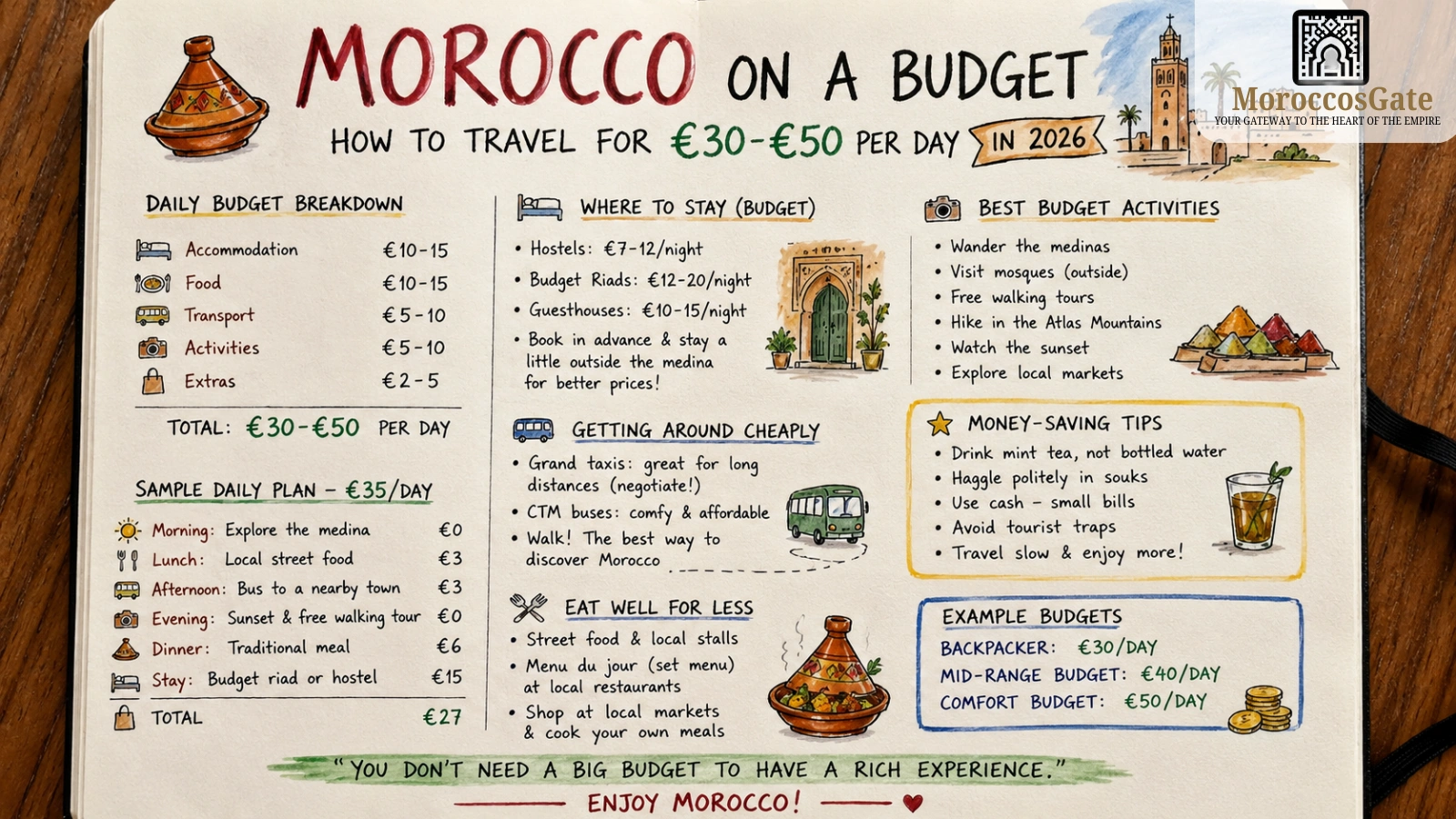
Morocco costs €30–€50 per day for a comfortable budget trip in 2026. This covers a hostel dorm or budget guesthouse (€8–€20), street food and local restaurant meals (€8–€18), CTM buses or shared grand taxis (€5–€12), and free or low-cost activities (medina walking, museum entry, mosque visits). A 7-day Morocco budget trip costs roughly €350–€550 excluding flights. Mid-range travel runs €60–€110 per day for private riad rooms and guided tours. Morocco remains one of Europe’s best-value short-haul destinations, though prices are rising 10–15% annually as the country prepares for the 2030 FIFA World Cup — so 2026 is genuinely one of the best years to go.
Morocco has a reputation problem of sorts — not for being unsafe or unwelcoming, but for being assumed to be more expensive than it actually is. People picture luxury riads with infinity pools, private Sahara camps with white-tablecloth dinners under the stars, and a country that requires a substantial travel fund. That version of Morocco absolutely exists. But it sits alongside an entirely different, equally legitimate Morocco: one where a hostel bed costs less than a coffee in Dublin, where a full tagine with bread and mint tea costs the same as a sandwich at home, and where intercity buses cross the country in comfort for a few euros.
This guide is the honest, numbers-based answer to the question everyone asks before a Morocco trip: how much does Morocco cost per day? We have broken it down by category — accommodation, food, transport, activities — and by city, with real 2026 prices gathered from our own travel and cross-checked against multiple current sources. We have also built a full sample 7-day budget itinerary so you can see exactly how the numbers add up in practice.
One important note before we start: Morocco’s prices are rising. Tourism is booming, the country is investing billions ahead of the 2030 FIFA World Cup, and accommodation prices in Marrakech and Casablanca have already risen 15–20% since 2024. The budget traveller of 2026 still has access to genuinely excellent value — but the case for going sooner rather than later, covered fully in our guide on visiting Morocco before 2030, applies as much to budget travellers as to anyone else.
Morocco Daily Budget at a Glance: 2026
| Travel Style | Daily Budget | Accommodation | Food | Transport |
|---|---|---|---|---|
| Backpacker / Shoestring | €28–€38 | Hostel dorm (€8–€15) | Street food (€5–€10) | CTM bus / shared taxi (€3–€8) |
| Comfortable Budget | €38–€55 | Budget riad private room (€18–€35) | Street food + 1 restaurant meal (€10–€18) | Bus + occasional petit taxi (€5–€12) |
| Mid-Range | €60–€110 | Quality riad (€55–€90) | Restaurant meals (€15–€30) | Train / private taxi (€10–€25) |
| Luxury | €180+ | Boutique riad / 5-star (€150+) | Fine dining (€40+) | Private driver (€40+) |
All figures in euros, converted from current Moroccan Dirham (MAD) pricing. 1 EUR ≈ 10.7 MAD as of 2026. This guide focuses on the €30–€50/day “Comfortable Budget” category — genuinely good travel, not just survival travel.
Accommodation: Where Your Money Goes Furthest
Hostels: €8–€18 Per Night
Hostel dormitory beds in Marrakech, Fes, and Chefchaouen start from approximately €8–€12 per night — genuinely some of the cheapest quality hostel accommodation available anywhere within a short-haul flight of Ireland or the UK. Quality varies significantly between properties, so always check recent reviews on Hostelworld or Booking.com before committing, filtering for a minimum 8.0 rating.
The best hostel cities for budget travellers are Marrakech (highest density, most social atmosphere), Fes (excellent value, fewer crowds than Marrakech), Chefchaouen (some of the cheapest dorm beds in the country, often inside genuine traditional medina buildings), and Essaouira (relaxed surf-town hostel culture). Book at least two weeks ahead for peak season (April, May, October, November) — the best hostels fill up fast.
Budget Riads and Guesthouses: €15–€35 Per Night
This is where Morocco’s exceptional accommodation value truly shines. Basic single or double rooms in family-run guesthouses (maisons d’hôtes) cost approximately €15–€25 per night and often include a simple breakfast of khobz bread, amlou (almond and argan oil butter), and mint tea. A step up — a proper budget riad with a courtyard, rooftop terrace, and private bathroom — typically costs €25–€35 per night.
Our complete guide to the best riads in Marrakech under €80 covers specific properties in detail, several of which dip below €50 in low season. For Chefchaouen specifically, our Chefchaouen travel guide notes that the same riad experience costing €60–€90 in Marrakech can be found there for €25–€50.
Booking Strategy for Budget Accommodation
- Book riads instead of chain hotels. A budget riad gives you a more authentic Moroccan experience at a lower cost than an equivalent international hotel chain.
- Always confirm what is included. Some budget guesthouses include breakfast; others charge separately (typically €3–€5). Check before booking.
- Email properties directly. Many budget riads offer a 5–10% discount for direct bookings versus OTA platforms.
- Spread your nights strategically. Spend slightly more for one or two special nights (a Sahara desert camp, for instance) and balance the budget with cheaper nights elsewhere.
Food: Morocco’s Best Budget Secret
If accommodation is where Morocco’s value becomes apparent, food is where it becomes genuinely remarkable. This is a country where eating extraordinarily well costs almost nothing, provided you know where to look.
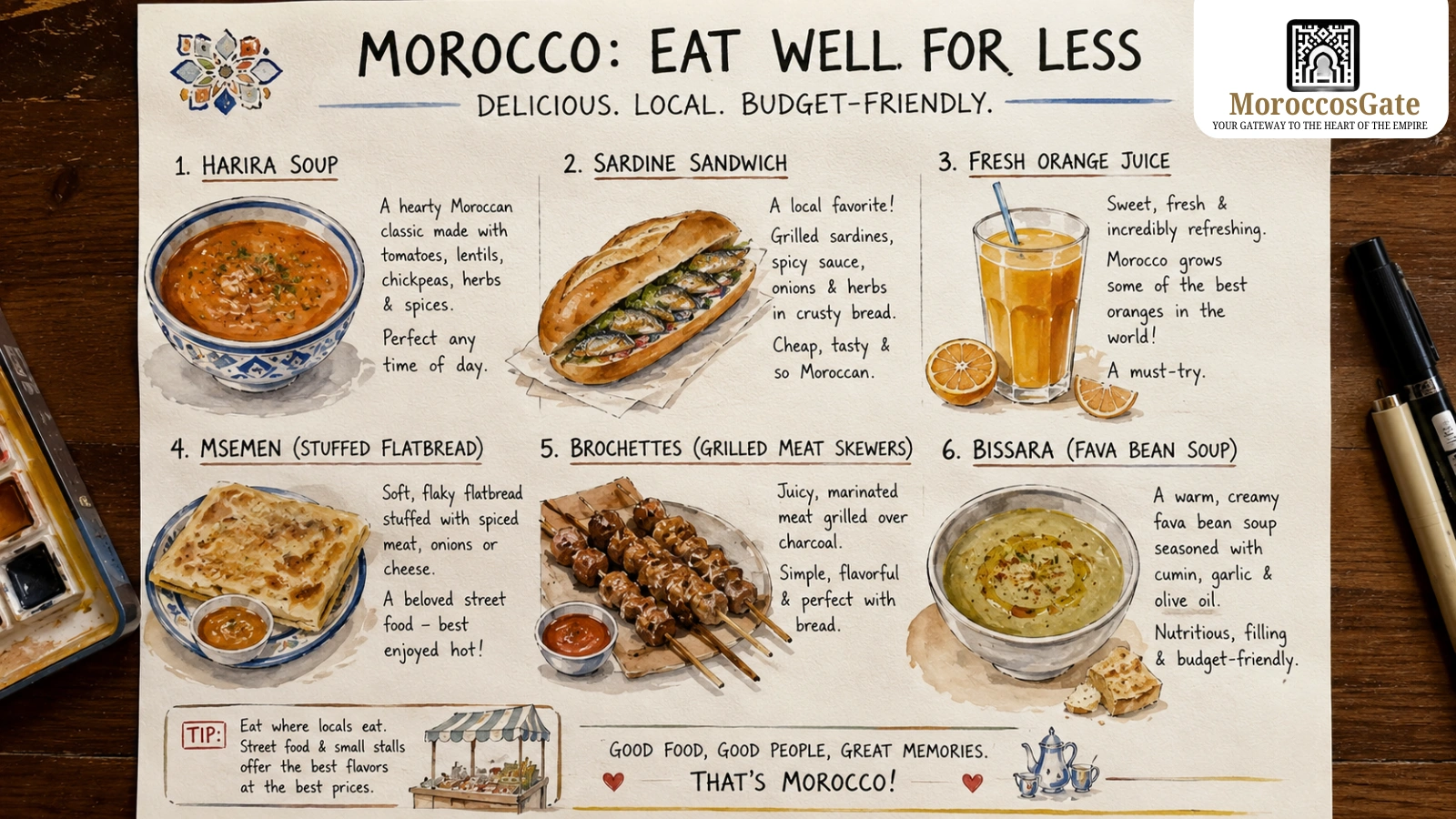
Street Food Prices in Morocco 2026
- Harira soup: from €0.50 — Morocco’s beloved tomato and lentil soup, sold from street carts everywhere, especially in the evening.
- Sardine sandwich: from €0.80 — fresh grilled sardines in a baguette with harissa and salad. A Moroccan classic.
- Fresh orange juice: from €0.40 — squeezed to order at stalls throughout every medina, particularly around Jemaa el-Fna in Marrakech.
- Msemen (stuffed flatbread): €0.50–€1.50 — sold at breakfast stalls, often with honey, cheese, or spiced meat fillings.
- Brochettes (grilled meat skewers): €1.50–€3 — sold at evening food stalls, particularly excellent at the Jemaa el-Fna food stalls in Marrakech.
- Bissara (fava bean soup): from €0.50 — particularly popular in northern Morocco, including Chefchaouen, where it is a warming breakfast staple.
Local Restaurant Meal Prices
A local restaurant meal — a full tagine or couscous, bread, and mint tea — costs approximately €5–€10. Mid-range tourist-facing restaurants charge €15–€25 per person. The honest rule that every experienced Morocco traveller learns quickly: walk two streets away from any major tourist sight and your meal costs half the price with better food. The restaurants immediately on Jemaa el-Fna or facing a major monument entrance charge a location premium that the same quality of food two streets back simply does not.
Self-Catering and Market Shopping
Morocco’s fresh produce markets offer extraordinary value for travellers with access to a kitchen (some riads and most hostels with shared kitchens). Fresh bread (khobz) costs €0.20–€0.40 per loaf. Seasonal fruit — oranges, dates, figs — is abundant and cheap. Olives, sold by weight from market stalls, are excellent and inexpensive. A self-catered breakfast of bread, cheese, fruit, and mint tea can cost under €2 per person.
Daily Food Budget Summary
A realistic daily food budget combining street food, one local restaurant meal, and drinks runs €8–€15 per person. This allows for genuine variety and quality — not survival eating, but proper enjoyment of one of the world’s great culinary traditions.
Transport: Getting Around Morocco Cheaply
Intercity Buses: CTM and Supratours
CTM (Compagnie de Transports Marocains) is Morocco’s national bus operator and the backbone of budget intercity travel. Routes connect virtually every city and town in the country, with comfortable air-conditioned coaches, assigned seating, and reliable schedules. Intercity buses start from approximately €6–€7 for shorter routes (Tangier to Chefchaouen, for example) and scale up to €15–€20 for longer journeys (Marrakech to Fes, or Marrakech to Merzouga for the Sahara).
Supratours, a subsidiary of the national rail operator ONCF, runs an equally reliable network and is particularly useful for connecting to towns not served by rail, including Essaouira and Chefchaouen.
Trains: The Best Value for Major Cities
Morocco’s ONCF rail network connects Tangier, Rabat, Casablanca, Fes, Meknes, and Marrakech with comfortable, affordable, and genuinely reliable trains. Second-class tickets are excellent value — typically €8–€18 depending on distance — and the Al Boraq high-speed service (Tangier–Casablanca in 2 hours) costs only a modest premium over the conventional rail equivalent.
Grand Taxis: Shared and Affordable
Grand taxis (large shared vehicles, typically older Mercedes sedans) run fixed routes between towns and cities at a per-seat price, departing when full. These are the backbone of rural and short-distance Moroccan transport and are remarkably cheap — typically €1–€4 per seat for shorter routes (Marrakech to Imlil, for instance) and €4–€8 for longer ones. This is also how most budget travellers reach Imlil for the Toubkal hike.
Petit Taxis: City Transport
Petit taxis (small, often beige or red, metered taxis) operate within city limits and are the standard way to move around urban Morocco for short distances. Always ask the driver to use the meter (“compteur” in French, or simply gesture) — a fare within most city centres costs €1–€4. Unmetered tourist-zone taxis can attempt to charge considerably more; agreeing a price before departure if the meter is “broken” (a common excuse) protects you from overpaying.
Daily Transport Budget Summary
A realistic daily transport budget for a Morocco itinerary that moves between cities every 2–3 days, with local taxis for short city journeys, runs €5–€12 per day on average across the trip (some days will be zero — when you are exploring one city on foot — and some days will be higher, covering an intercity bus or train).
Activities and Attractions: Mostly Free or Very Cheap
One of Morocco’s great budget-travel secrets is that the best things to do often cost nothing at all. Wandering the medinas of Marrakech, Fes, and Chefchaouen costs nothing. Watching the sunset from the Spanish Mosque viewpoint above Chefchaouen costs nothing. Sitting in Jemaa el-Fna in Marrakech as the evening food stalls set up costs nothing beyond whatever you choose to eat. Visiting the Ras el-Maa waterfall in Chefchaouen costs nothing. The Atlas Mountains day trip to Imlil and the Ourika Valley costs only your transport.
Paid Attractions Worth the Money
- Hassan II Mosque, Casablanca: €13 (130 MAD) for the guided tour — one of the world’s great architectural achievements and one of the very few mosques in Morocco open to non-Muslims. Genuinely worth every dirham.
- Bahia Palace, Marrakech: Approximately €7 (70 MAD). One of Morocco’s finest pieces of 19th-century Islamic architecture.
- Saadian Tombs, Marrakech: Approximately €7 (70 MAD). Small but exceptional 16th-century royal necropolis.
- Majorelle Garden, Marrakech: Approximately €13–€16 (140–170 MAD). The garden created by Yves Saint Laurent. Pricier than other attractions but consistently rated among Marrakech’s finest experiences.
- Chefchaouen Kasbah and Museum: Approximately €1 (10 MAD) — extraordinary value for the rooftop views alone.
The Sahara Desert: Your Biggest Budget Splurge (And Worth It)
If there is one experience worth stretching your daily budget for, it is an overnight Sahara Desert tour. A shared group tour from Marrakech to Merzouga — including transport, an overnight stay in a desert camp, camel trekking, and meals — typically costs €60–€100 for a 2–3 day trip, which works out at roughly €20–€35 per day when spread across the tour duration. This is exceptional value for one of the most extraordinary travel experiences available anywhere in the world: sleeping under a sky of unfiltered stars in the Sahara, riding a camel into the dunes at sunset, and waking before dawn to watch the light change over Erg Chebbi.
Budget travellers should book shared (not private) desert tours — the savings are substantial and the experience, beyond the vehicle and the size of your group, is identical. Book through a licensed local operator; ask your hostel or riad for a recommendation, as personal referrals tend to connect you with reliable small operators rather than resold tours from intermediaries.
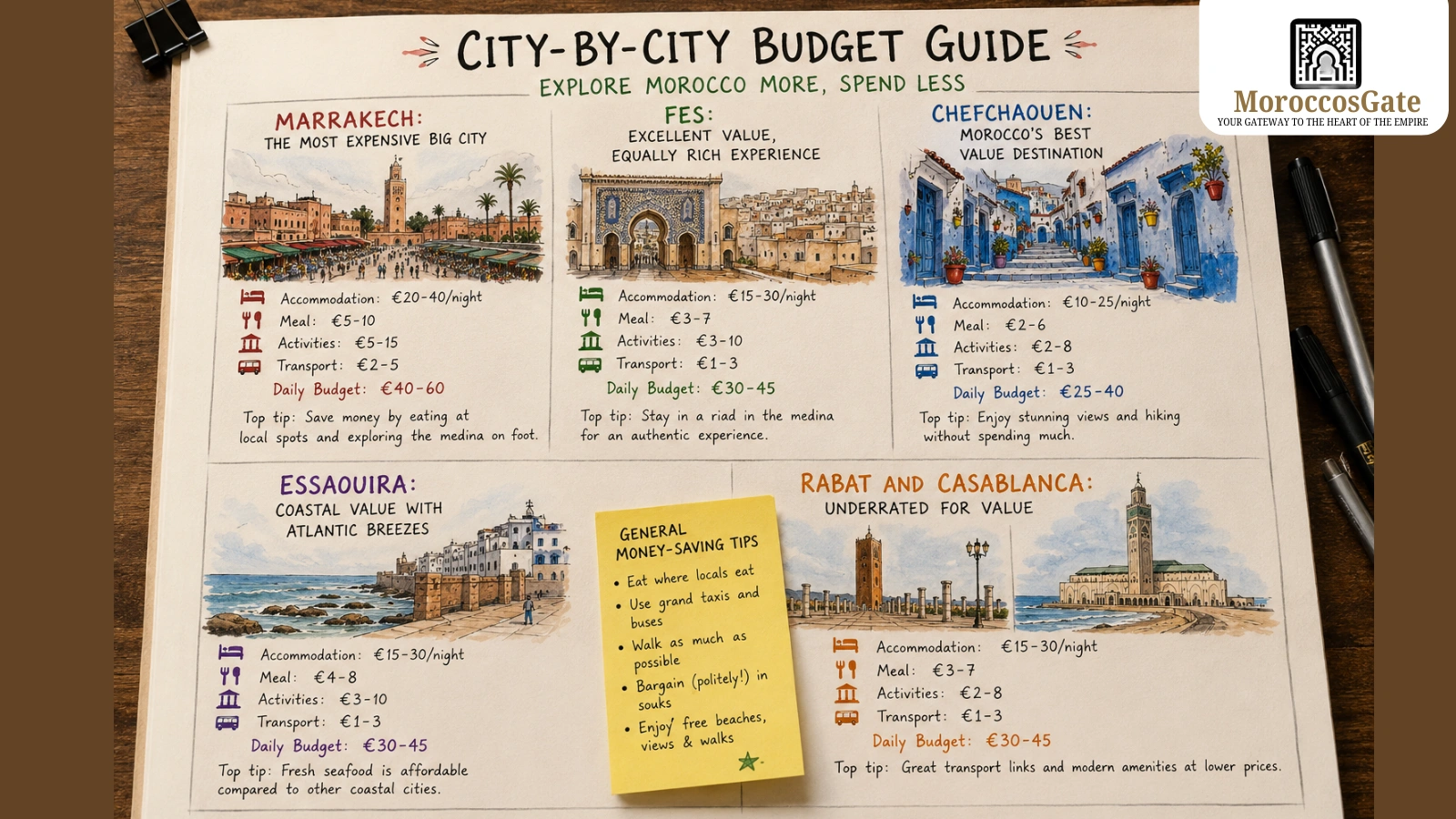
City-by-City Budget Guide: Where Your Money Goes Furthest
Marrakech: The Most Expensive Big City
Marrakech is Morocco’s most visited city and, correspondingly, its most expensive — though “expensive” remains relative. Accommodation, food, and activities in the medina’s most touristic zones (immediately around Jemaa el-Fna) carry a premium. The fix: stay slightly further into the medina (Bab Doukkala or northern Derb Dabachi, both covered in our riad guide), eat where locals eat rather than at restaurants with English menus and photos, and walk rather than taxi for anything under 20 minutes.
Fes: Excellent Value, Equally Rich Experience
Fes offers comparable cultural richness to Marrakech — arguably superior, in the view of many seasoned Morocco travellers — at noticeably lower prices. Hostel beds, restaurant meals, and guided medina tours all run cheaper than their Marrakech equivalents, while the medina itself (the largest car-free urban area in the world) is, if anything, more extraordinary.
Chefchaouen: Morocco’s Best Value Destination
Chefchaouen is the standout budget destination in this entire guide. A comfortable day in Chefchaouen — budget riad, street food breakfast and dinner, one local restaurant meal, and free activities (medina wandering, Spanish Mosque hike, Ras el-Maa walk) — can be achieved for €20–€30 per day. For the complete picture, see our Chefchaouen travel guide 2026.
Essaouira: Coastal Value with Atlantic Breezes
Essaouira offers excellent budget value with the added bonus of consistently cooler weather than the interior — useful for travellers visiting in the warmer months. Fresh seafood at the port-side grills is genuinely some of the best-value fresh fish anywhere in Morocco, often costing less than €5 for a substantial portion of grilled fish with bread and salad.
Rabat and Casablanca: Underrated for Value
Rabat, Morocco’s relaxed capital, delivers strong value in its restaurant scene due to lower tourist volumes than Marrakech or Fes. Casablanca, as Morocco’s business capital, runs slightly higher than smaller tourist cities on food and accommodation but remains good value by any international comparison, and the Hassan II Mosque tour is unmissable regardless of budget level.
Sample 7-Day Morocco Budget Itinerary
Here is a realistic 7-day itinerary built around the €30–€50 per day target, covering Marrakech, the Sahara, and Essaouira:
| Day | Activity | Approx. Daily Cost |
|---|---|---|
| 1 | Arrive Marrakech. Hostel dorm. Medina exploration (free). Street food dinner. | €32 |
| 2 | Marrakech: Bahia Palace, Saadian Tombs, Jemaa el-Fna evening. Budget riad upgrade. | €40 |
| 3–4 | 2-day shared Sahara Desert tour from Marrakech (transport, camp, camel trek, meals included). | €35/day average |
| 5 | Return to Marrakech. Rest day. Hammam visit (€8–€15). Street food. | €38 |
| 6 | CTM bus to Essaouira (€10). Budget guesthouse. Seafood dinner at the port. | €34 |
| 7 | Essaouira: medina, ramparts, beach walk (free). Evening departure or onward travel. | €30 |
Total for 7 days: approximately €245–€280, excluding international flights. This figure aligns closely with current independent budget estimates, which place a typical budget week in Morocco at €230–€330 covering hostel or cheap riad accommodation, street food and local restaurants, public transport, and free activities.
Money-Saving Tips: The Morocco’s Gate Method
1. Haggle — But Respectfully and Realistically
Haggling is an expected and culturally normal part of souk shopping in Morocco — but it is not a competitive sport, and approaching it as one creates friction rather than savings. The traditional approach: ask the price, counter at roughly 40–50% of the initial asking price, and negotiate towards a figure both parties are comfortable with. A few words of Darija — “Bshhal hada?” (how much is this?) and “Ghali bzaf” (too expensive) — go a long way and are received warmly rather than as confrontation.
2. Eat Where the Queue Is Moroccan, Not International
The single most reliable rule for budget eating in Morocco: a stall or small restaurant with a queue of Moroccan customers, no English menu, and prices not displayed in multiple currencies will almost always be both cheaper and better than the equivalent tourist-facing establishment fifty metres away.
3. Travel in Shoulder Season
Spring (March–May, excluding the Ramadan period) and autumn (September–November) offer not only the best weather but generally better accommodation availability and slightly lower prices than the absolute peak weeks. Avoid the most expensive peak periods (Easter week, major festival weekends) if budget is the primary driver of your trip. See our Best Time to Visit Morocco 2026 guide for the full seasonal breakdown.
4. Book Shared Tours, Not Private Ones
For the Sahara Desert and other multi-day excursions, shared group tours cost a fraction of private equivalents while delivering the same core experience (desert camp, camel trek, guide). Reserve private tours for when genuine flexibility or a special occasion justifies the premium.
5. Use Public Transport for Intercity Travel
CTM buses and ONCF trains are comfortable, reliable, and dramatically cheaper than private transfers or taxis for intercity journeys. Reserve private transfers for situations where time genuinely matters (an early flight, a tight festival schedule) rather than as a default choice.
6. Carry Enough Cash
Cash is essential for souks, street food, petit taxis, tips, and small medina shops. Card acceptance is improving across Morocco but remains patchy outside hotels and larger restaurants. Withdraw Moroccan Dirhams from ATMs (widely available in all cities) rather than exchanging currency at inflated airport or hotel rates. Budget travellers should plan to carry roughly €40–€60 in cash for a typical day covering food, transport, and small purchases.
7. Drink Mint Tea, Not Imported Soft Drinks
A small but genuinely effective saving: mint tea is ubiquitous, inexpensive (often free with a meal, or €0.50–€1 standalone), and infinitely preferable to the imported soft drinks that carry a noticeable price premium in tourist areas.
Is Morocco Cheaper Than Europe? The Honest Comparison
Yes — substantially. Morocco is approximately 10–15% more expensive for food and hotels compared to two or three years ago, but transportation costs remain broadly similar, and the overall comparison with Western Europe remains heavily in Morocco’s favour. A week of comfortable budget travel in Morocco — accommodation, food, transport, and activities — costs roughly the same as 2–3 nights of equivalent comfort in most Western European capital cities.
The genuine caveat, covered extensively in our Morocco tourism boom 2026 guide, is that this gap is narrowing. Morocco’s accommodation prices are rising 10–15% annually as the country prepares for the 2030 World Cup. The budget traveller of 2026 still gets outstanding value. The budget traveller of 2029 will need a noticeably larger daily allowance for the same experience.
Frequently Asked Questions — Morocco Budget Travel 2026
Q1. How much does Morocco cost per day in 2026?
A1. A comfortable budget trip to Morocco in 2026 costs €30–€50 per day, covering a hostel dorm or budget guesthouse, street food and one local restaurant meal, CTM buses or shared taxis, and mostly free activities. Backpackers managing on the absolute minimum can travel for as little as €25–€30 per day. Mid-range travel runs €60–€110 per day.
Q2. How much does a 7-day trip to Morocco cost?
A2. A budget 7-day Morocco trip costs approximately €245–€330, excluding international flights, covering accommodation, food, local transport, and activities including a Sahara Desert excursion. A mid-range 7-day trip with private riad rooms, restaurant meals, and guided tours costs approximately €500–€800.
Q3. Is Morocco cheaper than Europe to visit?
A3. Yes, significantly. Morocco’s accommodation, food, and transport all cost noticeably less than equivalent experiences in Western Europe. A week of comfortable Morocco travel can cost roughly the same as 2–3 nights of equivalent comfort in most Western European capital cities, although prices are rising 10–15% annually as Morocco prepares for the 2030 World Cup.
Q4. How much is street food in Morocco?
A4. Street food in Morocco is extremely affordable: harira soup from €0.50, a sardine sandwich from €0.80, fresh orange juice from €0.40, and grilled meat skewers (brochettes) from €1.50. A full street food meal with several items typically costs €3–€6.
Q5. What are the cheapest cities to visit in Morocco?
A5. Chefchaouen, Fes, Meknes, and Essaouira offer the best value, with lower accommodation and food prices than Marrakech, while delivering equally rich cultural experiences. Chefchaouen in particular is consistently the cheapest destination for quality riad and guesthouse accommodation in the country.
Q6. How much does a Sahara Desert tour cost in Morocco?
A6. A shared 2–3 day Sahara Desert tour from Marrakech, including transport, an overnight desert camp, camel trekking, and meals, typically costs €60–€100 total — exceptional value for one of Morocco’s most extraordinary travel experiences. Private tours cost considerably more for the same core experience.
Q7. Will Morocco get more expensive before the 2030 World Cup?
A7. Yes. Accommodation prices in Marrakech and Casablanca have already risen 15–20% since 2024 and are increasing 10–15% annually as Morocco invests in infrastructure ahead of the 2030 FIFA World Cup. 2026 represents one of the last genuinely affordable years to experience Morocco’s value-for-money travel before prices rise further.
Q8. Do I need a lot of cash for budget travel in Morocco?
A8. Cash is essential for souks, street food, petit taxis, tips, and small medina shops. Card acceptance is improving but remains inconsistent outside hotels and larger restaurants. Budget travellers should carry approximately €40–€60 per day in Moroccan Dirhams, withdrawn from ATMs rather than exchanged at inflated airport rates.
Plan Your Morocco Budget Trip with Morocco’s Gate
Morocco remains one of the very best value destinations accessible from Ireland and the UK — a country where a genuinely rich, memorable travel experience does not require a substantial budget. Hostels in medieval medinas, street food that rivals any restaurant, intercity buses that cross dramatic landscapes for a few euros, and a Sahara Desert experience that costs less than a single night in many European city hotels.
Morocco’s Gate has been helping travellers plan Morocco trips at every budget level since 2015 — and we know exactly where the genuine value lies and where cutting corners costs you the experience rather than just the money. Whether you are backpacking on €30 a day or planning a comfortable mid-range trip, we can help you build the right itinerary.
- → Talk to our team and start planning your Morocco budget trip
- → Browse our curated Morocco travel deals
- → Read our Best Riads in Marrakech Under €80 guide
- → Read our Chefchaouen Travel Guide 2026
- → Read the Best Time to Visit Morocco 2026 guide
About the Author: Morocco’s Gate Editorial Team
Morocco’s Gate is based between Dublin, Ireland, and Morocco. We have travelled Morocco on every budget level — backpacking on shared grand taxis and hostel dorms in our early years exploring the country, and arranging private riad stays and bespoke itineraries for clients today. We know precisely where the genuine savings are in Morocco (street food, CTM buses, shared desert tours) and where cutting corners costs you the experience rather than just the money (skipping a licensed guide in Fes’s medina, choosing an unlicensed desert operator). Every price in this guide reflects honest, current 2026 research cross-checked against our own direct travel experience. Morocco’s Gate has been helping Irish and European travellers plan Morocco trips at every budget level since 2015.
Affiliate Disclosure: This article contains affiliate links. Morocco’s Gate may earn a commission when you book accommodation, tours, or travel services through links on this page — at no additional cost to you. All recommendations are based on genuine first-hand experience and verified independent research. This commission helps us continue producing free, independent Morocco travel content.