
Chefchaouen Travel Guide 2026: The Blue City — What to See, Eat & Do
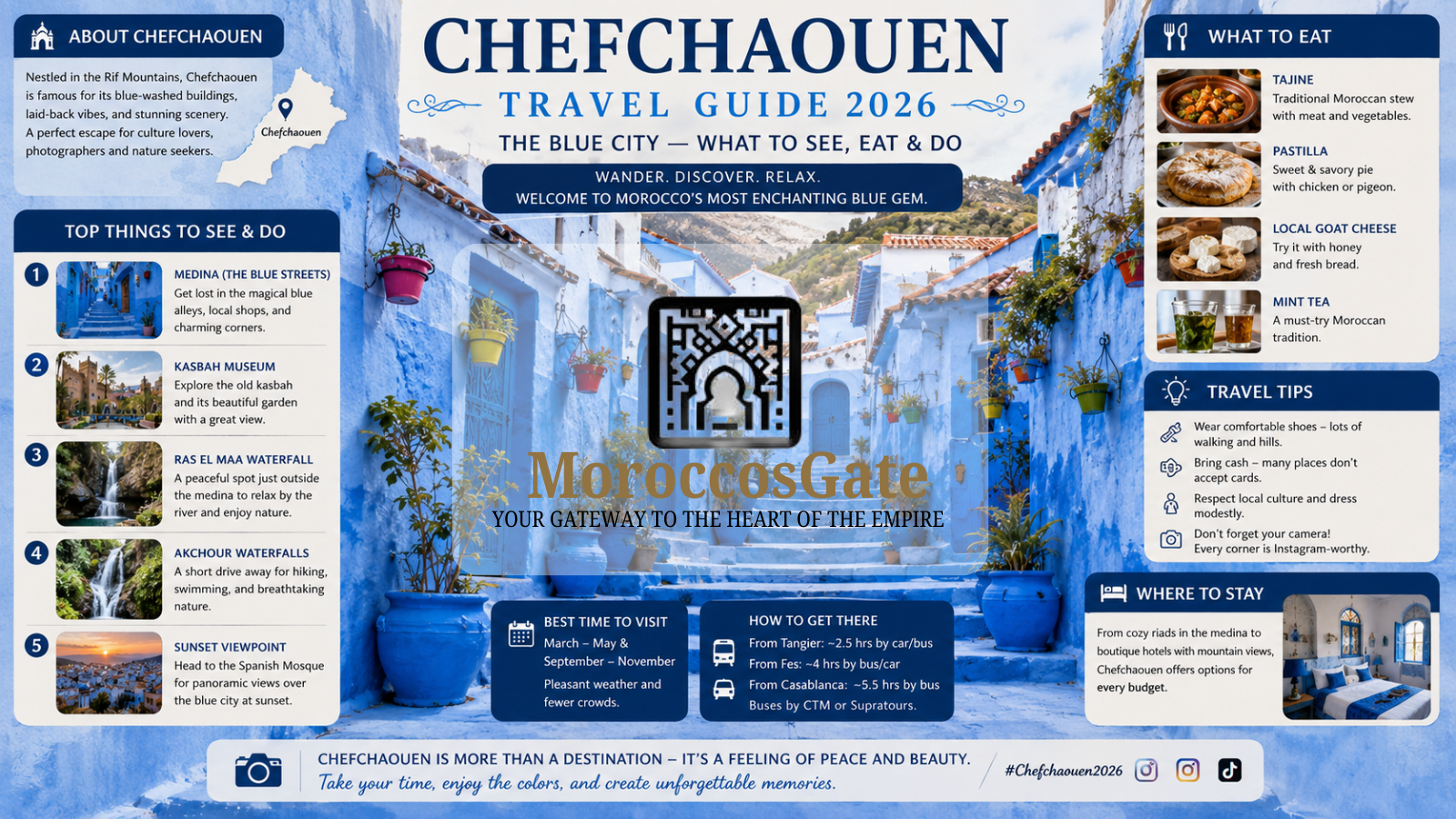
Chefchaouen in 2026 is absolutely worth visiting — and the short answer to what you should see, eat, and do is this: spend at least one full day wandering the blue-painted medina, hike to the Spanish Mosque for sunset, walk to Ras el-Maa waterfall in the morning, eat goat cheese and tagine at a rooftop restaurant on Plaza Uta el-Hammam, and if time allows, take a day trip to the Akchour waterfalls in the Rif Mountains. Arrive from Tangier (2.5 hours by bus) or Fes (4 hours). Stay 1–2 nights inside the medina. Budget from €30 per day all-in.
There is a particular kind of place that photographs so beautifully that you wonder, before visiting, whether the reality could possibly match the image. Chefchaouen — the Blue City of Morocco’s Rif Mountains — is one of the very few places where the reality not only matches the photograph but surpasses it.
The photographs cannot convey the smell of the mountain air, which is different from anywhere else in Morocco — cooler, cleaner, carrying a faint hint of juniper from the hills above. They cannot capture the particular quality of silence in the medina at 6 AM, before the first day-tripper buses arrive from Tangier and Fes, when the blue walls are glowing in early light and a solitary cat is picking its way across the steps below you. They cannot replicate the specific pleasure of sitting in Plaza Uta el-Hammam with mint tea and warm bread, watching the square fill slowly with a mix of locals, travellers, and children running between the fountain and the arches of the old Kasbah.
Chefchaouen is one of those places that Morocco provides abundantly — deeply beautiful, genuinely human, unhurried — and which the rest of the world is still in the process of discovering. Morocco’s tourism boom of 2026 (see our Morocco tourism boom guide) is bringing more visitors here every year. The window to experience the Blue City at its most uncrowded is not unlimited. This guide tells you everything you need to make the most of it.
Chefchaouen at a Glance: Key Facts for 2026
| Detail | Information |
|---|---|
| Location | Rif Mountains, northern Morocco (600m altitude) |
| Province | Chefchaouen Province, Tanger-Tétouan-Al Hoceïma Region |
| Population | Approximately 45,000 |
| Best time to visit | Spring (March–May) and autumn (September–November) |
| How long to stay | Minimum 1 night; ideally 2 nights |
| Nearest city | Tangier (90 km, 2.5 hours by bus) / Fes (200 km, 4 hours) |
| Getting there | Bus (CTM/Supratours), grand taxi, private transfer. No train or airport. |
| Daily budget (mid-range) | €30–€55 per person (accommodation, meals, activities) |
| Language | Moroccan Darija, Tamazight (Riffian Berber), French |
| Currency | Moroccan Dirham (MAD). 1 EUR ≈ 10.7 MAD |
| Safety | One of Morocco’s safest towns. Very low crime. Relaxed atmosphere. |
Why Chefchaouen Is Painted Blue: The Story Behind the Colour
Before we get to what to see and do, a question that every visitor asks: why is Chefchaouen blue?
The honest answer is that nobody is entirely certain. Multiple theories exist and no single explanation has been definitively established. The most widely cited account holds that Jewish refugees fleeing the Iberian Peninsula in the 15th and 16th centuries — and later Jewish communities who settled here — painted buildings blue, a colour associated in Jewish tradition with heaven and divinity, and specifically with tekhelet, the sacred blue mentioned in the Torah.
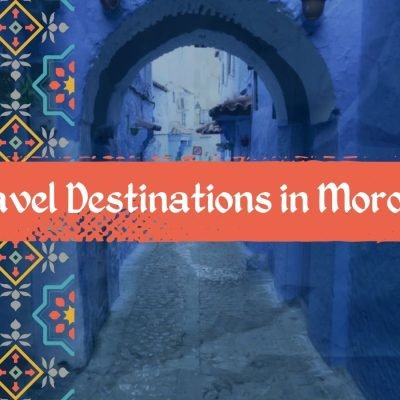
Other explanations include the practical claim that blue paint repels mosquitoes (a theory with some limited entomological support), and the more cynical view that the blue was revived or intensified in relatively recent decades to attract tourism. Whatever the origin, the effect is indisputable: the Chefchaouen medina, painted in every shade of blue from powder-pale to deep cobalt, with flowerpots and carved wooden doorframes and terraced staircases all submerged in this palette, is one of the most visually extraordinary urban environments on earth.
The colour is not static, either. The blue changes quality throughout the day: pale and misty in the morning light, brilliant at noon, deeply saturated at dusk, almost luminous in the blue hour just after sunset. Returning to the same alleyway at different times of day produces genuinely different photographs — and genuinely different feelings.
What to See in Chefchaouen: The Complete Sights Guide
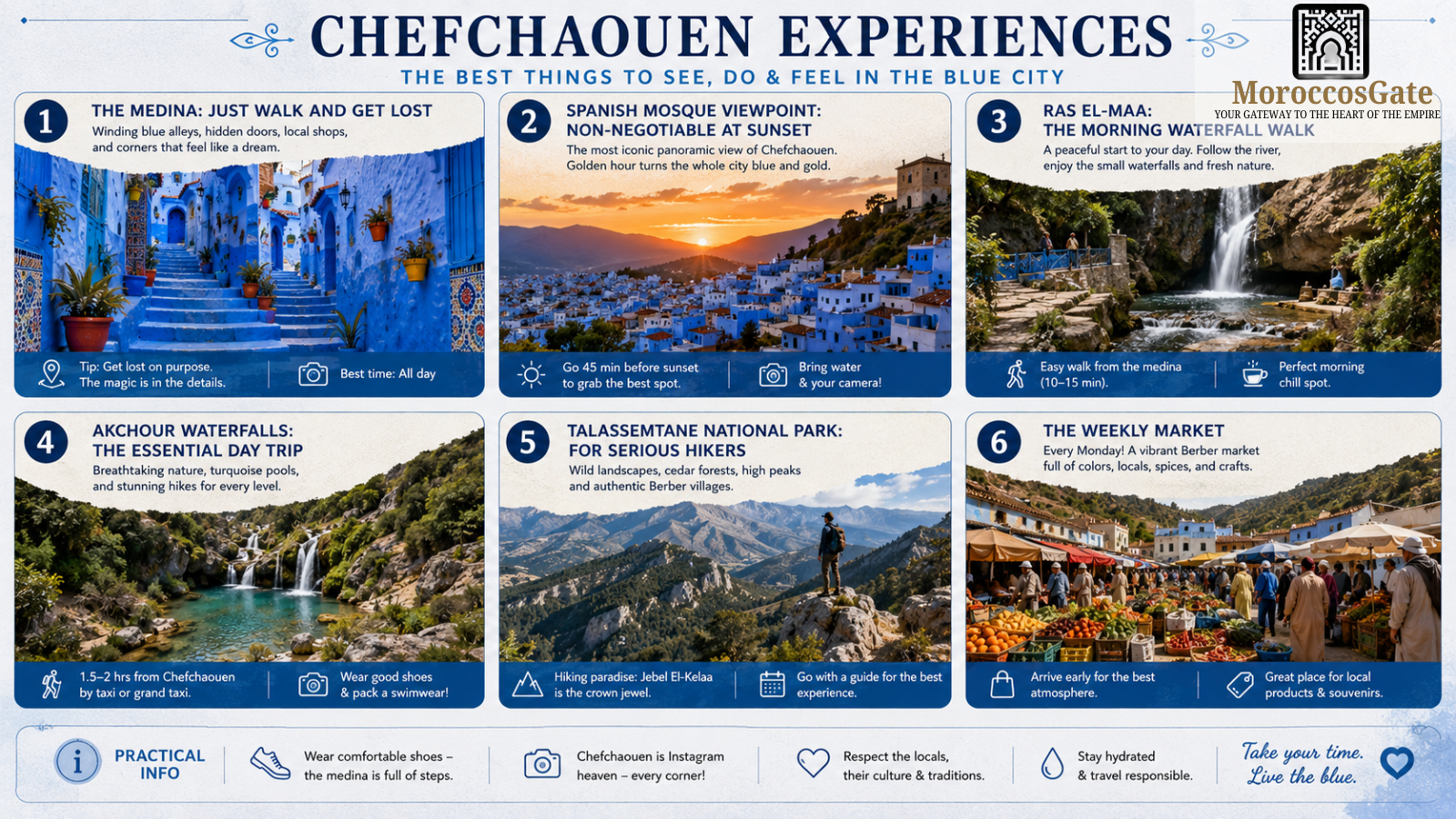
1. The Medina: Just Walk and Get Lost
The Chefchaouen medina is small enough that you cannot get permanently lost — but large enough that there are always new alleyways to discover. Unlike the medinas of Fes and Marrakech, which require licensed guides to navigate properly, Chefchaouen’s medina is genuinely walkable without assistance. The best approach — and the most consistently recommended by everyone who has ever written about visiting Chefchaouen Morocco — is the deliberate absence of a plan.
Start at Plaza Uta el-Hammam (the main square) and walk in any direction. Turn left when something interests you. Climb a staircase that looks like it might have a view. Follow a cat. Sit on a step when you find an alleyway that is particularly beautiful and stay there for ten minutes. The medina rewards slowness and punishes rushing.
The key areas to find your way to:
- Plaza Uta el-Hammam: The central square, anchored by the old Kasbah (a 15th-century fortress with a small museum) and the Grande Mosquée. The square is lined with cafés and restaurants, and the quality of the people-watching is exceptional at all hours. This is where local life visibly intersects with tourist life, and where the city’s genuine community character is most apparent.
- The Upper Medina (above the square): The residential lanes above the main square are where the medina feels most genuinely lived-in. Fewer tourist stalls, more local life. The blue walls become more intensely painted as you climb — this is the area for photography, especially in early morning light.
- The Blue Staircases: Several staircase streets in the upper medina have become iconic photography spots — blue steps, flowerpots on every ledge, cats surveying the scene from above. Ruelle des Fleurs (Flower Lane) is the most famous, but equally beautiful versions exist throughout the upper medina.
- The Old Kasbah and Museum: The 15th-century Kasbah at the corner of Plaza Uta el-Hammam houses a small ethnographic museum and a rooftop garden with exceptional views over the medina and the Rif Mountains. Entry is approximately 10 MAD — extraordinary value for the views alone.
2. Spanish Mosque Viewpoint: Non-Negotiable at Sunset
If you do only one thing in Chefchaouen beyond wandering the medina, make it this: hike to the Spanish Mosque viewpoint for sunset. The abandoned mosque (built by the Spanish colonial administration in the 1920s and never used for Islamic worship) sits on the hillside above the city, a 30–45 minute walk from the medina through pine and olive trees. The trail is well-worn and straightforward, though it is steep in places.
The view from the mosque’s terrace at sunset is the definitive Chefchaouen image: the entire medina spread below you, the blue rooftops glowing in the afternoon light, the Rif Mountains rising behind, and the sky doing whatever it decides to do that particular evening. On clear days, the view extends north towards the Mediterranean coast. Even on hazy days, the quality of the light at this angle — the sun dropping behind the hills to your right, casting long shadows across the medina — is extraordinary.
Arrive at least 45 minutes before sunset to secure a good position. The viewpoint is increasingly popular and the terrace fills up in the final 20 minutes before sunset. Bring a light jacket — the hillside is always cooler than the medina below, and it cools rapidly once the sun goes down.
3. Ras el-Maa: The Morning Waterfall Walk
Ras el-Maa — the name translates as “head of the water” — is a natural spring and small waterfall at the edge of the medina, approximately 15 minutes’ walk from Plaza Uta el-Hammam along the river. The water source supplies the city and has done so for centuries; the waterfall itself is small but the setting is beautiful — a stream flanked by green vegetation, small restaurants with tables right at the water’s edge, and the sound of flowing water replacing the gentle chaos of the medina.
Ras el-Maa is best visited in the morning, when local women often come to wash clothes in the traditional manner and the light through the surrounding trees creates beautiful reflections on the water. Small cafés and basic restaurants here serve breakfast — fresh bread, honey, eggs, Riffian goat cheese — at prices significantly lower than the Plaza restaurants. This is our preferred breakfast spot in Chefchaouen.
From Ras el-Maa, a mountain trail continues upward through the forest — this is the beginning of the longer hiking network that connects Chefchaouen to the surrounding Rif Mountain terrain. A short walk up this trail, even if you go no further than 20 or 30 minutes, gives you dramatically different views of the city from above.
4. Akchour Waterfalls: The Essential Day Trip
If you are spending two nights in Chefchaouen — which we strongly recommend — dedicate one of your days to the Akchour National Park, 45 minutes’ grand taxi ride from the city. Akchour is one of the most beautiful natural environments in northern Morocco: a river gorge with emerald pools, dramatic rock formations, and two hiking destinations that suit different levels of commitment.
- God’s Bridge (Pont de Dieu): A massive natural limestone rock arch spanning the gorge, approximately 1.5 hours’ walk from the Akchour village. The trail follows the river through increasingly dramatic canyon scenery. The bridge itself is startling in scale — a genuinely impressive natural formation that photographs cannot quite prepare you for.
- The Grand Cascade: A longer hike (approximately 2.5–3 hours return) leads to a large waterfall with clear, cold pools perfect for swimming in the warmer months. The trail passes through the gorge and climbs through forest above the river. Bring water and snacks; there are basic cafés at the trailhead but nothing on the trail itself.
Grand taxis from Chefchaouen to Akchour village cost approximately 15–20 MAD per person (shared) or 80–100 MAD for a full taxi. Negotiate a return pickup time. Avoid visiting on summer weekends when the site is extremely busy with Moroccan domestic tourists — a 2026 travel tip firmly endorsed by every recent visitor account. Weekday visits in May, June, September, or October offer the best conditions.
5. Talassemtane National Park: For Serious Hikers
The mountains surrounding Chefchaouen are part of Talassemtane National Park — a protected area of exceptional biodiversity containing the rare Moroccan fir (Abies maroccana), endemic to a small area of the Rif Mountains and found almost nowhere else on earth. The national park offers multi-day trekking routes for those who want to go deeper into the mountains than the Akchour day trip allows.
Local guides — licensed through the Chefchaouen guide association — can be hired for half-day, full-day, and multi-day hikes from Plaza Uta el-Hammam. Rates are reasonable and the knowledge they provide about the mountain ecology, Berber communities, and hidden viewpoints adds significant value to what would otherwise be straightforward hill walking.
6. The Weekly Market
Chefchaouen’s weekly market takes place outside the medina walls on Mondays and Thursdays. This is where the surrounding Rif Mountain communities — Riffian Berber farmers, shepherds, and traders — come to buy and sell. The produce is excellent: local honey, fresh goat cheese, dried figs, olives, herbs, and seasonal vegetables. The wool blankets, djellabas, and handwoven textiles on sale here are made in the Rif region and are distinct from the souvenir-oriented crafts of the medina shops.
Arriving at the market between 8 and 10 AM gives you the best activity and the freshest produce. This is not a performance staged for tourists — it is a functional weekly market and the atmosphere is genuinely different from anything in the medina. The goat cheese in particular is worth seeking out: tangy, crumbly, and completely unlike anything sold in Moroccan supermarkets.
What to Eat in Chefchaouen: The Local Food Guide
Chefchaouen’s food scene is mountain-influenced, rustic, and — at its best — exceptional. The cuisine here leans rustic and mountain-influenced rather than the elaborate cuisine of Fes or Marrakech, and this simplicity is precisely the appeal.
The Essential Chefchaouen Dishes
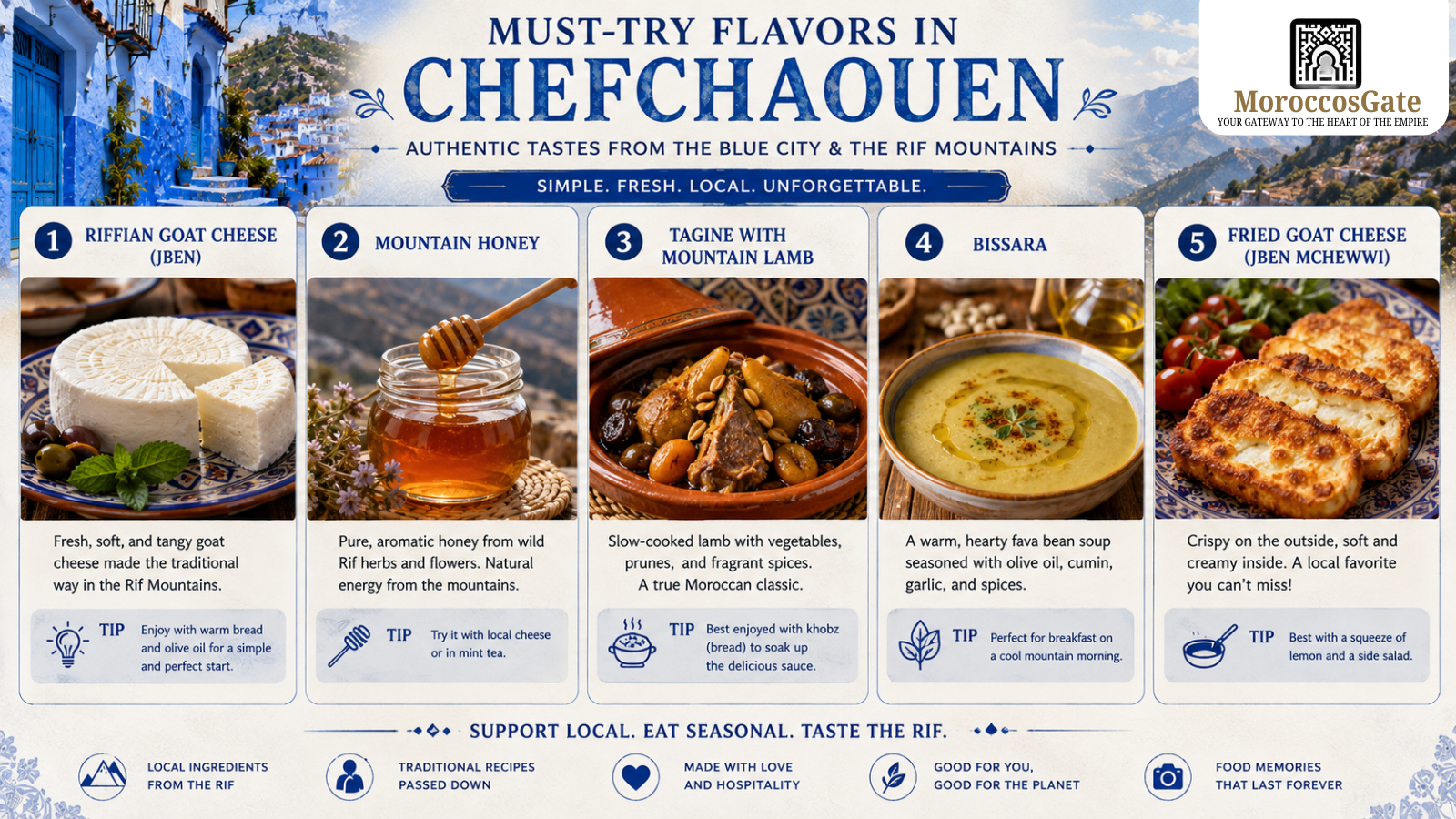
- Riffian Goat Cheese (Jben): The single most distinctive local food product. Soft, fresh goat cheese produced by Berber communities in the surrounding hills, sold at small market stalls in the upper medina lanes and at the weekly market. It is tangy, crumbly, and completely unlike the processed cheese sold in Moroccan supermarkets. Buy it with flatbread from a nearby stall and eat it on the steps of a blue staircase. This is the best meal in Chefchaouen — and we have eaten everywhere in this city.
- Mountain Honey: Rif Mountain honey — dark, aromatic, intensely flavoured — is sold throughout the medina and at the weekly market. Buy a small jar and eat it with local bread and argan oil at breakfast. It is different in character from the honeys of the Souss or the High Atlas; more complex, slightly resinous, reflecting the wild mountain flora.
- Tagine with Mountain Lamb: Simple mountain lamb tagine — slow-cooked with preserved lemon, olives, and local herbs — served in the medina’s small restaurants with bread. Straightforward, honest, delicious.
- Bissara: A thick soup of fava beans, olive oil, cumin, and paprika — one of Morocco’s great street foods and particularly popular in the north. A bowl costs almost nothing and is one of the most warming and filling meals available in the medina on a cool morning.
- Fried Goat Cheese (Jben Mchewwi): Fresh goat cheese fried until crispy on the outside and melting inside, served with local honey for dipping. Found on some restaurant menus and best ordered as a starter. A revelation if you have only encountered jben in its cold, fresh form.
Where to Eat in Chefchaouen
- Restaurant Bab Ssour: A popular choice with a rooftop terrace overlooking the medina and a menu of reliable Moroccan classics. The tagines are well-executed and the breakfast spread is generous. One of the most consistent options in the mid-price range.
- Casa Aladdin: Another rooftop terrace restaurant with medina views. Popular with international visitors but maintains quality. Strong on grilled meats and Moroccan salads.
- Small stalls off Plaza Uta el-Hammam: The lanes immediately behind and to the sides of the main square have small family-run kitchens serving hot food from lunchtime. Msemen (flat-bread stuffed with meat or vegetables), harira soup, and daily specials at prices significantly below the plaza restaurants. These are our preferred lunch options in Chefchaouen.
- The Ras el-Maa cafés: The small restaurants along the river at Ras el-Maa spring are our favourite breakfast locations. Fresh bread, goat cheese, eggs, mountain honey, and mint tea eaten to the sound of running water — one of the finest breakfasts in Morocco at a fraction of the medina prices.
What to Drink
Chefchaouen’s mint tea is excellent and served everywhere — expect three small glasses at any sitting, poured from height for aeration. Fresh-squeezed orange juice is ubiquitous and very good. For the adventurous: Rif Mountain herbal tea, made with wild herbs gathered from the hillsides around the city, is served in some of the more local-facing cafés and offers a completely different flavour profile from the standard mint tea. Ask for atay bil awchab (mountain herb tea) and you will likely get an enthusiastic response.
Where to Stay in Chefchaouen: Riad and Guesthouse Guide
Chefchaouen is Morocco’s best-value destination for medina accommodation. The same riad experience that costs €60–€90 per night in Marrakech can be found here for €25–€50 — and the quality, in many cases, is comparable or superior. The Chefchaouen medina riads tend to be smaller and more family-run than their Marrakech equivalents, which gives them a warmth and personalisation that larger properties struggle to match.
Our Accommodation Recommendations by Budget
Budget (Under €30 per night)
Hostel dorms in Chefchaouen run €10–15 per night — some of the most affordable medina accommodation in Morocco. Several excellent hostels operate within the medina walls, with rooftop terraces, shared kitchens, and the social energy that solo travellers particularly value. Look for properties with a minimum 8.0 rating on Booking.com and at least 100 reviews.
Mid-Range (€25–€55 per night)
The majority of Chefchaouen’s traditional riads and guesthouses fall into this bracket — the sweet spot for quality and price. A mid-range riad in the Chefchaouen medina typically offers private rooms with en-suite bathrooms, a central courtyard, a rooftop terrace, and breakfast included. The best properties at this price point deliver a genuinely beautiful Moroccan accommodation experience at a fraction of the Marrakech equivalent. Book 4–8 weeks ahead for spring and autumn visits; 2–4 weeks for other periods.
Boutique / Upscale (€55–€120 per night)
Chefchaouen’s boutique riad properties at the upper end of the market offer thoughtfully designed interiors, fireplaces (essential in winter at this altitude), private terraces with mountain views, and the kind of attentive service that international boutique hotel guests expect. A handful of genuinely exceptional properties in the €70–€120 bracket rival anything in Marrakech or Fes for quality, in a setting that is considerably less crowded and more personally delivered. Our guide to Morocco’s finest riads includes selected Chefchaouen properties.
Booking Tips for Chefchaouen
- Always stay inside the medina. Guesthouses outside the medina walls exist and are cheaper — but miss the entire point of Chefchaouen. The experience of walking out of your front door into a blue alleyway is not replicable from outside the walls.
- Confirm arrival instructions. The medina’s alleyways are narrower and less well-signed than Marrakech. Ask your property to provide detailed WhatsApp directions and to send someone to meet you at the nearest accessible road.
- Check for heating/air conditioning. At 600 metres altitude, Chefchaouen winters are genuinely cold (below 5°C at night). Summer days are warm but evenings cool quickly. Confirm the property has functioning heating in winter and AC or ceiling fans for summer.
How to Get to Chefchaouen: Transport Guide 2026
Chefchaouen has no airport and no train station. Getting there requires road travel — which is, in this case, a feature rather than a bug. The mountain roads approaching Chefchaouen through the Rif are among the most scenic drives in Morocco.
From Tangier (90 km, 2.5 hours)
The most common approach for international visitors flying into Tangier Ibn Batouta Airport (TNG) — increasingly served by direct routes from European cities including London, Madrid, and Paris. CTM and Supratours buses run several daily services from Tangier bus station to Chefchaouen for approximately 50–70 MAD per person. Grand taxis also cover the route for approximately 40–60 MAD per person in a shared vehicle, leaving from near the bus station when full. Private transfer from Tangier to Chefchaouen is available for approximately €30–40 for the whole vehicle.
From Fes (200 km, 4 hours)
The second most common approach, particularly for travellers doing a northern Morocco circuit (Fes → Chefchaouen → Tangier or in reverse). CTM operates a daily Fes–Chefchaouen bus service. The route climbs through the Middle Atlas before entering the Rif — genuinely beautiful driving, but four hours is a long time on mountain roads. A private transfer from Fes to Chefchaouen (approximately €60–80 for the whole vehicle) is significantly more comfortable and allows stops at viewpoints along the route.
From Casablanca (300 km, 5–6 hours)
A long drive or bus journey — best broken into two stages (Casablanca → Rabat/Fes → Chefchaouen) or covered by domestic flight to Tangier followed by bus or transfer. CTM runs direct services but the duration makes it a commitment. For travellers on a northern Morocco circuit departing from Casablanca, the logical routing is Casablanca → Rabat (Al Boraq high-speed train) → Tangier (Al Boraq high-speed train, 2 hours) → Chefchaouen (bus or transfer, 2.5 hours).
By Car
The scenic route through the Rif Mountains — particularly from Tangier — is excellent driving on well-maintained roads. Parking at the edge of the medina is available (the medina itself is entirely pedestrianised). Renting a car allows stops at olive groves, small Riffian villages, and mountain viewpoints that the bus bypasses entirely. For independent travellers with time and confidence on mountain roads, this is the most rewarding way to arrive.
Best Time to Visit Chefchaouen in 2026
Chefchaouen’s altitude (600 metres) gives it a significantly different climate from Morocco’s coastal and desert regions. This is good news for summer visitors — the city stays comfortable when inland Morocco is at its most brutal — but requires consideration for other seasons too.
Spring (March–May): Our Top Recommendation
Spring is the finest season for visiting Chefchaouen. The surrounding Rif Mountains are lush and green from winter rain, wildflowers cover the hillsides, and the air has a freshness and clarity that the drier months cannot match. Temperatures are ideal — 18–25°C by day, cool but not cold at night. Crowds are manageable: tourism is growing but the genuine peak pressure of August has not yet arrived. The Festival Alegria cultural event (mid-July, just after spring ends) creates a festive energy that spills into late May and early June. See our full Morocco seasonal guide for the complete picture.
Summer (June–August): Warm Days, Weekend Crowds
Summer in Chefchaouen is warm (26–32°C by day), significantly cooler than the Moroccan interior, and genuinely pleasant for hiking and medina exploration. The major caveat is weekend crowds: Chefchaouen is a favourite summer retreat for Moroccan domestic tourists from the northern cities, and Friday evenings through Sunday afternoons see the medina fill significantly. If visiting in summer, aim for a mid-week arrival and departure. Evenings are cool and beautiful. The Festival Alegria in mid-July adds a cultural programme to the usual pleasures of the city.
Autumn (September–November): Equally Excellent
Autumn is our joint-top recommendation alongside spring. The summer crowds have dispersed, the light is exceptional (warm, golden, long), temperatures are perfect for hiking, and the Akchour waterfalls are at their most accessible and enjoyable. October in Chefchaouen is one of Morocco’s finest travel moments.
Winter (December–February): For Adventurous Travellers
Winter Chefchaouen is the quietest and most atmospheric version of the city. Temperatures can drop below 5°C at night and occasional snowfall transforms the blue medina into something entirely otherworldly. The mountain mist that settles over the city on winter mornings creates a visual quality unlike any other season. But this is not a season for the comfort-focused traveller: ensure your accommodation has proper heating, pack warm layers, and be prepared for some trails (particularly Akchour) to be inaccessible after heavy rain.
How Many Days in Chefchaouen?
One full day and one night is the absolute minimum. Two nights is our recommendation for most travellers. Here is why the extra night earns its keep:
- Day 1 afternoon: Arrive, check in, wander the medina, watch sunset from the Spanish Mosque, dinner in the plaza.
- Day 2 morning: Breakfast at Ras el-Maa, full morning in the medina at its quietest, weekly market if the day is right.
- Day 2 afternoon/evening: Day trip to Akchour (return in late afternoon), rooftop dinner with mountain views.
- Day 3 morning: Final medina wander at dawn — the city at its most beautiful — before departure.
Travellers who visit Chefchaouen as a day trip from Fes or Tangier (a common itinerary mistake) arrive at the same time as every other day-tripper, see the most crowded version of the medina, and leave without experiencing the city at its finest: early morning and late evening, when the day-trippers are gone and the blue walls belong to those who stayed the night.
Practical Tips for Visiting Chefchaouen in 2026
Photography Etiquette
Chefchaouen is extraordinary for photography and the temptation to point a camera at everything is understandable. Always ask before photographing people — many older residents genuinely dislike being photographed, and a smile and a gesture toward your camera is enough to ask permission. Children are often enthusiastic about being photographed but a tip or small gift (stationery is popular) is appropriate if a child has spent time posing for you.
The best photography conditions: early morning (5:30–8:00 AM) and late afternoon/evening (5:00 PM–sunset). Midday light in the blue medina creates harsh shadows and washes out the subtlety of the colour palette.
Cultural Respect
Chefchaouen is a conservative Riffian Berber community, and visitors who dress and behave respectfully are received with extraordinary warmth. Cover shoulders and knees in the medina. Use your right hand for eating and passing things. Greet shopkeepers and guesthouse staff with “Salam aleikum” — the response you receive will reset your expectations about Moroccan hospitality. A few words of Darija (“Shukran” for thank you, “Bshhal hada?” for how much is this) earn genuine appreciation and typically better prices in the souks.
The Hashish Question
It would be dishonest to write a Chefchaouen guide without acknowledging this: the city is located in the heart of Morocco’s cannabis-growing region, and visitors will likely be approached by locals whispering offers of hashish on the medina streets. The possession and use of cannabis is illegal in Morocco. We advise against engaging with these approaches — not only because of the legal risk, but because accepting and then being pressured for inflated prices or followed through the medina is a consistently reported negative experience that disrupts what should otherwise be an entirely pleasant visit.
ATMs and Cash
Chefchaouen has ATMs in the new town (outside the medina walls) but fewer inside the medina itself. Withdraw sufficient Moroccan Dirhams before entering the medina — most small restaurants, market stalls, and craft shops are cash-only.
Chefchaouen in the Broader Morocco Itinerary
Chefchaouen works best as part of a northern Morocco circuit rather than a standalone destination. The most logical itineraries from Ireland and the UK:
- Northern Morocco Circuit (7–10 days): Fly Dublin → Tangier. Spend 1 night Tangier. Bus or transfer to Chefchaouen (2 nights). Grand taxi or bus to Fes (4 hours). Spend 2–3 nights Fes. Train to Rabat/Casablanca. Fly home.
- Full Morocco Circuit (12–14 days): Fly into Casablanca → Marrakech → Atlas Mountains → Sahara Desert → Fes → Chefchaouen → Tangier → fly home from Tangier.
- Northern Short Break (4–5 days): Fly Dublin → Tangier (Thursday evening). Tangier 1 night. Chefchaouen 2 nights. Return to Tangier for flights home (Sunday).
For everything you need to plan a Morocco trip that includes Chefchaouen alongside other experiences — from Atlas Mountains trekking to summer festivals in Casablanca and Rabat — our team at Morocco’s Gate can help you design the ideal itinerary.
Is Chefchaouen Worth Visiting in 2026?
It is one of the few Moroccan destinations that lives up to its reputation. Plan 1–2 days and pair it with Tangier or Fes.
We would put it more strongly than that. Chefchaouen is one of the world’s genuinely great small cities — a place with a visual identity unlike anywhere else, with hiking trails and waterfalls and weekly markets and mountain cheese and rooftop sunsets that sit entirely outside the Instagram version of themselves and exist as real, tactile, sensory experiences for anyone who turns up in person.
Morocco’s tourism boom is bringing more visitors here every year. The city that was once a well-kept secret among Morocco circuit travellers is now increasingly on everyone’s list. Visiting in 2026 — particularly in spring or autumn, particularly with two nights rather than a day trip — is the best version currently available. For the full case on why visiting Morocco sooner rather than later is the smarter travel decision, see our article on visiting Morocco before the 2030 World Cup.
Frequently Asked Questions — Chefchaouen Travel Guide 2026
Is Chefchaouen worth visiting in 2026?
Yes — absolutely. Chefchaouen is one of Morocco’s most extraordinary destinations and genuinely lives up to its reputation. The blue medina, Spanish Mosque sunset, Akchour waterfalls, mountain food, and peaceful atmosphere combine into one of Morocco’s finest 2-day travel experiences. Plan 1–2 nights and combine with Tangier or Fes.
How many days should I spend in Chefchaouen?
Two nights is the ideal minimum. One night allows only the medina wander and Spanish Mosque sunset. Two nights adds the Ras el-Maa morning walk, the weekly market, and an Akchour day trip — the full Chefchaouen experience. Day trips from Fes or Tangier see only the crowded midday medina and miss the city at its best.
What is the best time to visit Chefchaouen?
Spring (March–May) and autumn (September–November) are optimal — warm days, cool evenings, manageable crowds, and the city at its most atmospheric. Summer is comfortable at 600m altitude but busy at weekends with domestic tourists. Winter is cold but extraordinarily atmospheric, particularly if it snows.
How do I get to Chefchaouen from Tangier?
CTM or Supratours buses run several daily services from Tangier bus station to Chefchaouen for approximately 50–70 MAD, taking about 2.5 hours. Grand taxis cost approximately 40–60 MAD per person in a shared vehicle. Private transfers from Tangier to Chefchaouen cost approximately €30–40 for the whole vehicle.
Why is Chefchaouen painted blue?
The most widely cited explanation is that Jewish refugees who settled here from the 15th century onwards painted buildings blue — a colour associated with divinity and heaven in Jewish tradition. Other theories include the practical claim that blue repels mosquitoes. Whatever the origin, the entire medina has been painted in shades of blue from powder-pale to deep cobalt for generations.
What should I eat in Chefchaouen?
The must-try foods are Riffian goat cheese (jben) with flatbread, mountain honey, bissara soup, simple lamb tagine, and fried goat cheese with honey. The best breakfast is at the Ras el-Maa riverside cafés. For dinner, Restaurant Bab Ssour and Casa Aladdin both offer good rooftop terrace experiences. The best-value meals are in the small family kitchens in the lanes behind Plaza Uta el-Hammam.
Is Chefchaouen safe for solo female travellers?
Yes — Chefchaouen is one of the safer towns in Morocco, with low crime and a relaxed atmosphere. Solo female travellers consistently report feeling comfortable here. Dress modestly (shoulders and knees covered), as anywhere in Morocco, and you will have a positive experience. The medina is small and the community atmosphere means you are rarely far from other people.
What are the best day trips from Chefchaouen?
The Akchour National Park (45 minutes by grand taxi) is the best day trip — offering the God’s Bridge natural arch and the Grand Cascade waterfall. Talassemtane National Park offers longer hiking options with a local guide. The scenic drive through the Rif Mountains toward Tetouan or the Mediterranean coast is also excellent for those with a car.
How much does a trip to Chefchaouen cost per day?
A comfortable budget is €30–€55 per person per day, covering mid-range medina accommodation (€20–€40 per night), local meals (€8–€15 per day), activities (most are free or under €5), and transport. Budget travellers staying in hostels and eating local can manage on €20–€30 per day. The Akchour day trip adds approximately €5–€10 in grand taxi fares.
Plan Your Chefchaouen Trip with Morocco’s Gate
Chefchaouen does not need much selling. It is one of those rare places that does the work itself — the blue walls, the mountain air, the mint tea, the cats on the steps in the morning light. What it needs is for you to actually go, to stay two nights rather than rushing through on a day trip, to wake up early enough to have it to yourself for an hour before the rest of the world arrives.
Morocco’s Gate has been helping Irish and European travellers discover exactly these moments in Morocco since 2015. If you want a personalised Chefchaouen itinerary — or a complete Morocco circuit that combines the Blue City with Fes, Marrakech, the Sahara, or any other destination — we are ready to help.
- → Talk to our team and plan your Chefchaouen and Morocco trip
- → Browse our curated Morocco travel deals
- → Read the Best Time to Visit Morocco 2026 guide
- → Explore Morocco’s 2026 music festival calendar
- → Discover more of Morocco’s hidden gems