
Fes Medina Tourist Attractions: The Complete Guide to Morocco’s Ancient Walled City
Stepping into the Fes Medina is like walking backward through nine centuries of history in a single afternoon. Officially known as Fes el Bali, this UNESCO World Heritage Site is widely regarded as the best-preserved medieval city in the Arab world, and it remains one of the largest car-free urban areas on the planet. Inside its ancient walls, more than 9,000 narrow alleys twist between mosques, madrasas, tanneries, and souks, forming a living, breathing city where donkeys still outnumber cars as the primary mode of transport.
For travelers researching Fes Medina tourist attractions, the sheer scale can feel overwhelming — this is not a single monument to check off a list, but an entire historic ecosystem to get lost in, quite literally. This guide walks through the medina’s essential landmarks, practical visiting tips, and answers to the questions travelers ask most often, so you can plan a visit that captures the depth of what makes Fes one of Morocco’s most extraordinary destinations.
Why the Fes Medina Matters
Founded in the 9th century, Fes el Bali grew into the intellectual and spiritual capital of Morocco, and by the 13th and 14th centuries under the Marinid dynasty, it had become one of the greatest centers of learning, craftsmanship, and trade in the Islamic world. UNESCO inscribed the medina as a World Heritage Site in 1981, recognizing it as an outstanding example of a medieval Islamic city that has retained its urban fabric, architecture, and traditional crafts largely intact.
Unlike cities that have modernized their historic cores, Fes Medina still functions as it did centuries ago: artisans hammer brass in the same workshops their grandfathers used, tanners dye leather in the same stone vats that have operated since the medieval period, and the daily rhythm of the souks follows patterns established generations ago. This living continuity is precisely what makes the Fes Medina tourist attractions so compelling — you’re not visiting a museum reconstruction, you’re walking through an authentic working city.
Al-Qarawiyyin University and Mosque — The Oldest Continuously Operating Educational Institution in the World
Founded in 859 AD by Fatima al-Fihri, a wealthy and educated woman, Al-Qarawiyyin holds the Guinness World Record and UNESCO recognition as the oldest continuously operating educational institution in the world, predating both Oxford and Cambridge by centuries.
The complex functions simultaneously as a mosque, a university, and a library, and its architecture reflects layers of expansion and restoration across more than a thousand years. Intricately carved cedar wood ceilings, geometric zellige tilework, and horseshoe archways showcase the evolution of Moroccan-Andalusian design. The Qarawiyyin Library, restored in a major renovation project completed in the 2010s, houses an extraordinary collection of rare manuscripts, including early Quranic texts and medieval scientific works.
Because it remains an active mosque, non-Muslim visitors cannot enter the prayer hall, but the ornate entrance doors and outer courtyards can be admired from just outside, and the surrounding streets offer some of the best glimpses into the scale and grandeur of the complex. Even from the exterior, the craftsmanship on display makes it clear why this site anchors any list of essential Fes Medina tourist attractions.
Bou Inania Madrasa — A Masterpiece of Marinid Architecture
Built between 1350 and 1357 under Sultan Abu Inan Faris, the Bou Inania Madrasa is widely considered the finest example of Marinid architecture in Fes, and it is one of the only madrasas in the city that also functioned as a full congregational mosque, complete with a minaret — a rare distinction that made it historically significant beyond its role as a religious school.
Visitors who step inside (this is one of the few religious sites in the medina open to non-Muslims) are greeted by a breathtaking central courtyard featuring a marble fountain, surrounded by walls layered with carved cedar wood, ornate stucco, and colorful zellige tilework climbing from floor to ceiling. Upstairs, small student cells where scholars once lived and studied still line the upper galleries, offering a tangible sense of what academic life looked like in medieval Fes.
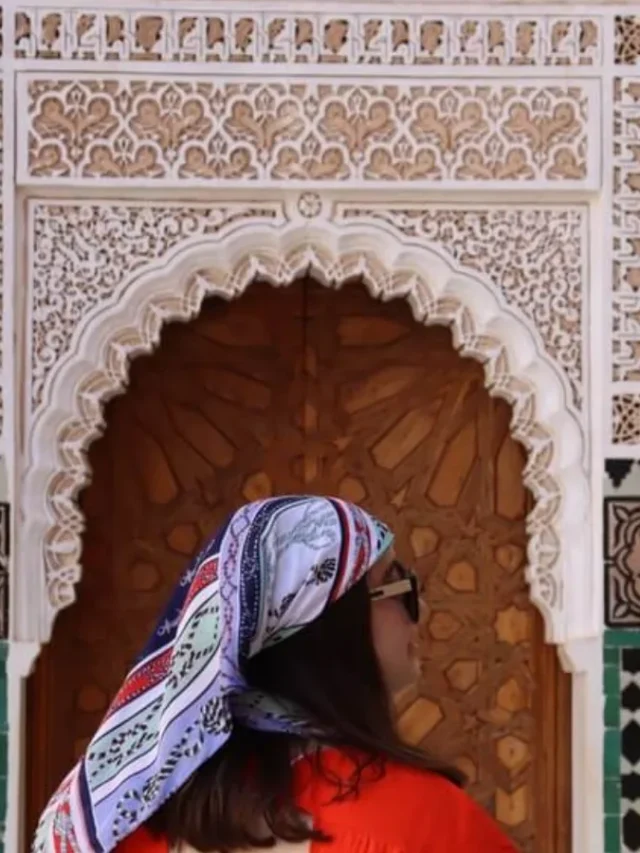
The madrasa’s elaborate horseshoe-arched entrance, adorned with bronze-plated doors, is considered one of the most photographed architectural details in the entire medina.
Chouara Tannery — Morocco’s Most Iconic Leather-Making Site
No list of Fes Medina tourist attractions would be complete without the Chouara Tannery, one of the oldest tanneries in the world and easily the most photographed site in the city. From above, the tannery resembles a painter’s palette: dozens of round stone vats filled with dye in shades of red, yellow, blue, and green, where workers still process leather using techniques passed down for centuries.
The process begins with softening animal hides in a mixture of cow urine, quicklime, water, and pigeon droppings — a step that explains why leather shop owners hand visitors sprigs of fresh mint upon arrival, offered as a natural way to offset the pungent smell. After the hides are cleaned and softened, they’re transferred to the dye pits, where workers wade in, sometimes waist-deep, to hand-treat the leather using pigments historically derived from natural sources like poppy flowers, indigo, and saffron.
Most visitors experience the tannery from one of the surrounding leather shop terraces, which offer an elevated, panoramic view of the vats in action. It’s customary (though not obligatory) to browse the shop’s leather goods — bags, jackets, poufs, and slippers — as a courtesy for terrace access, and the quality of Fes leatherwork is genuinely some of the best in Morocco.
Dar Batha Museum — Moroccan Art Inside a 19th-Century Palace
Housed in a former royal palace built in the late 19th century by Sultan Moulay Hassan I, the Dar Batha Museum blends Hispano-Moorish architecture with a rich collection of traditional Moroccan arts. Inside, visitors will find rooms dedicated to Fassi ceramics known for their distinctive cobalt blue patterns, intricately embroidered textiles, antique carpets, wrought ironwork, and carved wooden astrolabes once used for astronomy and navigation.
The museum’s real showstopper, however, may be its garden: a tranquil, Andalusian-style courtyard shaded by an enormous, centuries-old barbary oak tree, with the gentle sound of water features cutting through the noise of the medina just outside the walls. After hours spent navigating crowded alleyways, the Dar Batha’s garden offers one of the few genuinely peaceful pauses within the old city, making it a favorite stop for travelers who want to slow down and reflect on everything they’ve seen.
Nejjarine Museum of Wooden Arts & Crafts
Set inside a stunningly restored funduq — a historic caravanserai that once housed traveling merchants and their goods — the Nejjarine Museum celebrates Morocco’s centuries-old tradition of woodworking. The building itself, arranged around a central courtyard with a marble fountain and cedar balustrades, is as much of an exhibit as the artifacts inside.
Displays include antique Quranic writing boards, ornately carved doors, traditional musical instruments, and the specialized tools used by generations of Fassi carpenters, several of whom continue to work in nearby workshops using techniques largely unchanged since the medieval period. Climbing to the rooftop terrace café rewards visitors with one of the best panoramic views in the entire medina — a sweeping vista of minarets, satellite dishes, and rooftop terraces stretching toward the surrounding hills, best enjoyed with a glass of Moroccan mint tea.
The Souks of Fes Medina — A Living Marketplace
If the monuments represent the medina’s history, the souks represent its beating heart. Fes is organized into distinct craft quarters, a structure that has remained largely unchanged for centuries, making it possible to trace an entire supply chain — from raw material to finished product — within a few blocks.
- Souk Attarine (Spice and Perfume Market) fills the air with the scent of saffron, cumin, dried rosebuds, and amber resin, alongside stalls selling traditional Moroccan cosmetics like kohl and ghassoul clay.
- Souk Sabbaghine (Dyers’ Souk) showcases skeins of freshly dyed wool and thread hanging overhead in vivid colors, a smaller-scale companion to the leather-dyeing seen at Chouara Tannery.
- Souk El Henna specializes in henna, herbal remedies, and traditional beauty products, set in one of the medina’s quieter, tree-shaded squares.
- Metalworkers’ Quarter rings with the sound of hammers on brass and copper, where artisans shape lanterns, trays, and teapots using techniques passed down through generations of the same families.
- Textile and Carpet Souks display richly patterned Berber rugs, embroidered kaftans, and woven blankets, often sold directly by cooperatives that support rural artisan communities.
Wandering the souks without a fixed destination is, for many visitors, the single best way to understand what makes Fes Medina tourist attractions so distinct from monuments in other cities — the market itself is the living exhibit.
Bab Bou Jeloud — The Iconic Blue Gate
Bab Bou Jeloud, completed in 1913 during the French Protectorate era in a deliberately traditional Moroccan style, serves as the grand, ceremonial entrance to Fes el Bali from the newer parts of the city. Its exterior is tiled in intricate blue mosaic patterns — blue being the traditional color associated with Fes — while the interior-facing side is decorated in green, the color symbolizing Islam.
The gate’s three horseshoe arches frame a lively square filled with cafés where both locals and travelers linger over mint tea, watching the constant flow of pedestrians, donkey carts, and vendors passing beneath the gate. It’s an ideal spot to get oriented before diving into the medina’s alleys, and equally satisfying as a place to unwind at the end of a long day of sightseeing.
Other Notable Fes Medina Tourist Attractions
Beyond the headline sites, several additional landmarks reward travelers with extra time:
- Zaouia of Moulay Idriss II — the mausoleum of the city’s founder, considered one of the holiest sites in Fes; non-Muslims cannot enter but can view the ornate exterior and the wooden bar marking the sacred boundary.
- Borj Nord and the Merenid Tombs — a hilltop fortress and ruined tombs offering the best panoramic viewpoint over the entire medina, particularly stunning at sunset.
- Fondouk Tsetouanianne and other historic funduqs — smaller restored caravanserais scattered throughout the medina, many now housing artisan cooperatives.
- Andalusian Quarter (Fes El Jdid) — a slightly less crowded section of the old city with its own mosques, gardens, and the historic Mellah (Jewish quarter), known for its distinctive wrought-iron balconies.
Practical Tips for Visiting Fes Medina Tourist Attractions
Hire a Licensed Guide, at Least for Your First Day
With over 9,000 alleys and no reliable street signage in many sections, even seasoned travelers get disoriented in the Fes Medina. A licensed local guide not only prevents you from getting lost but also unlocks historical context and access to workshops and viewpoints that aren’t obvious from the street. Guides can be arranged through official tourism offices or reputable riads.
Wear Comfortable, Closed-Toe Shoes
The medina’s stone and cobblestone alleys are uneven, often slick near the tanneries and butcher stalls, and involve constant stepping aside for donkey carts, which remain the primary way goods are transported through the car-free old city.
Visit Early in the Day
Arriving shortly after sites open allows visitors to experience the medina’s ancient monuments before both the midday heat and the heaviest crowds set in, and it offers the best light for photography at landmarks like Bab Bou Jeloud and the Chouara Tannery terraces.
Carry Small Bills
Many souk vendors, tea stalls, and smaller attractions don’t have change for large notes, so keeping a stock of small denominations makes transactions smoother and speeds up minor purchases.
Respect Photography Etiquette
Always ask before photographing individual artisans or shop owners directly, and expect that some may request a small tip in exchange. Photography inside religious sites open to visitors, like Bou Inania Madrasa, is generally welcomed, though flash photography is best avoided out of respect for the space.
Be Ready to Politely Decline “Guide” Offers
Unofficial self-appointed guides sometimes approach tourists near major gates. It’s fine to politely decline and continue on; if you want a guide, arranging one through your riad or the official tourism office ensures a knowledgeable, licensed professional.
Best Time of Day and Year to Visit
Late morning through early afternoon tends to be the busiest period at major sites like the Chouara Tannery and Bou Inania Madrasa, while early morning and the hour before sunset offer a quieter, more atmospheric experience, particularly around Bab Bou Jeloud. Seasonally, spring (March–May) and autumn (September–November) provide the most comfortable temperatures for hours of walking, while summer heat in Fes’s interior can be intense during midday hours.
How Much Time to Budget for the Medina
Most travelers spend a full day covering the medina’s core landmarks — Bab Bou Jeloud, Al-Qarawiyyin, Bou Inania Madrasa, the Chouara Tannery, and the main souks — but travelers with a genuine interest in history, architecture, and artisan crafts often dedicate two full days, adding the Dar Batha Museum, Nejjarine Museum, and a sunset visit to Borj Nord for a comprehensive experience.
Frequently Asked Questions About Fes Medina Tourist Attractions
What are the top tourist attractions in Fes Medina? The most essential Fes Medina tourist attractions include Al-Qarawiyyin University, Bou Inania Madrasa, the Chouara Tannery, Dar Batha Museum, the Nejjarine Museum of Wooden Arts, the medina’s souks, and the iconic Bab Bou Jeloud gate.
Is the Fes Medina worth visiting? Yes. As the best-preserved medieval city in the Arab world and a UNESCO World Heritage Site, the Fes Medina offers an unmatched combination of intact architecture, living craft traditions, and an authentic, still-functioning old city that few destinations in the world can rival.
How many days do you need to see the Fes Medina? One full day covers the core landmarks, but two days allow for a deeper visit including museums, hilltop viewpoints, and more time exploring the souks without rushing.
Can non-Muslims enter Al-Qarawiyyin Mosque? No, non-Muslim visitors cannot enter the prayer hall of Al-Qarawiyyin, though the ornate exterior and entrance can be admired from the surrounding streets and courtyards.
Do I need a guide to visit Fes Medina? A guide isn’t strictly required, but given the medina’s maze-like layout of more than 9,000 alleys, a licensed local guide is highly recommended, especially for first-time visitors who want to avoid getting lost and gain historical context.
Is Fes Medina safe for tourists? Yes, the medina is generally safe for tourists, though visitors should stay alert in crowded areas, watch their belongings in busy souks, and politely decline unsolicited guide offers from unlicensed individuals.
What is the best time of day to visit the Chouara Tannery? Morning visits tend to offer better light for photography and slightly smaller crowds, though the tannery is active and visually striking throughout most of the day.
Final Thoughts
The Fes Medina tourist attractions collectively form one of the richest historical experiences in North Africa — a place where a nine-century-old university still educates students, artisans still hand-dye leather using medieval techniques, and every alley seems to lead to another architectural surprise. Whether you’re marveling at the intricate tilework of Bou Inania Madrasa, breathing in the color and scent of the Chouara Tannery, or simply losing yourself in the souks, the Fes Medina delivers a journey through time unlike anywhere else in Morocco.
#FesMedina #MoroccoTravel #ExploreFes #TravelGuide #HistoricalSites #CulturalHeritage #VisitMorocco