
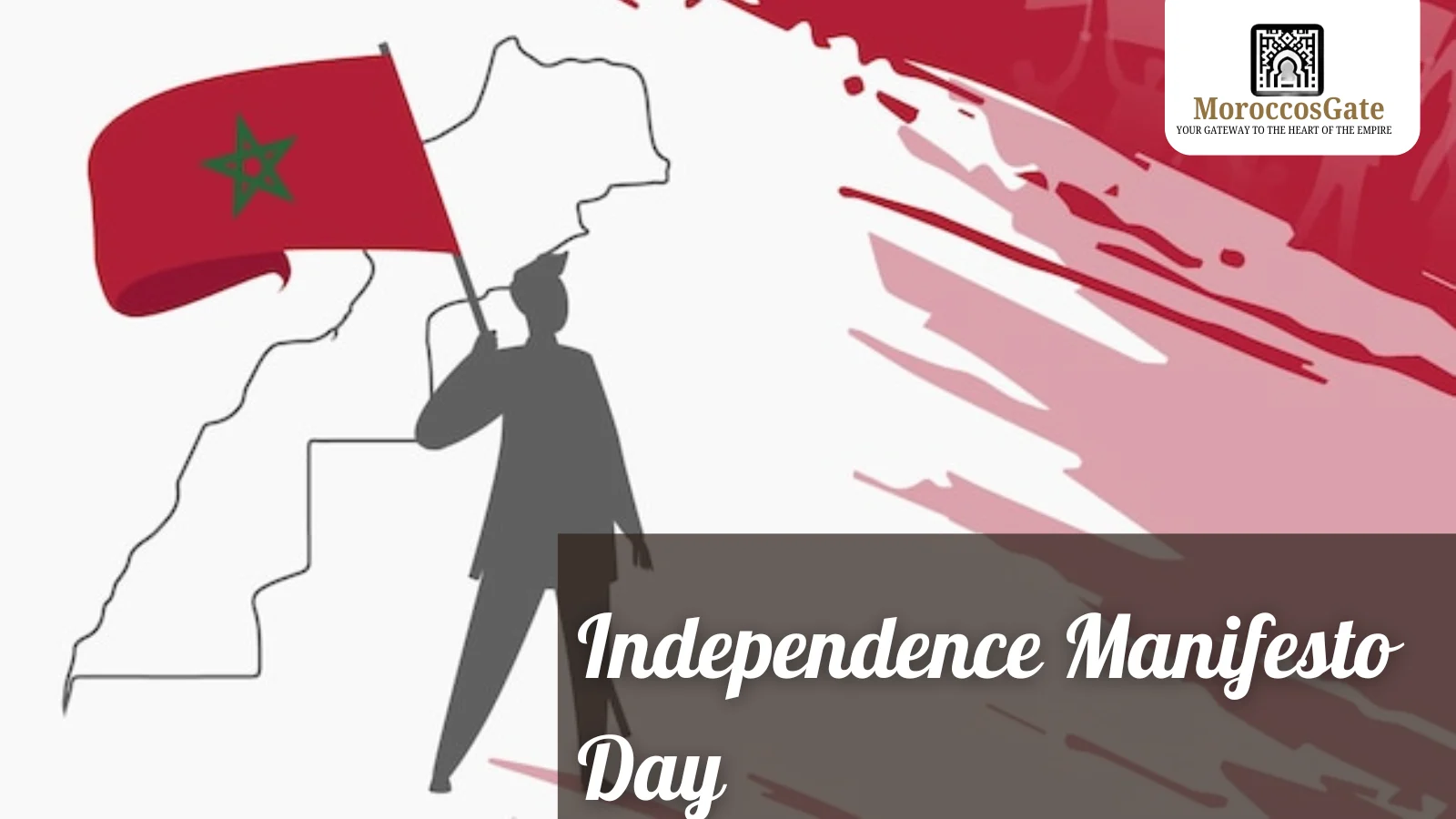
Independence Manifesto Day: The Day Morocco Said “No” to Colonialism
Every nation has a date that defines its character. For the Kingdom of Morocco, that date is January 11th. Today, we do not just mark a holiday on the calendar. We stand at attention to salute a moment of supreme bravery. Independence Manifesto Day is the anniversary of the moment when Morocco looked into the eyes of the colonial powers and demanded its dignity back.
At MoroccosGate, we usually guide you through the beauty of our landscapes and the taste of our food. But today, we guide you through the landscape of our history. To our Moroccan brothers and sisters here in Ireland and back home: this is your story. To our friends visiting the Kingdom: this is the soul of the land you walk upon.
Here is the epic story of the Manifesto of 1944—the document that broke the chains of fear.
Come to Morocco on Jan 11 2026, book Flight tickets now. Click here👇
The Shadow of the Protectorate: The Context of the Struggle
To understand the bravery of January 11, 1944, you must understand the darkness that came before it.
Since the Treaty of Fez in 1912, Morocco had been divided. We were under the “Protectorate” of France in the center and Spain in the north and south. Our land was carved up. Our resources were extracted. Our identity was being suffocated.
For decades, the resistance fought. From the Rif mountains where Abdelkrim el-Khattabi waged war, to the Atlas where the tribes refused to bow, the spirit of the warrior was always alive. But by the 1940s, the battle shifted from the mountains to the cities, from the sword to the pen.
The world was burning in the fires of World War II. The colonial powers were weakened. The Allies (Americans and British) had landed on our shores (Operation Torch). The time to strike was not tomorrow. It was now.
January 11, 1944: The Thunderclap
On this Tuesday in 1944, a group of 66 brave souls—men and one woman, Malika al-Fassi—did the unthinkable.
They were members of the nationalist movement, primarily from the Istiqlal (Independence) Party. They drafted a document. It was not a request. It was not a plea for better treatment. It was a Manifesto.
They walked into the offices of the French Residence-General, the foreign consulates, and the palace of the Sultan. They handed over the “Manifesto of Independence” (Wathiqat al-Istiqlal).
What Did They Demand?
The audacity of the document shakes us to this day. They demanded:
- The End of the Protectorate: They declared the Treaty of Fez obsolete.
- Full Sovereignty: Not partial rule, but complete independence for Morocco.
- Territorial Integrity: A united Morocco, free from French and Spanish division.
- A Constitutional Monarchy: They asked Sultan Mohammed V to lead a free nation under a democratic constitution.
In 1944, this was treason. To sign your name on that paper was to sign your own arrest warrant. Yet, 66 patriots signed it. They put their lives on the line for the freedom we breathe today.
The Lion and The People: Sultan Mohammed V
No story of Independence Manifesto Day is complete without honoring the Father of the Nation, Sultan Mohammed V (later King Mohammed V).
The colonial powers thought the Sultan was their puppet. They were wrong. He was the spearhead of the resistance.
Before the Manifesto was released, the nationalists met secretly with the Sultan. He did not just approve it; he encouraged it. He worked hand-in-hand with the resistance. When the French authorities pressured him to denounce the nationalists, he refused.
He stood like a lion protecting his pride. He famously declared that he was the Sultan of all Moroccans, not a subordinate of France. This partnership between the Throne and the People (Thawrat al-Malik wa al-Sha’ab) is the bedrock of modern Morocco. It was a bond forged in fire.
The Price of Courage: The Aftermath
We celebrate Independence Manifesto Day with flags and joy, but we must remember the blood that followed.
The colonial response was brutal. Days after the Manifesto was presented, the French authorities cracked down. The leaders of the movement were arrested.
- Ahmed Balafrej, the Secretary-General of the Istiqlal party, was arrested.
- Protests erupted in Rabat, Salé, Fez, and Azrou.
- The colonial troops opened fire. Thousands of Moroccans were imprisoned, exiled, or martyred.
But the bullet cannot kill an idea.
The Manifesto had lit a fire that could not be extinguished. The fear was gone. The Moroccan people had tasted the possibility of freedom, and they would settle for nothing less.
This path of resistance led directly to the exile of Sultan Mohammed V in 1953 (to Corsica and then Madagascar), which only fueled the revolution further, eventually forcing the colonizers to grant independence in 1956.
But it all started on January 11. That was the day the psychological chains were broken.
The 66 Signatories: The Heroes We Honor
On Independence Manifesto Day, we honor the names on that paper. They came from all walks of life—teachers, lawyers, merchants, writers. They represented the diversity of Morocco.
Among them was Malika al-Fassi, the only woman to sign the document. In a conservative society in the 1940s, her bravery was a beacon. She proved that the defense of the homeland is the duty of every man and woman.
These signatories knew they would be hunted. They knew their families would suffer. Yet, they prioritized the Watan (Nation) over their own safety. That is the definition of heroism.
Stay and Relax in your Luxury hotel room. Click here👇
Why We Celebrate Independence Manifesto Day Today
For the young generation, or for our Moroccan community living abroad in Ireland, why does this date still matter in 2025/2026?
It matters because freedom is not free.
The Morocco you see today—a country building high-speed trains, hosting the World Cup, leading Africa in renewable energy—stands on the shoulders of the men and women of 1944.
We celebrate to remind ourselves that we are a nation of fighters. We are a nation that does not accept subjugation.
- National Unity: It reminds us that whether you are Arab or Amazigh, from the North or the South, we are one people under one flag.
- Loyalty: It celebrates the unbreakable bond between the Monarchy and the People.
- Resilience: It teaches us that no matter how powerful the enemy, the will of the people is stronger.
How Independence Manifesto Day is Celebrated
If you are in Morocco on January 11th, you will feel the gravity of the day.
1. A Public Holiday
Schools, banks, and public administrations are closed. It is a day of rest and reflection.
2. Royal Pardon
It is customary for King Mohammed VI to grant royal pardons to prisoners on this day, symbolizing mercy and national cohesion.
3. Television and Media
The TV channels broadcast documentaries about the resistance. Veterans of the struggle (those few who remain) share their testimonies. The national anthem is played with extra fervor.
4. Street Decorations
The Red flag with the Green Pentagram adorns every street lamp, government building, and many private homes.
A Message to the Moroccan Diaspora
To our Moroccan brothers and sisters living in Ireland and across the world:
You may be far from the soil of the motherland, but the spirit of Independence Manifesto Day lives in your blood.
When you succeed abroad, you honor the dream of 1944. They fought for a sovereign, proud Morocco. Every time you represent our culture with dignity, every time you teach your children Darija or Amazigh, every time you wear the Caftan or make tea for a friend—you are keeping the resistance alive.
Do not let this date pass as just another day. Tell your children the story of the 66 heroes. Tell them about the Sultan who chose exile over betrayal. Tell them that they come from a line of warriors.
Visiting Morocco on January 11th?
For tourists and visitors planning a trip with MoroccosGate during this time:
You are witnessing a special moment. While shops and tourist sites remain open (tourism never sleeps!), you might see official ceremonies or parades.
- Respect the Vibe: It is a patriotic day. You will see more flags than usual.
- Visit History: Use this day to visit the Mohammed V Mausoleum in Rabat. It is the resting place of the King who received the Manifesto. Standing there on January 11th is a moving experience.
- Ask a Local: Ask your guide or a taxi driver what today means to them. You will hear stories of grandfathers and grandmothers who marched for freedom.
The Torch is Passed
The ink on the Manifesto of 1944 is dry, but the message is eternal.
Independence Manifesto Day is not just about looking back at the past; it is about looking forward. The battle of 1944 was for political independence. Today, the battle is for economic development, for education, for modernization, and for maintaining our rich heritage in a changing world.
The torch of bravery has been passed from the generation of 1944 to us. We must carry it with the same courage, the same dignity, and the same unshakeable love for Morocco.
Taxi Service available all over Morocco, Book Now. Click here👇

Allah, Al-Watan, Al-Malik. (God, The Country, The King).
Long live free Morocco.
Experience the History with MoroccosGate
If this story has stirred your soul, come and walk the streets where history was made.
- Visit the old medina of Fez where the secret meetings were held.
- Stand before the Royal Palace in Rabat where the destiny of a nation changed.
Plan your journey to the land of heroes.
- WhatsApp: +353-892614066
- Email: travel@moroccosgate.com
- Explore: Read more about our history in our “Moroccan Culture & Traditions” section.