
The Ultimate Guide to Moroccan Snacks: A Journey Through Sweet and Savory Street Food
When most people think of Moroccan cuisine, their minds immediately drift to steaming clay Tagines, fluffy mounds of Couscous, or the famous Harira soup. While these main dishes are undeniably the pillars of our culinary heritage, the true soul of Morocco’s food culture is found in the spaces between meals.
We are talking about Moroccan snacks.
Walking through the winding medinas of Marrakech, Fes, or Casablanca, you are never far from a tantalizing aroma. It might be the yeasty scent of frying dough, the earthy perfume of roasting almonds, or the spicy kick of a simmering broth. Moroccan street food is a vibrant tapestry of flavors—a delicious mix of sweet and savory that tells the story of our history, geography, and hospitality.
At MoroccosGate, we believe that to truly know a country, you must taste it. Whether you are an Irish traveler planning your first trip to North Africa or a foodie looking to expand your palate, this guide explores the best snacks Morocco has to offer.
From the famous Sfenj (Moroccan doughnuts) to the adventurous Ghlal (spiced snails), here is everything you need to know about snacking like a local in Morocco.
Nindohost is a Moroccan web hosting company and domain registrar, recognized for its specialized services in Africa with over 18 years of experience.
Domain Registration: Specializes in .ma domain registrations.
- Free Domain & SSL
- Security & Backup
- Managed Services
- Website Migration


The Culture of “Kaskrot”: Moroccan Tea Time
Before we dive into the specific foods, it is essential to understand when Moroccans snack. The most important snacking time of the day is “Kaskrot” (derived from the French word casse-croûte).
Kaskrot typically happens in the late afternoon, between 5:00 PM and 7:00 PM. It is a sacred pause in the day where families gather, or friends meet at cafes. The centerpiece is always a pot of fresh Moroccan mint tea, accompanied by a spread of breads, pastries, and savory bites.
However, Moroccan street food culture is alive 24/7. In the bustling squares like Jemaa el-Fna, snack stalls are the beating heart of the city, offering quick, cheap, and incredibly delicious fuel for locals and tourists alike.
Savory Moroccan Snacks: The Kings of Street Food
If you crave salt, spice, and crunch, savory Moroccan snacks are unmatched. These items are often vegetarian-friendly, incredibly affordable, and packed with bold flavors.
1. Maakouda (The Potato Fritter)
If there is one king of the budget-friendly street food scene, it is Maakouda. These are deep-fried mashed potato fritters, but to call them just “potato cakes” does them a disservice.
The potatoes are mashed and mixed with garlic, cilantro, cumin, and turmeric, then dipped in an egg batter and fried until golden and crispy.
- How to eat it: You can buy them individually for a few Euro as a quick bite. However, the best way to enjoy them is in a sandwich. Ask for a “Sandwich Maakouda,” and the vendor will stuff a baguette with the fritters, tomato sauce, olives, and a spicy kick of Harissa.
- Best for: A filling lunch on the go.
2. Ghlal (Spiced Snails)
For many tourists, this is the ultimate “dare.” For locals, it is a comfort food known as Babbouche.
Ghlal consists of small land snails slow-cooked in a giant cauldron. The broth is the real star here—it is a complex, medicinal brew containing over 15 spices and herbs, including thyme, licorice root, aniseed, and gum arabic.
- The Experience: You stand at the cart, use a toothpick to pluck the snails from their shells, and then drink the warm, peppery broth from a small bowl. It is believed to be excellent for digestion and fighting colds.
- Taste Verdict: Earthy, herbal, and spicy.
3. Msemen (The Layered Flatbread)
Msemen is the workhorse of Moroccan flour-based snacks. It is a square-shaped, laminated flatbread that strikes a texture somewhere between a crepe and a croissant.
- Savory Version: While often eaten with honey, savory Msemen can be stuffed with a mixture of spicy ground meat (Kefta), onions, peppers, and fat (Khlii). This stuffed version, known as Msemen Maamer, is a savory explosion often found during Ramadan evenings.
- Best for: Breakfast or late-afternoon tea time.
4. Bokeado (The Moroccan Bocadillo)
A direct influence from our Spanish neighbors to the north, the Bokeado (or Bocadillo) is Morocco’s answer to the sub sandwich.
Unlike a simple ham and cheese, a Moroccan Bokeado is an “everything but the kitchen sink” affair. A typical baguette is stuffed with tuna, rice, potatoes, olives, boiled eggs, tomato, lettuce, and mayonnaise. It is a heavy, hearty meal disguised as a snack.
- Where to find it: Northern cities like Tangier and Tetouan are famous for the best Bokeados.
5. Krichlate (Fekkas / Achoura Snacks)
Walking through the souks, you might see bins filled with tiny, crunchy, cracker-like bites. These are Krichlate.
- They come in two varieties: sweet (with anise and sesame) and savory (spicy and salty). They are particularly popular during the Ashura festival but are eaten year-round as a crunchy accompaniment to tea, much like popcorn or pretzels in the West.
Dispo.Travel provides taxi transfers, private limousines, and chartered bus rentals.
- Comprehensive Transport Options
- Specialized Features for Agents
- Extensive Network & Support
- Convenience
- Flexible Payments
- Comfort Focus

Sweet Snacks & Pastries: A Sugar Lover’s Paradise
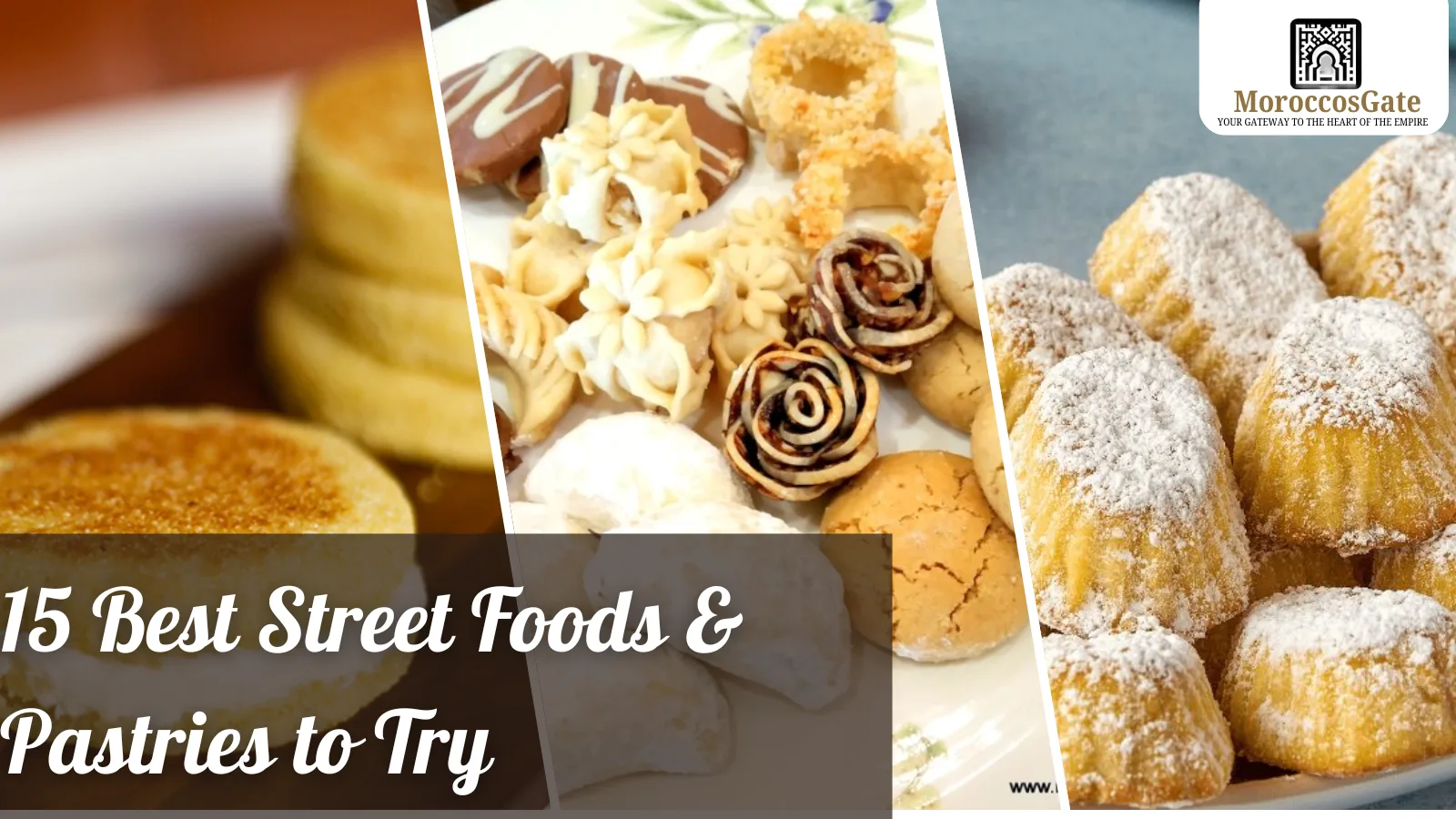
Moroccan sweets are world-renowned. They rarely rely on cream or chocolate; instead, they utilize honey, almonds, orange blossom water, and sesame seeds to create dense, sticky, and aromatic treats.
6. Sfenj (Moroccan Doughnuts)
You will smell a Sfenj shop before you see it. These are chewy, ring-shaped doughnuts made from an unsweetened, sticky yeast dough. They are deep-fried in hot oil until they are crispy on the outside and airy on the inside.
- The Ritual: Locals usually buy them by the dozen, strung together on a palm frond loop. You can eat them plain (Soussia style) or dusted with sugar.
- Pro Tip: Sfenj is best eaten fresh out of the fryer. A cold Sfenj loses its magic!
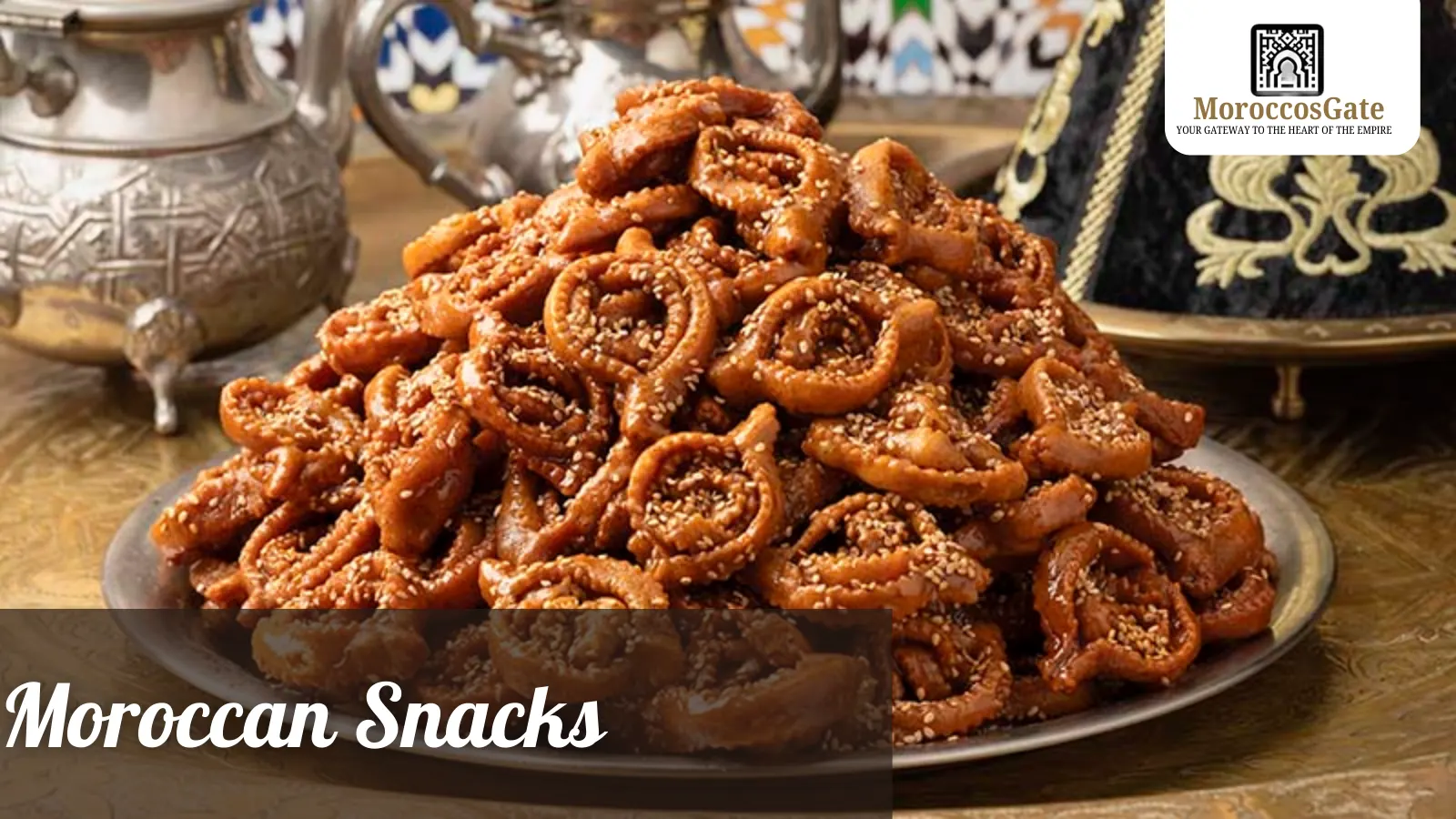
7. Chebakia (The Ramadan Cookie)
Chebakia is perhaps the most intricate and beautiful of all Moroccan snacks. It is a sesame cookie dough, rolled out, folded into a flower shape, fried, and then immediately soaked in hot honey flavored with orange blossom water. Finally, it is sprinkled with toasted sesame seeds.
While available year-round, Chebakia is the star of the Ramadan table. Its high energy content helps break the fast. The texture is crunchy, sticky, and chewy all at once.
8. Ghriba (The Cracked Cookie)
Ghriba (or Ghoriba) refers to a family of round cookies recognizable by the cracks on their surface. They are similar to shortbread or macaroons but with a Moroccan twist.
- Varieties:
- Ghriba Bahla: Made with toasted sesame and almonds, very buttery.
- Ghriba with Coconut: Softer and chewier.
- Ghriba with Walnuts: A premium version, often featuring a caramelized walnut on top.
These are the ultimate “dunking” cookies for your mint tea.
9. Kaab el Ghazal (Gazelle Horns)
If Chebakia is the popular street cookie, Kaab el Ghazal is the aristocrat of pastries.
Translating to “Gazelle Horns” due to their crescent shape, these pastries feature a delicate, almost transparent pastry shell filled with a dense, high-quality almond paste flavored with cinnamon and orange blossom water. They are not overly sweet, making them a sophisticated treat often served at weddings and special guests.
10. M’hanncha (The Snake Cake)
Don’t worry, there are no reptiles involved! M’hanncha gets its name from its shape—a long tube of phyllo pastry stuffed with almond paste, coiled into a large spiral that resembles a coiled snake.
It is baked until golden and then dusted with powdered sugar and cinnamon. You can buy a small individual coil or a slice from a massive “snake” at a bakery.
11. Briouat (The Triangular Treat)
Briouats are small, triangular parcels made from Warqa (Moroccan phyllo dough). They define the “sweet and savory” mix perfectly because they come in both forms:
- Sweet Briouat: Filled with almond paste, fried, and dipped in honey.
- Savory Briouat: Filled with cheese, seafood, chicken, or minced meat.
The crunch of the Warqa dough is immensely satisfying.
12. Sellou (Sfouf)
This is a unique snack that is technically a powder or a paste. Sellou is a rich mixture of toasted flour, fried almonds, toasted sesame seeds, sugar, anise, and fennel seeds, all bound together with butter or oil.
It is a nutritional powerhouse, packed with calories and energy. It is traditionally made for Ramadan and for nursing mothers, but you can find it in sweet shops sold by the kilo.
Fruits & Natural Treats: Nature’s Candy
Not all Moroccan snacks are fried or soaked in honey. The fertile lands of Morocco produce some of the best fruits and nuts in the world, which are sold as popular street foods.
13. Hendia (Prickly Pear)
In the summer months, you will see carts piled high with green, yellow, and red cactus fruits. This is Hendia.
- Warning: Do not try to peel this yourself! The skin is covered in invisible, hair-like thorns.
- The Experience: You pay the vendor a few coins, and they expertly peel the fruit for you in seconds, handing you the sweet, juicy interior. It tastes like a mix between a melon and a kiwi, filled with edible seeds.
14. Dates (The Symbol of Hospitality)
Morocco produces over 100 varieties of dates, with the Medjool date from the Erfoud region being the “King of Dates.”
Dates are not just a snack; they are a cultural symbol. You are often welcomed into a Moroccan home or hotel with a date and a glass of milk. They are naturally sweet, caramel-like, and often stuffed with walnuts or almonds for a more substantial snack.
15. Amlou (Moroccan “Nutella”)
While not a snack you eat on its own, Amlou is a dip that transforms any piece of bread into a gourmet treat.
Originating from the Berber (Amazigh) regions, Amlou is a blend of:
- Roasted Almonds
- Pure Honey
- Argan Oil (culinary grade)
It is rich, nutty, and incredibly healthy. Dip your warm Msemen or baguette into Amlou for a breakfast you will never forget.
16. Moroccan Nougat
In the medinas, you will see pyramids of colorful blocks. This is Moroccan Nougat. Unlike European nougat, the Moroccan variety relies heavily on nuts and seeds locally sourced. You will find layers of sesame, pistachio, almond, and peanut bound together with honey and sugar. It is chewy, sweet, and sold by weight.
GetYourGuide is a leading global online marketplace for booking tours, activities, and attractions, boasting over 150,000 experiences from more than 35,000 supply partners.
- Extensive Selection
- Skip-the-Line Access
- Flexible Cancellation
- Verified Reviews
- Reliability
- Instant Confirmation

Your Questions Answered (FAQs)
To help you navigate the world of Moroccan food, here are answers to the most common questions our readers ask.
Q1: Is Moroccan street food safe to eat?
A1: Generally, yes. Look for stalls that are busy with locals—this ensures high turnover and fresh food. For fried items like Sfenj or Maakouda, ensure they are cooked fresh in front of you. Avoid tap water and uncooked vegetables if you have a sensitive stomach.
Q2: What is the most popular snack in Morocco?
A2: Sfenj (doughnuts) and Msemen (pancakes) are the most popular daily snacks. During Ramadan, Chebakia takes the top spot.
Q3: Are there vegetarian snacks in Morocco?
A3: Yes, Morocco is very vegetarian-friendly. Maakouda, Sfenj, Chebakia, Amlou, Hendia, and plain Msemen are all vegetarian.
Q4: What are the sweet cookies in Morocco called?
A4: The most common sweet cookies are Ghriba (round almond cookies), Chebakia (honey sesame cookies), and Kaab el Ghazal (Gazelle Horns).
Q5: Do Moroccans eat pork?
A5: No. Morocco is a Muslim country, and pork is forbidden (Haram). All meat snacks found in the street (like sausages or stuffed breads) will be Beef, Lamb, Chicken, or Camel.
Flights anywhere. Click here👇
A Feast for the Senses
Moroccan snacks are more than just food; they are an invitation to slow down and enjoy the moment. Whether you are sipping tea and eating Gazelle Horns in a high-end salon, or standing in a busy alleyway devouring a hot Maakouda sandwich, the flavors of Morocco will stay with you long after you leave.
At MoroccosGate, we encourage you to be adventurous. Try the snails. Stop at the Sfenj cart. Let the vendor peel a prickly pear for you. The memories you make through food are often the best travel souvenirs.
Ready to taste Morocco?
If you are planning a trip, check out our [Travel Tips & Essentials] to prepare for your journey. Looking for the best food tours in Marrakech or Fes? Contact our team today!
Follow us for more food inspiration.
- Contact us on WhatsApp: +353-892614066
- Email: travel@moroccosgate.com
Bon Appétit, or as we say in Morocco, Bsseha!